4

I guess I have to use that it is a closed surface (manifold) and therefore its boundary is empty, so then I gotta use Gauss-Bonnet easily (but I just cannot think of how to use it.)

i.e. $$\chi(\textit{Klein Bottle})=\frac{1}{2\pi}\int\int_{\textit{Klein Bottle}}K\,d\sigma$$

I was thinking on using that a Klein bottle is homeomorphic to 2 "glued" Möbius strips, but how from then...?

P.S. this is from my first course on Differential Geometry, so talkings on higher-level courses wouldn't help me at all
azimut
  • 24,589
omivela17
  • 151

1 Answers1

6

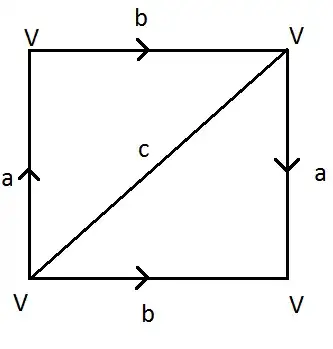
This is one triangulation of the Klein bottle, with vertex $V$ and edges $a, b, c$:

enter image description here

Can you calculate the Euler characteristic from this?

Arthur
  • 206,103
  • 4
    This is not, strictly speaking, a triangulation. Using Hatcher's language, it's a $\Delta$-complex. One has a(n almost identical) form of simplicial homology for $\Delta$-complexes, though, so it doesn't really matter in practice. –  Nov 11 '14 at 20:39
  • are you sure that this is a triangulation for the Klein-bottle ? – wanderer Nov 11 '14 at 20:41
  • =s so it isn't? – omivela17 Nov 11 '14 at 20:42
  • if I can calculate this via triangulation (not necessarily I'm saying I gotta use the triangulation from above) then you have helped me a lot by now, thank you all. – omivela17 Nov 11 '14 at 20:43
  • 3
    Certainly this is a CW-complex. In general, for finite CW complexes, the alternating sum of numbers of simplices equals the Euler characteristic. – Lee Mosher Nov 12 '14 at 01:52
  • 1
    Even without that line labelled $c$, you have one face, two edges, and one vertex, so you can get the Euler characteristic, etc. – Gerry Myerson Nov 12 '14 at 10:30
  • This can be made into a triangulation however by barycentrically subdividing the complex twice. But calculating Euler characteristic out of it would be a bit tedious. Alternatively, you can see a simplicial homology of $\Delta$ complexes in Hatcher. – Balarka Sen Mar 10 '15 at 08:04