2

Let $\triangle ABC$ be a triangle such that each angle is less than $ 90^\circ $. I want to prove that $\sin A + \sin B + \sin C > 2$.

Here is what I have done:

Since $A+B+C=180^{\circ}$ and $0 < A,B,C < 90^\circ$, at least two of $A,B,C$ are in the range 45 < x < 90, without loss of generality, let these angles be $A$ and $B$.

$\sin A + \sin B + \sin C = \sin A + \sin B + \sin(180^\circ-A-B) = \sin A + \sin B + \sin(A+B)$

Since $45^\circ < A,B < 90^\circ$ it follows that $2^{0.5} < \sin A + \sin B < 2.$ Am I near the answer?

YuiTo Cheng
  • 3,851
  • For some basic information about writing math at this site see e.g. here, here, here and here. –  Dec 13 '14 at 20:06
  • $\sin 45^\circ = \frac {\sqrt 2} 2$, so from $45^\circ \lt A,B$ you can derive $\sqrt 2 \lt \sin A + \sin B$. It is true that $\sin A + \sin B \lt 2$, but that doesn't help your argument. – Ross Millikan Dec 13 '14 at 20:10
  • If $\dfrac {\pi}2 \lt A+B \le \dfrac {3\pi}4$, then $\sin(A+B) \ge \dfrac {\sqrt{2}}2$ and you're done. So that reduces it to the case where $\dfrac {3\pi}4 \lt A+B \lt \pi$ –  Dec 13 '14 at 20:21

3 Answers3

2

Multiplying both sides by $2R$ and exploiting the sine theorem, we have to prove that:

The perimeter of acute triangle is always greater than four times the circumradius.

Assume that $A,B$ and the circumradius $R$ are fixed. Since $ABC$ is an acute triangle, the circumcenter $O$ of $ABC$ lies inside $ABC$, so $C$ lies between the antipode $A'$ of $A$ and the antipode $B'$ of $B$ in the circumcircle $\Gamma$:
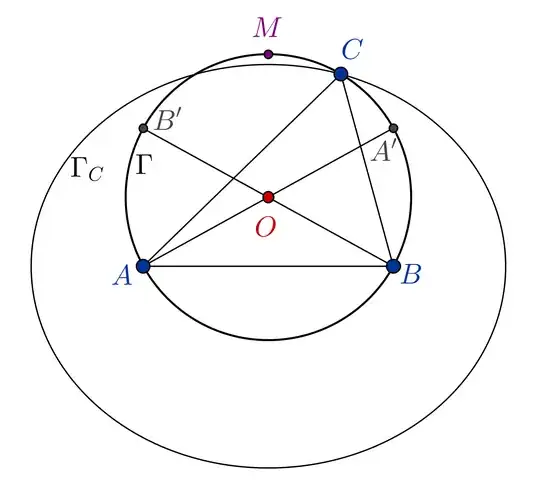
enter image description here

Let $M$ be the midpoint of the arc $A'B'$ and $\Gamma_C$ be the ellipse through $C$ with foci in $A,B$, i.e. the locus of points $P$ for which $PA+PB=CA+CB$. Since $A'$ and $B'$ lie inside $\Gamma_C$, we have $A'A+A'B<CA+CB$, so the perimeter of $ABC$ is minimized when $C\equiv A'$ or $C\equiv B'$, i.e. when $\widehat{C}=\frac{\pi}{2}$. This gives that the minimum perimeter is achieved in the limit case when $A$ and $B\equiv C$ are endpoints of a diameter of $\Gamma$. In such a case, obviously, the perimeter is $4R$.


As an alternative, we can use concavity. Since $\sin x$ is a concave function over $[0,\pi/2]$, $$ f(A,B,C)=\sin A+\sin B+\sin C $$ is a concave function over the set $E=\{(A,B,C)\in[0,\pi/2]^3:A+B+C=\pi\}$, so its minima lie on $\partial E$.

Jack D'Aurizio
  • 372,937
  • 42
  • 421
  • 888
1

I have found a simpler solution.

Observing the graph of $y = \sin x$ and $y = \frac{2}{\pi}x$, $x\in[0,\frac{\pi}{2}]$.
We can see that $\sin x\ge\frac{2}{\pi}x$.

Let $\bigtriangleup ABC$ be a triangle such that each angle is less than $90^{\circ}$. So we have: $A\in(0,\frac{\pi}{2}),B\in(0,\frac{\pi}{2}),C\in(0,\frac{\pi}{2})$.

Because $\sin x>\frac{2}{\pi}x$, when $x\in(0,\frac{\pi}{2})$,
$$\sin A+\sin B+\sin C > \frac{2}{\pi}(A+B+C)=2$$

cosmo5
  • 10,799
wzj7531
  • 11
0

i am able to simplify $$ \sin A + \sin B + \sin (A + B) = \sin A + \sin B + \sin A \cos B + \sin B \cos A \\ = (1+\cos B)\sin A + (1 + \cos A)\sin B \\ = 4\cos^2 B/2\sin A/2 \cos A/2 + 4\cos^2 A/2 \sin B/2 \cos B/2 \\ = 4\cos B/2 \cos A/2(\sin A/2 \cos B/2 + \sin B/2 \cos A/2) \\ = 4\cos B/2 \cos A/2\sin (A/2 + B/2) = 4\cos A/2 \cos B/2 \cos C/2 $$

4now, using the fact that $A/2 < 45^\circ, B/2 < 45^\circ$ and $C/2 < 45^\circ,$ i can only conclude $$\sin A + \sin B + \sin C > \sqrt 2.$$

i am going to try to improve the bound. introduce $0 <\alpha, \beta < 45^\circ$ so that $A/2 = 45^\circ - \alpha, B/2 = 45^\circ - \beta, C/2 = \alpha + \beta.$ in terms of these new variables,

$$ 4\cos A/2 \cos B/2 \cos C/2 = 2(\cos \alpha + \sin \alpha)(\cos \beta + \sin \beta)\cos(\alpha + \beta) \\ = 2(\cos(\alpha + \beta) + \sin(\alpha + \beta))\cos(\alpha + \beta) \\ = 1 + \cos(2\alpha + 2\beta) + \sin(2\alpha + 2\beta) = 1 + \sqrt 2 \sin(2\alpha + 2\beta + 45^\circ)$$

since $0 < 2\alpha + 2 \beta < 90^\circ,$ we get the desired bound

$$2 < 1 + \sqrt 2\sin(2\alpha + 2 \beta) < 1 + \sqrt 2 $$

abel
  • 29,730