If $f, g : M \to N$ are immersions, then $f, g \in \operatorname{Imm}(M, N)$. They are in the same path component if there is a path in $\operatorname{Imm}(M, N)$ from $f$ to $g$, i.e. a continuous map $p : [0, 1] \to \operatorname{Imm}(M, N)$ such that $p(0) = f$ and $p(1) = g$. To make sense of this, we have to fix a topology on $\operatorname{Imm}(M, N)$. There are two relevant topologies to consider, and they correspond to different notions.
If $\operatorname{Imm}(M, N)$ is equipped with the compact-open topology, then $p$ is continuous if and only if the map $H : M \times [0, 1] \to N$, $(x, t) \mapsto p(t)(x)$ is continuous. In this case, $H$ is a homotopy from $f$ to $g$ such that $H(\cdot, t)$ is an immersion for all $t \in [0, 1]$. We call $H$ a homotopy through immersions. Similarly, if $C(M, N)$ denotes the collection of continuous maps from $M$ to $N$, then $f, g \in C(M, N)$ are homotopic if and only if they are in the same path-connected component of $C(M, N)$ equipped with the compact-open topology.
If $\operatorname{Imm}(M, N)$ is instead equipped with the $C^1$ topology, then $p$ is continuous if and only if $H$ as above is continuous and the induced map $H' : TM\times[0, 1] \to TN$, $(v, t) \mapsto p(t)_*(v)$ is continuous. This follows from the description of the $C^1$ topology as an initial topology here. We call $H$ a regular homotopy. Note that every regular homotopy is a homotopy through immersions.
The current Wikipedia article doesn't do a great job of distinguishing between a homotopy through immersions and a regular homotopy.
An isotopy between embeddings $f, g : M \to N$ is a smooth homotopy $H$ from $f$ to $g$ such that $H(\cdot, t) : M \to N$ is an embedding for every $t \in [0, 1]$. One immediate difference between an isotopy and a regular homotopy is that the former is required to be smooth, but the latter is not. Another difference is that an isotopy doesn't require anything of the induced map $H' : TM\times[0, 1] \to TN$ while a regular homotopy does. However, the geometric difference between an isotopy and a regular homotopy (or even just a homotopy through immersions) is the same as the geometric difference between an embedding and an immersion.
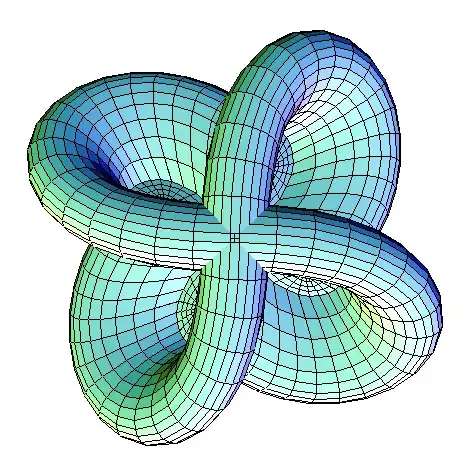
At some point in the regular homotopy between $f : S^2 \to \mathbb{R}^3$ and $-f$, one of the intermediate maps will be an immersion but not an embedding; for example, whenever the image of the sphere has self-intersection. One of the explicit regular homotopies between $f$ and $-f$ was given by Morin; halfway through the regular homotopy, the image of the sphere is Morin's surface (image below from Wikipedia) which has self-intersection, so it cannot be the image of an embedding.
$\hspace{26mm}$