15

You have a grid of regular hexagons.

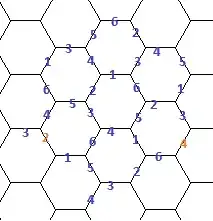
The aim of the game is to have each hex contain the numbers 1-6 on its edges.

Each edge must also be connected to another edge that has a value one higher and one lower than the value of itself, with 6's wrapping to 1's. The other two edges can be any number as long as the first rule isn't broken.

Below, I have completed a small section by hand as an example:

Complete hex flower

Can this pattern propagate to a hex grid of infinite size and does it repeat?

In this example I started with a hex labeled 1-6 going anti-clockwise from the top however this is not a requirement.

Markus Scheuer
  • 113,070
  • The periodic part of the question is equivalent to asking for a similar tiling by flat hexagons on a flat torus (flat here just means each vertex should be the intersection of exactly $3$ edges). If such a tiling existed, I think one should be able to then say something about the $\mathbb{Z}/6\mathbb{Z}$ $1$-cochain that such an edge assignment corresponds to so you might be able to turn this into a question about the cohomology of the torus. – Dan Rust Jan 13 '15 at 20:17
  • 2
    Expanding out from that seed (image provided in question), you reach a dead end (or clash) within 2 hexes. Perhaps it is possible with a different start, but the pattern given above can't continue indefinitely. –  Jan 15 '15 at 06:49
  • @Joffan: What do you mean? Andre's answer hints a direction to start researching. It doesn't yet give a clear answer one way or the other. – Frames Catherine White Jan 22 '15 at 06:37
  • According to your example all numbers from $2$ to $6$ are regarded to be larger as well as smaller than $1$. Right? – Markus Scheuer Jan 22 '15 at 08:32
  • @oxinabox sorry, I had an answer but it is currently deleted to fix up errors (if possible) - I'd forgotten about the comment – Joffan Jan 22 '15 at 13:22
  • Markus: it is modulo 6 incrementIon. 6==0. – Frames Catherine White Jan 22 '15 at 16:54
  • @oxinabox: Thanks! Now it's clear to me. Please prefix names with @ which invokes a notification message to the addressee. Best regards, – Markus Scheuer Jan 23 '15 at 10:33
  • I suppose it can't be done. – ghosts_in_the_code Jan 26 '15 at 10:37
  • For those looking at solving the problem here is the disproof against a proposed solution (in a now deleted answer), based of repreating the image which is a quater of the one linked. I think this can be used to disprove that this is not possible https://i.sstatic.net/V060O.png (I will pay bountry to such a proof) – Frames Catherine White Jan 27 '15 at 08:54

3 Answers3

11

My computer graphics are not up to scratch, so please bear with me.

Here are 8 basic hexagons:

$$A=\matrix{&1&\cr6&&2\cr5&&3\cr&4&\cr};\quad B=\matrix{&4&\cr3&&5\cr2&&6\cr&1&\cr};\quad C=\matrix{&4&\cr5&&3\cr6&&2\cr&1&\cr};\quad D=\matrix{&1&\cr2&&6\cr3&&5\cr&4&\cr}$$

$$E=\matrix{&4&\cr6&&3\cr2&&5\cr&1&\cr};\quad F=\matrix{&1&\cr3&&6\cr5&&2\cr&4&\cr};\quad G=\matrix{&1&\cr5&&2\cr3&&6\cr&4&\cr};\quad H=\matrix{&4&\cr2&&5\cr6&&3\cr&1&\cr}$$

and they get put together in this pattern: $$\matrix{A&&C&&A&&C&\cr&F&&H&&F&&H\cr B&&D&&B&&D&\cr&E&&G&&E&&G\cr A&&C&&A&&C&\cr&F&&H&&F&&H\cr B&&D&&B&&D&\cr&E&&G&&E&&G\cr}$$

So, for example, $E$ shares an edge 6 with $B$, 4 with $F$ above it, 3 with $D$, 5 with $C$, 1 with $F$ below it, and 2 with $A$.

Gerry Myerson
  • 188,081
  • As much as I like deus ex machina responses, I'm afraid I have to ask: Did you run a computer program, did you have some sudden $($or not so sudden$)$ flash of insight, or maybe a bit of both, or were you just inspired by the Holy Spirit ? $($Or did Cleo hijack your MSE account $?)$ – Lucian Jan 27 '15 at 23:04
  • @Luc, none of the above. I tried something (pen & paper, no computing), it didn't work, tried a few more things, got a better idea of how hard the problem was and just where the difficulties were, and eventually found a way to do it (although it would be nice to have someone confirm that what I've done works). – Gerry Myerson Jan 28 '15 at 01:28
  • @GerryMyerson: I have told my people to verify this, with paper. Hopefully they will get verification done sometime today. It would be great if you could share more insights in to the difficulties you found etc. – Frames Catherine White Jan 28 '15 at 03:17
  • @oxi, you have people? I'm not sure I have any insights. I tried stuff, it didn't work, so I tried stuff that didn't have the flaws of the first stuff I tried, it still didn't work, etc., etc., until it worked (or seems to have worked, pending verification by your people). – Gerry Myerson Jan 28 '15 at 03:21
  • I do have people. They are unpaid people (like me), but they nominally do as they are told. @Jon is one of them. We are making a boardgame, and solutions to this particular puzzle, is a solution to a particular functional art piece. One person came up with the first requirement (each side numbers 1-6) as a way to solve an issue. Jon suggest that if we could also solve for the second (adjacent edges) the final art would be more visually appealing (we are going to draw lines with thickness given by the numbers). Noone could be sure if this could be done, so I suggested that Jon put in on here. – Frames Catherine White Jan 28 '15 at 03:31
  • That pattern looks good to me. Can't see any reason why it wouldn't tesselate. – Jonathan Van Buren Jan 28 '15 at 07:36
  • 1
    @GerryMyerson: Nice answer and even without using graphical tools a visually pleasing and informative representation! :-) +1 – Markus Scheuer Jan 28 '15 at 17:34
  • 1
    @GerryMyerson: Hi, I've added an answer as supplement to your answer. It might be of interest for you. Best regards, – Markus Scheuer Jan 28 '15 at 20:50
  • 2
    I just thought I would confirm your answer with a few pictures. The first is the fundamental domain of the tiling. The second is an idealised version of this labeling edge identifications. The third is what we get by cutting and pasting, leaving us with a parallelogram which closes in the usual way to a torus. – Dan Rust Feb 03 '15 at 16:14
6

The following is a supplement to the nice answer of @GerryMyerson. It was inspired by the visually pleasing and inspiring representation of his solution.

When looking at his solution we can analyse

  • the $8$ hexagons with respect to symmetry
  • the tesselation with respect to the relationship between hexagons and their neighbours

We start with

Hexagons: Some symmetry considerations

Let's assume a hexagon $A$ is labelled as follows \begin{align*} A= \begin{matrix} &a&\\ b&&f\\ c&&e\\ &d&\\ \end{matrix} \end{align*} We want to analyse it with respect to certain symmetries. We can reflect it on a centered horizontal axis or on a centered vertical axis. Let's introduce corresponding operators $T_x$ and $T_y$. Applying these operators, we get \begin{align*} T_xA= \begin{matrix} &d&\\ c&&e\\ b&&f\\ &a&\\ \end{matrix}\qquad\qquad T_yA= \begin{matrix} &a&\\ f&&b\\ e&&c\\ &d&\\ \end{matrix}\qquad\qquad T_xT_yA= \begin{matrix} &d&\\ e&&c\\ f&&b\\ &a&\\ \end{matrix} \end{align*}

It's easy to see that other combinations of $T_x$ and $T_y$ provide no more information:

The following is valid: \begin{align*} T_xT_x=Id,\qquad T_yT_y=Id,\qquad T_xT_y=T_yT_x \end{align*} with $Id$ the identity operator $Id(A)=A$

Applying these operators to \begin{align*} A= \begin{matrix} &1&\\ 6&&2\\ 5&&3\\ &4&\\ \end{matrix} \end{align*} we obtain \begin{align*} T_xA= \begin{matrix} &4&\\ 5&&3\\ 6&&2\\ &1&\\ \end{matrix} =C\qquad\qquad T_yA= \begin{matrix} &1&\\ 2&&6\\ 3&&5\\ &4&\\ \end{matrix} =D\qquad\qquad T_xT_yA= \begin{matrix} &4&\\ 3&&5\\ 2&&6\\ &1&\\ \end{matrix} =B \end{align*} Similarly completing the $8$ hexagons of @GeryMyersons solution we get \begin{align*} E= \begin{matrix} &4&\\ 6&&3\\ 2&&5\\ &1&\\ \end{matrix} \qquad\qquad T_xT_yE= \begin{matrix} &4&\\ 2&&5\\ 6&&3\\ &1&\\ \end{matrix} =G\qquad\qquad \end{align*} and \begin{align*} F= \begin{matrix} &1&\\ 3&&6\\ 5&&2\\ &4&\\ \end{matrix} \qquad\qquad T_xT_yF= \begin{matrix} &4&\\ 2&&5\\ 6&&3\\ &1&\\ \end{matrix} =H\qquad\qquad \end{align*}

We conclude:

  • With respect to the reflection operators $T_x$ and $T_y$ there are three basis elements $A,E$ and $F$ and all other elements can be generated by applying $T_x$ resp. $T_y$ to them.

  • $A$ is the generator of four heaxagons, while $E$ and $F$ are the generators of two hexagons.

Summary: The eight hexagons are: \begin{align*} \begin{array}{llll} A,\qquad&B=T_xT_yA,\qquad&C=T_xA,\qquad&D=T_yA;\\ \\ E,\qquad&G=T_xT_yE;\qquad&F,\qquad&H=T_xT_yF\\ \end{array} \end{align*}

We proceed now with:

Tesselation: Analysing the neighbours of a hexagon

Let's start with the tesselation provided by @GerryMyerson and let's put the focus on the hexagon $E$ and its neighbours.

\begin{align*} \begin{matrix} A\quad&&C\quad&&A\quad&&C\\ &\color{blue}{\mathbf{F}}\quad&&H\quad&&\color{blue}{\mathbf{F}}\quad&&H\\ \color{blue}{\mathbf{B}}\quad&&\color{blue}{\mathbf{D}}\quad&&\color{blue}{\mathbf{B}}\quad&&\color{blue}{\mathbf{D}}\\ &\mathbf{E}\quad&&G\quad&&\mathbf{E}\quad&&G\\ \color{blue}{\mathbf{A}}\quad&&\color{blue}{\mathbf{C}}\quad&&\color{blue}{\mathbf{A}}\quad&&\color{blue}{\mathbf{C}}\\ &\color{blue}{\mathbf{F}}\quad&&H\quad&&\color{blue}{\mathbf{F}}\quad&&H\\ B\quad&&D\quad&&B\quad&&D\\ &E\quad&&G\quad&&E\quad&&G\\ \end{matrix} \end{align*}

The central hexagon $E$ and its surrounding hexagons are written in boldface, the surrounding also in color ${\color{blue}{\mathbb{\text{blue}}}}$. Observe, that the hexagons $G$ and $H$ are not neighbours of $E$. We now write the same pattern using the reflection operators $T_x$ and $T_y$ and check if we can see some relationship.

\begin{align*} \begin{matrix} A\quad&&T_xA\quad&&A\quad&&T_xA\\ &\color{blue}{\mathbf{F}}\quad&&T_xT_yF\quad&&\color{blue}{\mathbf{F}}\quad&&T_xT_yF\\ \color{blue}{\mathbf{T_xT_yA}}\quad&&\color{blue}{\mathbf{T_yA}}\quad&&\color{blue}{\mathbf{T_xT_yA}}\quad&&\color{blue}{\mathbf{T_yA}}\\ &\mathbf{E}\quad&&T_xT_yE\quad&&\mathbf{E}\quad&&T_xT_yE\\ \color{blue}{\mathbf{A}}\quad&&\color{blue}{\mathbf{T_xA}}\quad&&\color{blue}{\mathbf{A}}\quad&&\color{blue}{\mathbf{T_xA}}\\ &\color{blue}{\mathbf{F}}\quad&&T_xT_yF\quad&&\color{blue}{\mathbf{F}}\quad&&T_xT_yF\\ T_xT_yA\quad&&T_yA\quad&&T_xT_yA\quad&&T_yA\\ &E\quad&&T_xT_yE\quad&&E\quad&&T_xT_yE\\ \end{matrix} \end{align*}

So, what do we see?

  • The central hexagon $E$ is surrounded by all four hexagons $A,T_xA,T_yA$ and $T_xT_yA$ generated by $A$.
  • $E$ is connected to the other base element $F$ twice
  • $E$ is not connected to the element $G=T_xT_yE$ and so it's not connected to any element generated by $E$ itself.

Further questions which could be of interest:

  • Putting the other hexagons as center. What is the structure of the surrounding hexagons with respect to the reflection operators?

  • Do all possible tesselations need three base elements like $A,E$ and $F$ as it is used within this solution?

  • Is the partitioning of generated elements by the base elements always $(4,2,2)$?

  • Formulated the other way round: Can we easily generate new solutions by taking one center $\widetilde{A}$ and look for four surrounding neighbours $\widetilde{B},T_x\widetilde{B},T_y\widetilde{B}$ and $T_xT_y\widetilde{B}$ and add one other hexagon $\widetilde{C}$?

  • Is it reasonable to introduce additional operators besides $T_x$ and $T_y$ in order to reduce the number of base hexagons?


Note: OPs tessalation which is according to a comment from @RowanAshwin not expandable ad infinitum has the central hexagon \begin{align*} \begin{matrix} &1&\\ 2&&6\\ 3&&5\\ &4&\\ \end{matrix} \end{align*}

The six surrounding hexagons have top/bottom edges labelled with $$(2,6), (3,5), (4,2), (4,3), (5,1) \text{ and }(6,1).$$ Since the operator $T_x$ exchange top with bottom and $T_y$ leaves them unchanged we observe that all six surrounding hexagons and the central one are independent base elements.

Maybe this lack of symmetry is the reason that the tessalation cannot be expanded to the whole plane.

Markus Scheuer
  • 113,070
  • It seems to me that we use $A$ and its transforms a great deal because it contains more of the required numerical adjacency than any other arrangement. To get a more balanced usage of different forms it might be worth avoiding the hexagon with complete cyclic order - perhaps having just one switch from that order? – Joffan Feb 05 '15 at 18:21
  • 1
    @Joffan: Your argument sounds reasonable. I've tried to address this aspect with my third question. A symmetric partitioning with respect to the base elements, e.g. $(3,3,3)$ suggests a labelling in direction to your proposal. Despite this vague opinion of mine, my visualsation capabilities for hex structures are absurdly weak. I'm trained to think in walks of typical lattice pathes, so adjacency props of hexagons are hard for me to imagine. My conclusion: A more systematic approach is necessary to cope with this problem. :-) – Markus Scheuer Feb 05 '15 at 19:52
2

This isn't so much a geometric problem about a hexagonal grid, this is very much a topological problem, specially a graph theory problem, involving an (infinite) graph, where the nodes are the vertices of the hexagonal grid and the edges are the edges.

The problem you present reminds me very much of edge colouring (http://en.wikipedia.org/wiki/Edge_coloring), except whereas colours have no particular order or structure, your "colours" (i.e. numbers) come from Z_6 ( i.e. the integers modulo 6 , i.e. the quotient group Z/6Z , i.e. {0, 1, 2, 3, 4, 5} with 5+1=0 ), and there are added restrictions of the "colouring" based on this group structure.

In fact, your problem isn't even restricted to tesselations in the plane. It can be abstracted to all "generalised polyhedra", which also includes such "tilings of polygons" as Euclidean polyhedra and hyperbolic tesselations. For instance, you could also ask the same question about the tiling of triangles on an icosahedron, or a tiling of pentagons where 4 pentagons meet at each vertex, even though such a regular tiling is impossible in the Euclidean plane. (http://en.wikipedia.org/wiki/List_of_regular_polytopes#Hyperbolic_tilings)

Perhaps this is the way to approach it, by looking at tesselations in this way, and starting at the simplest case and working out how to expand it into more complex ones.

Anyway way, that's just my initial thoughts. :)