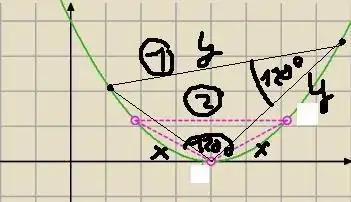
choose the coordinates so that the equation of the parabola is $y = x^2.$ let the triangle be $OAB$ with $O =(0,0), A = (a, a^2), B= (b, b^2)$ and $\angle AOB = 120^\circ$ by cosine rule, $$AB^2 = OA^2 + OB^2 + OA*OB $$ so that
$$(a-b)^2 + (a^2 - b^2)^2 = a^2 + a^4 + b^2 + b^4 + \sqrt{(a^2 + a^4)(b^2+b^4)} $$
cleaning it up a bit we end up with $$3a^2b^2 + 8ab - a^2 - b^2 + 3 = 0$$
which simplifies to $$-2ab(1+ab) = \sqrt{(a^2 + a^4)(b^2+b^4)} \tag 1$$ from $(1)$ we can see that $a$ and $b$ cannot be of the same sign. using symmetry we can assume that $a > 0, b < 0.$
a special solution is $-b= a = \sqrt{1+\sqrt 2}$ to find the general solution we will square $(1)$ and get a quadratic equation for $b$ $$b^2(3a^2 - 1) + 8ab + (3-a^2) = 0 $$ and the solution is $$ b = \dfrac{-2a \pm \sqrt 3 |a^2 -1|}{3a^2 - 1} \text{ and } b < 0.$$
if you take the negative solution you find that a negative solution exist for $0 \le < \sqrt 3$ and for the positive solution you have $\dfrac{1}{\sqrt 3} < a.$