7

In http://en.wikipedia.org/wiki/Circle but also in the corresponding article in the German Wikipedia I find this formulation ( sorry, I exchange x and y as I am accustomed to it in this way ) :

"An alternative parametrisation of the circle is: $$x=a+r\frac{1-t^2}{1+t^2}$$ and $$y=b+r\frac{2t}{1+t^2}$$ with real-valued parameter $t$."

But if I plot this curve I only get a half-circle with these formulas when $(a,b)\neq(0,0)$ which is obviously not what is searched for and expected.

I recently found without any elementary trigonometry e.g. for the unit circle with $(a,b)=(1,0)$ a closed rational parametrization which plots the "whole" circle perfectly if $\lim_{t\to\infty}$.

Now my 2 questions:

  1. What is your formula for the case of the unit circle with $(a,b)=(1,0)$ and how is your way to derive it ?
  2. Is there a way to calculate a rational parametrization for the unit circle with general $(a,b)$ which allows "whole"-circle plotting ? Maybe $a$ and $b$ must be rational numbers or even integers ?
  • 8
    What values of $t$ did you use then? Don't forget to include negative $t$ as well. – Hans Lundmark Apr 22 '15 at 16:03
  • Ah, OK. I was not aware of that as in the formula I got the parameter only ran through $[0,\infty)$ and the complete circle resulted in this case. – Wolfgang Tintemann Apr 22 '15 at 16:17
  • 5
    I am also accustomed to $x=(1-t^2)/(1+t^2)$ and $y=2t/(1-t^2)$ rather than the other way around. ${}\qquad{}$ – Michael Hardy Apr 22 '15 at 17:09
  • A rational parameterization will always miss a point because the $x$ and $y$ functions must remain bounded, hence will have an horizontal asymptote and the point "at infinity" cannot be reached. –  Sep 25 '25 at 17:38
  • You need to include not only negative $t$, but also $t=\infty$ (which yields $(a-r,b)$), to get the whole circle. – Emil Jeřábek Sep 26 '25 at 07:39
  • (I note that the Wikipedia article was fixed a while ago and now it also uses the $x=(1-t^2)/(1+t^2)$, $y=2t/(1+t^2)$ parametrization, which I would also regard as preferable.) – Emil Jeřábek Sep 26 '25 at 07:46

3 Answers3

10

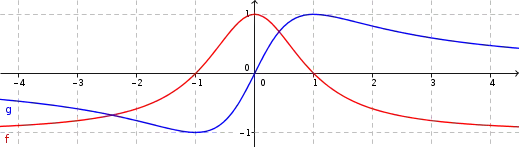
Write $$ f(t)=\frac{1-t^2}{1+t^2} $$ and $$ g(t)=\frac{2t}{1+t^2} $$ The point should be that $(f(t))^2+(g(t))^2=1$ so that $(f(t),g(t))=(\cos \theta,\sin\theta)$ for some angle $\theta$. It is easy to see that

  1. $f(t)=0\iff t=\pm 1$ and
  2. $f(t)>0\iff |t|<1$ and
  3. $f(t)=1\iff t=0$

It is also easy to see that

  1. $g(t)=0\iff t=0$ together with
  2. $g(t)>0\iff t>0$ and
  3. $|g(t)|=1\iff |t|=1$

But $f(t)=-1$ is never reached. Analyzing $f$ and $g$, we see that $$ t\to-\infty\implies f(t)\to -1, g(t)\to 0_- $$ and $$ t\to+\infty\implies f(t)\to -1, g(t)\to 0_+ $$ so to have a full circle (except for one point at $(-1,0)$) we must have $t\in\mathbb R$.


enter image description here


As you can see, it is like having one period of $\cos\theta$ and $\sin\theta$ reparametrized to $f(t)=\cos(\theta(t))$ and $g(t)=\sin(\theta(t))$ such that $\theta(t)\to-\pi$ for $t\to-\infty$ and $\theta(t)\to\pi$ for $t\to\infty$.

String
  • 18,958
  • I want to mention that I was puzzled because I have the following parametrization of the shifted unit circle with the parameter only running in $[0,\infty)$ $$x(t)=2(\frac{1-t^2}{1+t^2})^2$$ $$y(t)=2\frac{2t(1-t^2)}{(1+t^2)^2}$$ – Wolfgang Tintemann Apr 22 '15 at 17:11
  • 2
    @Wolfgang: The curve $(x, y)$ in your comment traces the small circle here; since$$2\cos\theta = 2f(t) = 2\frac{1 - t^{2}}{1 + t^{2}},$$your curve is $x(t) = 2\cos^{2}\theta$, $y(t) = 2\sin\theta \cos\theta$, which traces the polar graph $r = 2\cos\theta$. As you say, letting $t$ range over $[0, \infty)$ traces the right half of the large circle (stereographic projection from $(0, 1)$), but all of the small circle. This trick works because your circle passes through the origin. – Andrew D. Hwang Apr 22 '15 at 17:41
  • If I understand you the radius of the circle $S$ in your ( for me very surprising ) picture is the $2$ in the case above. So if the small circle is turned by an angle maybe for it might ( sometimes ) also exist rational parametrization formulas ? – Wolfgang Tintemann Apr 22 '15 at 18:09
  • There is a good video explaining the 1 + t^2 rational parameterization here: https://www.youtube.com/watch?v=OqxYLyGLqcs – cessationoftime Aug 10 '23 at 05:14
4

Wiki form is correct. However, along with the so-called "advantage" of rational parametric form comes the limitation of infinite argument requirement to complete a deep circle.

For y to be zero or x to attain its extremum value you expect for single parameter $t$ have a reasonable domain for full circular arc description. But it is not so.. as one root of $t$ is at $t=0$ and another one at $ t= \infty$.

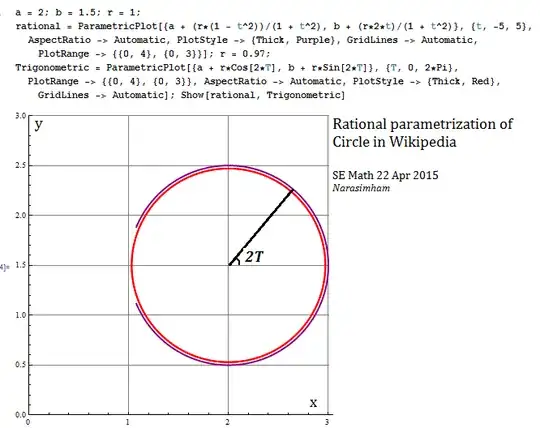
A trigonometric expression remedies the situation fully by expressing coordinates in terms of double angle $ 2 T$ ( double of half angle in Weierstrass form ) given in Wiki.( Actually I recommend its deletion or insertion of trig form as Wiki is a central reference).

$$ x = a + r \cos (2 T) ;\; y = b + r \sin (2 T) ; $$

TrigCircle

The Mathematica code is given in the image.I have slightly reduced rational circle radius to show full circle by trigonometrical parametrization by contrast.

As an aside the particular trig representation of Circle has significance in Mechanics of Structures. When y_offset = 0, it is the Mohr Circle, first used by famous German civil engineer Otto Mohr who defined static determinacy and constructed very useful diagrams of stress and strain. The angle $T$ represents angle between reference direction of stress and principal stress.

Standard form with half angle in trigonometric $$x = h + r \sin \theta ; \; y = k + r \sin \theta $$ serves the same purpose, it is simpler.

Narasimham
  • 42,807
1

Let's start out controversially and say the rational parameterization of the unit circle is the only true parameterization of the unit circle. Unlike the trigonometry parameterization, the rational parameterization produces exact points on the unit circle, ones that are easily verified to be so with some simple, finite arithmetic calculations on rational numbers. In the usual $(\cos \theta, \sin \theta)$ trig parameterization, we have to do an infinite sum or leave the expressions unevaluated; we don't really have numbers exactly on the unit circle.

The usual rational parameterization of the unit circle can be derived a number of ways. It's essentially Euclid's recipe for Pythagorean Triples. It's the other point where the line through $(-1,0)$ and $(0,t)$ meets the unit circle. That construction excludes $(-1,0)$ as a parameterized point; we have to resort to a projective parameter to cover that possibility.
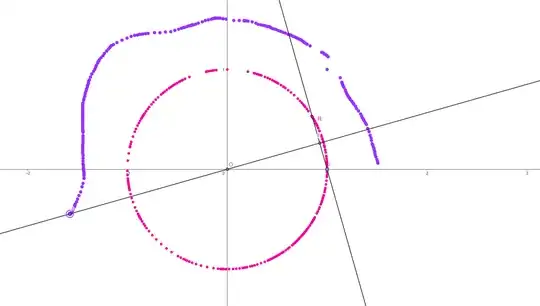
Rational parameterization of the unit circle via reflection

Instead, today let's look at it as the reflection $R$ of the point $I(1,0)$ in the line OA, through the origin and integer point $A(a,b)$. OA is, $bx-ay=0$. Since we allow OA to be a vertical line, our parameterization won't miss the point $(-1,0)$. We had to add an entire dimension, an $a$ and a $b$, to get the missing point, and we give that dimension back as only the ratio $a:b$ determines the point on the unit circle. (This is an example of projective geometry and homogeneous coordinates.)

The perpendicular to $bx-ay=0$ through $I(1,0)$ is $ax+by=a$. We have $(b,-a,0)\times(a,b,-a)=(a^2,ab, a^2+b^2)$ so the perpendicular lines meet at foot $$F = \left(\dfrac{a^2}{a^2+b^2}, \dfrac{ab}{a^2+b^2} \right)$$ So $\vec{IF}=F-I=\left[ \dfrac{-b^2}{a^2+b^2}, \dfrac{ab}{a^2+b^2} \right]$, and R, the reflection of I in OA, is $R = I+2\vec{IF}$: $$R = \left(\dfrac{a^2-b^2}{a^2+b^2}, \dfrac{2ab}{a^2+b^2} \right)$$

The reflection $R$ is necessarily on the unit circle, at a point determined by the ratio $a:b$. We can set $a=1$ and use $b$ as our main parameter, and, when we have to, set $a=0, b=1$ to pick up that missing point. That's essentially the answer to the 'whole circle' plotting question. We can get arbitrarily dense in our plot with rational points; in fact, all we ever plot in practice are rational points.

Dean Rubine
  • 564
  • 4
  • 12
  • 1
    Yes, homogenizing $(1-t^2:2t:1+t^2)$ to $(s^2-t^2:2st:s^2+t^2)$. If you really want the transcendentals, there's the $t=\tan{\frac{\theta}2}$ that makes an equality $(\frac{1-t^2}{1+t^2},\frac{2t}{1+t^2})=(\cos{\theta},\sin{\theta})$ – Jan-Magnus Økland Sep 26 '25 at 03:57