3

Snugly fitted spheres in a cube

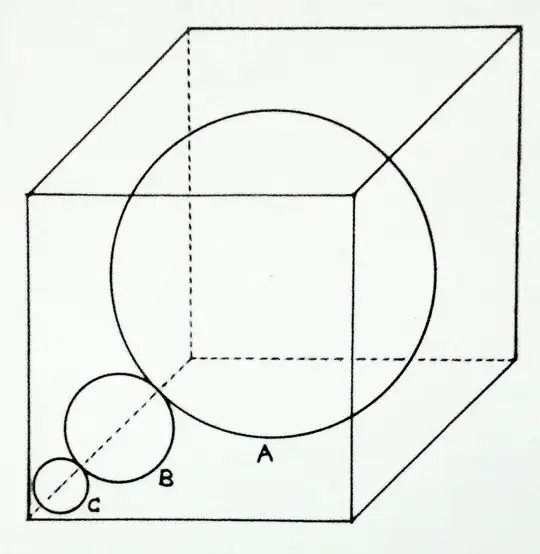
A larger sphere A, having a radius $R$ is snugly fitted in a cube (i.e. sphere A touches all six faces of the cube). Further, a small sphere B is snugly fitted in the corner of cube (i.e. sphere B touches sphere A & three orthogonal faces meeting at the same vertex). Further, a smaller sphere C, having a radius $r$, is snugly fitted in the same corner of the cube (i.e. sphere C touches sphere B & three orthogonal faces meeting at the same vertex).

How to find out the radius $r$ (of smaller sphere C) in terms of the radius $R$ (of larger sphere A)? I have tried this using vector analysis but I did not find the correct answer. Any help or pointing in the right direction is appreciated.

Note: None of the spheres touches any of 12 edges of the cube.

Unit vector equally inclined with three orthogonal axes X, Y & Z is given as $$ \hat{r}=\frac{1}{\sqrt{3}}(\hat{i}+\hat{j}+\hat{k})$$

angle of inclination of the vector with three axes is $$=\cos^{-1}\left(\frac{1}{\sqrt{3}}\right)\approx 54.73^{o}$$ but further if angle of inclination of this vector with each of three orthogonal faces is $\alpha \space$ then I have $$\sin\alpha =\frac{R_{B}}{R\sqrt{3}-R-R_{B}}$$ Similarly, for radius $r$ $$\sin\alpha =\frac{r}{R_{B}\sqrt{3}-R_{B}-r}$$

Further, how I can determine angle of inclination $\alpha$ with the orthogonal planes?

  • Some hints: 1 Don't worry about the angles. 2 Let's assume that the cube's centered on the origin & that the vertex of the cube surrounding the series of spheres is (1,1,1), so the radius of A is 1, the centers of the spheres are all on the line passing through (1,1,1), and A cuts that line at (a,a,a), where $a = \sqrt{1/3}$. 3 Let $b$ be the radius of B. Find the center of B = (x,x,x) in terms of $a$ and $b$. Prove that for B to touch the cube, $x+b=1$ 4 Now use that info to find $b$. – PM 2Ring Apr 30 '15 at 13:34
  • You can get $\sin\alpha$ fairly easily: $\alpha$ is the angle between the diagonal of the cube and a face, and the diagonal is also the hypotenuse of a right triangle whose leg adjacent to $\alpha$ is a face diagonal and whose leg opposite $\alpha$ is an edge of the cube. Ergo $\sin\alpha=\frac{1}{\sqrt3}$; plug that into one of your last two equations and you can easily find $\frac{R_B}{R}$ (which is also $\frac{r}{R_B}$). – David K May 01 '15 at 13:55
  • 1
    Here's an animated GIF diagram, created using POV-Ray. – PM 2Ring May 07 '15 at 15:41

2 Answers2

2

Extend the problem to get infinitely many spheres, each fitting snugly in the space between the previous one and the corner. From the scaling symmetry (around the bottom left vertex) of the problem the radii of the spheres decrease in geometric series. So the distance from the far-side of $A$ to the corner, which we denote by $d$, should be

$$ d = \frac{2R}{1 - r} $$

where $r$ is the ratio of the radii. We know that $d = R + \sqrt{3}R$. So we have

$$ r = (2- \sqrt {3}) $$

and the radius of $C$ being $r^2 R$ which you can compute yourself.

Willie Wong
  • 75,816
  • 1
    Not quite. The radius of the largest sphere plus the diameters of the infinite series of small spheres sum to $\sqrt{3}$. You are correct that the radii form a geometric progression, but I think you should prove that by more than an appeal to symmetry. – PM 2Ring Apr 30 '15 at 11:31
  • @PM: oops. Let me fix that. // And certain steps are left out for a reason. – Willie Wong Apr 30 '15 at 11:32
  • 3
    FWIW, I was about to start posting a solution when yours appeared (but it'd take me a while, since I'm not fast with LaTeX ). We can simplify $r$ to $2- \sqrt 3$ and $r^2 = 7 - 4\sqrt 3$. FWIW, $r^3 = 26 - 15\sqrt 3$, these coefficients can be found in the continued fraction of $\sqrt 3$. – PM 2Ring Apr 30 '15 at 11:38
  • There we go. That's better. // FWIW I wouldn't have minded if you just proposed an edit to my answer with the corrections. (Not that I mind the comments. Thanks!) – Willie Wong Apr 30 '15 at 11:43
  • The distance from the near side of $A$ to the origin is the distance from the far side of $B$ from the corner of the cube (that is, this is the distance to the point where those spheres are tangent). Call that distance $d_B$. If the distance from the far side of $A$ to the corner is $d$, then by geometric similarity $\frac{R_B}{R}=\frac{d_B}{d}=\frac{R\sqrt3-R}{R\sqrt3+R}=2-\sqrt3$. – David K May 01 '15 at 13:44
2

The distance from the corner of the cube to the center of $A$ is the diagonal of a cube with side $R$, which is $R\sqrt3$.

The distance from the corner of the cube to the "near side" of $A$ is the distance from the corner of the cube to the far side of $B$ (that is, this is the distance to the point where those spheres are tangent).

Call that distance $d_B$. If the distance from the far side of $A$ to the corner is $d,$ then by geometric similarity

$$\frac{R_B}{R} = \frac{d_B}{d} = \frac{R\sqrt3 - R}{R\sqrt3 + R} = 2 - \sqrt3.$$

And of course $$\frac rR = \left(\frac{R_B}{R}\right)^2.$$

David K
  • 111,757