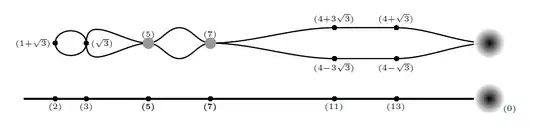
I am trying to understand the intuition of thinking about number theoretic ideas in terms of geometric ones. For example, ramification is something that happens when a "covering" space of a Riemann surfaces collapses down to a point. I can sort of see the analogy with ramification of primes like this:
Let $L/K$ be an extension of number fields, and $P$ a prime of $\mathcal{O}_K$. If $P$ splits in $\mathcal{O}_L$, then I imagine each of the $n = [L:K]$ primes as lying in $n$ distinct "layers" of some "covering" of the primes of $K$. Then when we have ramification, say $P = Q^e \prod Q_i$, the $Q_i$ remain as expected in the covering, but we have a degeneration at $Q$ giving us $e$ layers collapsing into just one above $P$, like in the case of Riemann surfaces.
So my question is: using this type of geometric analogy, where is the inertia hiding? I don't yet have enough background to understand etale morphisms yet, but I've heard that these give a nice analogue of covering maps in this kind of setting. Is there some concrete way I can try to build intuition about first? Maybe is there a way to interpret the residue field extension $k_Q/k_P$ using a corresponding unramified extension of the local fields $L_Q/K_P$ and give a uniform way of looking at this "covering" interpretation so that only ramification really feels like the "bad" points where we have less than expected cardinality of the fibers?