As suggested by @littleO, The use of Linear Operator and the ${L}_{1}$ Norm makes the problem a good fit for the Primal Dual Hybrid Gradient (PDHG) Method (Chambolle Pock Algorithm).
The objective can be written as:
$$ \arg \min_{\boldsymbol{x}} {\left\| \boldsymbol{A} \boldsymbol{x} - \boldsymbol{b} \right\|}_{1} + \delta_{\mathcal{C}} \left( \boldsymbol{x} \right) = f \left( \boldsymbol{A} \boldsymbol{x} \right) + g \left( \boldsymbol{x} \right) $$
Where $\delta_{\mathcal{C}} \left( \boldsymbol{x} \right) = \begin{cases}
0 & \text{if} \; \boldsymbol{x} \geq \boldsymbol{0} \\
\infty & \text{else}
\end{cases}$.
The method requires the Proximal of the Convex Conjugate of $f \left( \cdot \right)$ (For some connection, see The Proximal Operator of the ${L}_{\infty}$ (Infinity Norm) and Legendre Transform (Convex Conjugate) of a Norm):
$$ \operatorname{prox}_{\sigma {f}^{\ast}} \left( \boldsymbol{y} \right) = \operatorname{proj}_{ {\left\| \cdot \right\|}_{\infty} \leq 1 } \left( \boldsymbol{y} - \sigma \boldsymbol{b} \right) = \operatorname{clamp}_{\left[ -1, 1 \right]} \left( \boldsymbol{y} - \sigma \boldsymbol{b} \right) $$
The Proximal Mapping of $g \left( \cdot \right)$ is the projection of the non negative values:
$$ \operatorname{prox}_{\tau g} \left( \boldsymbol{y} \right) = \max \left\{ \boldsymbol{y}, \boldsymbol{0} \right\} $$
The whole algorithm becomes:
- $\boldsymbol{y}^{\left( k + 1 \right)} = \operatorname{prox}_{\sigma {f}^{\ast}} \left( \boldsymbol{y}^{\left( k \right)} + \sigma \left( \boldsymbol{A} \bar{\boldsymbol{x}}^{\left( k \right)} - \boldsymbol{b} \right) \right) = \operatorname{clamp}_{\left[ -1, 1 \right]} \left( \boldsymbol{y}^{\left( k \right)} + \sigma \left( \boldsymbol{A} \bar{\boldsymbol{x}}^{\left( k \right)} - \boldsymbol{b} \right) \right)$.
- $\boldsymbol{x}^{\left( k + 1 \right)} = \operatorname{prox}_{\tau {g}} \left( \boldsymbol{x}^{\left( k \right)} - \tau \boldsymbol{A}^{\top} \boldsymbol{y}^{\left( k + 1 \right)} \right) = \max \left\{ \boldsymbol{x}^{\left( k \right)} - \tau \boldsymbol{A}^{\top} \boldsymbol{y}^{\left( k + 1 \right)}, \boldsymbol{0}\right\}$.
- $\bar{\boldsymbol{x}}^{\left( k \right)} = \boldsymbol{x}^{\left( k + 1 \right)} + \theta \left( \boldsymbol{x}^{\left( k + 1 \right)} - \boldsymbol{x}^{\left( k \right)} \right)$.
Where $\sigma \tau {\left\| \boldsymbol{A} \right\|}_{2}^{2} \leq 1$ and $\theta \in \left[ 0, 1 \right]$.
It is a much faster method than the Projected Sub Gradient method, though a little sensitive to the hyper parameters values.
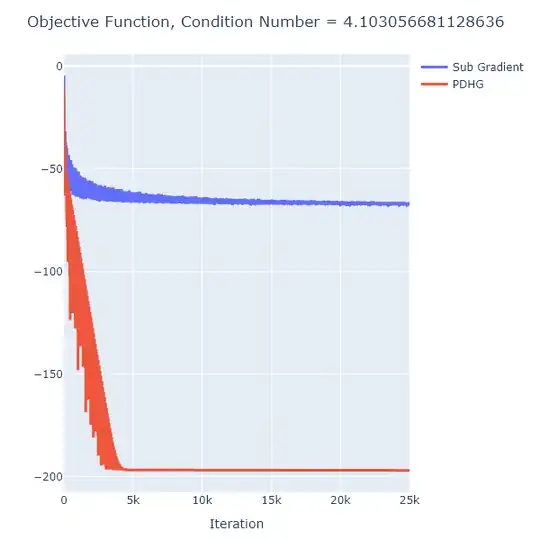
The performance are verified with a DCP solver which generates the reference solution.
The code is available on my StackExchange GitHub Repository (Look at the Mathematics\Q1385984 folder).

