5

The bottom of a glass cup (assuming it is a true circle) looks like & is drawn as an ellipse. But is the shape we are seeing really an ellipse?

After some tinkering with pen and paper, I see that this question comes down to: Is the right intersection of an oblique circular cone an ellipse?

*edit
@Aretino: I am certain my question concerns an oblique circular cone. I'm sorry my example with the glass cup was a little too specific and not explained fully. Here's another fuller explanation.

Standing afar a circle drawn on the ground, you see an ellipse-like shape. Here the rays of light coming from the circle on the ground into your eye form an oblique circular ellipse. Supposing that the eye works like a camera, the image we see is a right intersection of the cone of incoming light rays.

  • Maybe the question was "Is the oblique intersection of a right circular cone an ellipse?". If so, the answer is yes (https://en.wikipedia.org/wiki/Conic_section). If not, please explain what you mean. – Intelligenti pauca Feb 06 '19 at 09:17
  • Edited in some explanation. By the way, the tag "conic-sections" was added since its literal meaning matched the question - intersections of a cone. Since the term is used mainly for intersections of a right circular cone, and this question concerns an oblique circular cone, should the tag be deleted? – Y Watanabe Feb 06 '19 at 09:51
  • 2
    The tag is fine, and the answer is the same: the intersection of that cone with a plane is a conic section. As a matter of fact, Apollonius of Perga in his treatise considered this more general type of cone, containing all the lines issued from a point and passing through any point on a given circle. With a quick search I found for instance this: http://whistleralley.com/conics/ – Intelligenti pauca Feb 06 '19 at 12:23

2 Answers2

8

Suppose we have a circle of diameter $MN$ lying in a plane $\alpha$, and a point $V$ outside $\alpha$, which is the vertex of an oblique cone having circle $MN$ as its guiding line. I'll show below, following the derivation made by Apollonius of Perga in his treatise on conic sections, that the intersection between this cone and a plane can be described, using cartesian coordinates, by the usual equation of an ellipse.

Let's choose diameter $MN$ so that plane $VMN$ is perpendicular to $\alpha$. The cone is cut by another plane $\beta$, also perpendicular to $VMN$, intersecting the cone along a curve $APB$ (red in diagram below), where $A$ and $B$ are in particular the intersections of $\beta$ with lines $VM$ and $VN$. The more general case can be treated in a similar way, but the equation is then obtained with respect to a pair of oblique coordinate axes.

Let $P$ be any point on the curve and draw a plane through $P$ parallel to $\alpha$: it is easy to show that its intersection with the cone is a circle. Let $QR$ be the diameter of the circle parallel to $MN$. The perpendicular $PH$ from $P$ to $AB$ is also perpendicular to $MN$ and we have, by similitude in right triangle $QPR$: $$ PH^2=QH\cdot RH. $$ Draw now from $A$ and $B$ lines $AE$ and $BD$, parallel to $QR$. Triangles $QHA$ and $RHB$ are similar to $DBA$ and $EAB$, hence $QH=(BD/AB)AH$ and $RH=(AE/AB)BH$. Substituting that into the previous equation we get: $$ PH^2={BD\cdot AE\over AB^2}AH\cdot BH. $$ Finally, if $C$ is the midpoint of $AB$ we can write: $AH=AC+CH$, $BH=AC-CH$. With this substitution our equation becomes: $$ PH^2={BD\cdot AE\over 4AC^2}(AC^2-CH^2), $$ which can also be written as: $$ {CH^2\over AC^2}+{4PH^2\over BD\cdot AE}=1. $$ If we set up, in plane $\beta$, a coordinate system centred at $C$ and with $x$ axis along $AB$, then $CH$ and $PH$ are the coordinates of point $P$ and the above equation can be written as $$ {x^2\over a^2}+{y^2\over b^2}=1, \quad\text{where:}\quad a=AC,\quad b=\sqrt{BD\cdot AE}/2, $$ which is the usual equation of an ellipse with semi-axes $a$ and $b$ in cartesian coordinates.
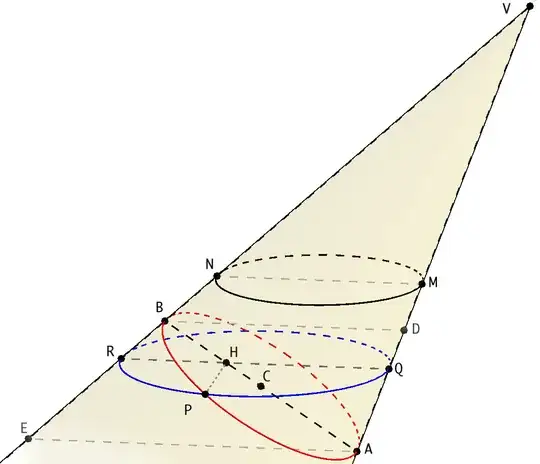
enter image description here

  • Thank you, that is beautiful. Makes me proud of my question. Shouldn't the center of the final coorinate be on A and the x^2 part be ( x - a )^2? – Y Watanabe Feb 07 '19 at 01:24
  • Acutally, the error seems to be in the substitution of AH and BH, where AH * BH should become ( AC^2 - CH ^2 ) instead of ( AC^2 - AH^2 ). Replacing AH with CH in the rest of the proof, we have x coordinate CH instead of AH. – Y Watanabe Feb 07 '19 at 04:00
  • Thank you @YWatanabe for pointing out my exchanging CH with AH: I'll correct in a moment. – Intelligenti pauca Feb 07 '19 at 13:56
  • Elegant and clear. Very nice. – sofend Aug 12 '25 at 09:44
  • In the derivation, is the red ellipse perpendicular to CV ? is it a particular case for which the ellipse equation is simple, and if so, how to compute the angle between the red ellipse and the blue circle ? – mocquin Nov 25 '25 at 19:26
  • The plane $\beta$ of the red ellipse is perpendicular to plane $VMN$. Line $VC$ is not, in general, perpendicular to $\beta$. @mocquin – Intelligenti pauca Nov 25 '25 at 19:31
1

The intersection of any quadric surface in $\mathbb R^3$ is a (perhaps degenerate) conic. This is fairly easy to show analytically using homogeneous coordinates.

Let $Q$ be a symmetric $4\times 4$ real matrix. This matrix defines some quadric surface via the equation $\mathbf X^TQ\mathbf X=0$ (where $\mathbf X=(x,y,z,1)^T)$. Further, let the $4\times 3$ matrix $M$ define a coordinate system on the intersecting plane via the mapping $\mathbf X=M\mathbf x$. Substituting into the quadric equation, we get $$(M\mathbf x)^TQ(M\mathbf x) = \mathbf x^T(M^TQM)\mathbf x = 0.$$ The matrix $M^TQM$ is a symmetric $3\times3$ real matrix, so this is the equation of a conic in the plane.

So, if the curve of intersection of your plane and cone looks like an ellipse, it is an ellipse.

Another simple way to see this is that your situation is related to the canonical conic section construction via some nonsingular affine transformation, and the image of an ellipse under such a transformation is another ellipse.

amd
  • 55,457
  • I was looking at a wine glass and I think an intuitive way to view the M matrix above is to simply take the point of view of the cone from its vertex. In that reference frame the cone is not oblique but just a regular cone and then one sees immediately that the circle is simply a part of a plane intersecting the (regular) cone at an angle -- which is the geometric definition of an ellipse. In other words, seeing a circle at some angle is just another way of saying a (partial) plane intersecting a cone at an angle. – sofend Aug 12 '25 at 09:47