This answer assumes the following definitions where $\tilde{f}_a(x)$ and $\tilde{f}_a'(x)$ are used to refer to analytic representations of $\sum\limits_{n}a(n)\,\theta(x-n)=\underset{\epsilon\to 0}{\text{lim}}\frac{f_a(x-\epsilon)+f_a(x+\epsilon)}{2}$ and it's first-order derivative $\sum\limits_{n}a(n)\,\delta(x-n)$ where $\theta(x)$ is the Heaviside step function and $\delta(x)$ is the Dirac delta function.
$$f_a(x)=\sum\limits_{n=1}^x a(n)\tag{1}$$
$$F_a(s)=s\int\limits_0^\infty f_a(x)\,x^{-s-1}\,dx=\sum\limits_{n=1}^\infty\frac{a(n)}{n^s}\,,\quad\Re(s)\ge 2\tag{2}$$
$$\tilde{f}_a'(x)=\underset{\substack{K,f\to\infty \\ K\gg f\,x}}{\text{lim}}\left(-4 f\sum\limits_{k=1}^K (-1)^k\ x^{2 k}\sum\limits_{j=1}^k \frac{(-1)^j\ (2 \pi f)^{2(k-j)}\ F_a(2 j)}{(2 k-2 j+1)!}\right)\tag{3}$$
$$\tilde{f}_a(x)=\underset{\substack{K,f\to\infty \\ K\gg f\,x}}{\text{lim}}\left(-4 f \sum\limits_{k=1}^K \frac{(-1)^k\ x^{2 k+1}}{2 k+1} \sum\limits_{j=1}^k\frac{(-1)^j\ (2 \pi f)^{2 (k-j)}\ F_a(2 j)}{(2 k-2 j+1)!}\right)\tag{4}$$
Partial evaluation of formula (3) for $\tilde{f}_a'(x)$ at a finite valuation frequency $f\in\mathbb{Z}_{>0}$ leads to the following analytic formula for $a(n)$. The OP's formula uses the evaluation frequency $f=1$, but also includes some additional terms that affect the evaluation at $x=0$ but not at other integer values of $x$.
$$\tilde{a}(x)=\frac{1}{2\,f}\tilde{f}_a'(x)\tag{5}$$
For the cases $a(n)=1$, $a(n)=(-1)^{n-1}$ and $a(n)=\delta_{n-1}$ where $F_a(s)=\zeta(s)$, $F_a(s)=\eta(s)$, and $F_a(s)=1$, formulas (3) and (4) above are simply the power series for the functions defined in formulas (6) to (11) below. This proves the validity of formulas (3) and (4) above for these particular cases, but I believe formulas (3) and (4) are more generally applicable to any definition of $a(n)$ for which the Dirichlet series $F_a(s)=\sum\limits_n\frac{a(n)}{n^s}$ converges for $\Re(s)\ge 2$. All formulas below are for $x\ge 0$, but $\tilde{f}_a'(x)$ and $\tilde{f}_a'(x)$ are actually even and odd functions respectively.
$\quad a(n)=1 \text{ where } F_a(s)=\zeta(s)$:
$$\tilde{f}_a'(x)=\sum\limits_n\delta(x-n)=\underset{f\to\infty}{\text{lim}}\left(-\frac{\sin (2 f \pi x)}{\pi x}+\sum\limits_{n=1}^f (\cos(2 n \pi x)+\cos(2 (n-1) \pi x))\right)\tag{6}$$
$$\tilde{f}_a(x)=\sum\limits_n\theta(x-n)=\underset{f\to\infty}{\text{lim}}\left(-\frac{\text{Si}(2 f \pi x)}{\pi}+\sum\limits_{n=1}^f \left(\frac{\sin(2 n \pi x)}{2 n \pi}+x\ \text{sinc}(2 (n-1) \pi x)\right)\right)\tag{7}$$
$\quad a(n)=(-1)^{n-1} \text{ where } F_a(s)=\eta(s)$:
$$\tilde{f}_a'(x)=\sum\limits_n (-1)^{n-1}\delta(x-n)=\underset{f\to\infty}{\text{lim}}\left(\frac{\sin(2 f \pi x)}{\pi x}-2 \sum\limits_{n=1}^f \cos((2 n-1) \pi x)\right)\tag{8}$$
$$\tilde{f}_a(x)=\sum\limits_n (-1)^{n-1}\theta(x-n)=\underset{f\to\infty}{\text{lim}}\left(\frac{\text{Si}(2 f \pi x)}{\pi }-\frac{2}{\pi}\sum\limits _{n=1}^f \frac{\sin ((2 n-1) \pi x)}{2 n-1}\right)\tag{9}$$
$\quad a(n)=\delta_{n-1} \text{ where } F_a(s)=1$:
$$\tilde{f}_a'(x)=\delta(x-1)=\underset{f\to\infty}{\text{lim}}\left(\frac{\sin(2 f \pi (x+1))}{\pi (x+1)}+\frac{\sin(2 f \pi (x-1))}{\pi (x-1)}\right)\tag{10}$$
$$\tilde{f}_a(x)=\theta(x-1)=\underset{f\to\infty}{\text{lim}}\left(\frac{\text{Si}(2 f \pi (x+1))+\text{Si}(2 f \pi (x-1))}{\pi }\right)\tag{11}$$
Figures (1) to (3) below illustrated formulas (7), (9), and (11) above in orange overlaid on the corresponding blue reference function where all three formulas are evaluated at $f=10$. The red discrete portion of the three figures below represent the evaluation of the three formulas at integer values of $x$. Note that formulas (7) and (9) illustrated in Figures (1) and (2) below both evaluate to $0$ at $x=0$ which is atypical of the Fourier series related to these functions. This is because formulas (6) and (8) are both missing a tooth of a Dirac comb at $x=0$.
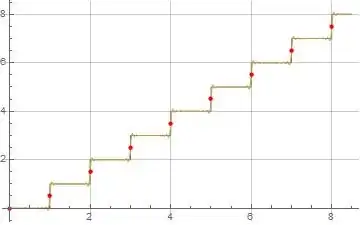
Figure (1): Illustration of formula (7) for $\tilde{f}_a(x)=\sum\limits_n\theta(x-n)$
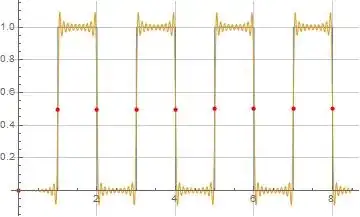
Figure (2): Illustration of formula (9) for $\tilde{f}_a(x)=\sum\limits_n (-1)^{n-1}\theta(x-n)$
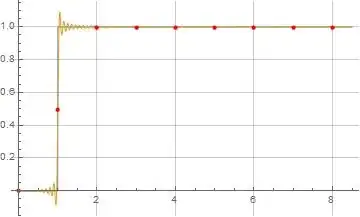
Figure (3): Illustration of formula (11) for $\tilde{f}_a(x)=\theta(x-1)$
Formulas (6) to (9) above lead to the following formulas for the Riemann zeta function $\zeta(s)$ and Dirichlet eta function $\eta(s)$. Formulas (12) and (13) for $\zeta(s)$ and $\eta(s)$ can also be used to derive formulas for $\zeta(s)$ and $\eta(s)$ which converge for $\Re(s)>-1$.
$$\zeta(s)=\underset{f\to\infty}{\text{lim}}\left(2^s \pi^{s-1} \sin\left(\frac{\pi s}{2}\right) \Gamma(1-s) \left(-\frac{f^s}{s}+\frac{1}{2} \left(1+\sum\limits_{n=2}^f \left(n^{s-1}+(n-1)^{s-1}\right)\right)\right)\right),\ \Re(s)<2\tag{12}$$
$$\eta(s)=\underset{f\to\infty}{\text{lim}}\left(2 \pi^{s-1} \sin\left(\frac{\pi s}{2}\right)\ \Gamma(1-s) \left(\frac{2^{s-1} f^s}{s}-\sum\limits_{n=1}^f (2 n-1)^{s-1}\right)\right),\ \Re(s)<2\tag{13}$$
Figure (4) below illustrates formula (13) for $\eta(s)$ evaluated at $f=100$ and $f=1000$ in orange and green overlaid on the blue reference function.
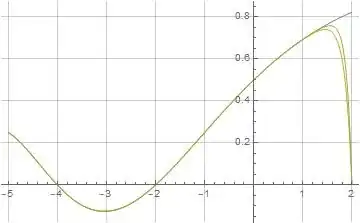
Figure (4): Illustration of formula (13) for $\eta(s)$ evaluated at $f=100$ and $f=1000$ (orange and green)
Figure (5) and (6) below illustrate the real and imaginary parts of formula (13) for $\eta(s)$ evaluated along the critical line $s=\frac{1}{2}+i\,t$ in orange overlaid on the blue reference function where formula (13) is evaluated at $f=1000$ for both figures. The red discrete portion of the two figures below represent the evaluation of formula (13) at the first ten non-trivial zeta zeros in the upper-half plane.
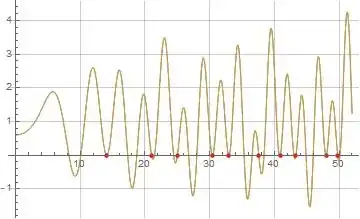
Figure (5): Illustration of real part of formula (13) for $\eta(\frac{1}{2}+i\,t)$
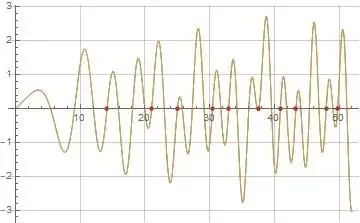
Figure (6): Illustration of imaginary part of formula (13) for $\eta(\frac{1}{2}+i\,t)$


