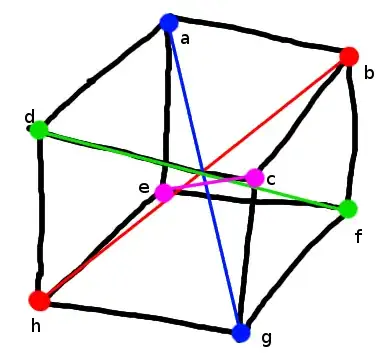
I want to prove that the automorphism group of the cube is $\mathbb{Z}_2 \times S_4$, by using information about the congruences of a cube. By the cube, I mean the graph of the platonic solid, i.e. the graph whose vertices are $\{0,1\}^3$, with two vertices being adjacent iff their bit strings differ in exactly one coordinate. This is an exercise in [Lovasz, Combinatorial Problems and Exercises]. The solution given there says "each automorphism of the cube is, in fact, induced by an a congruence and that the whole group is the direct product of $\mathbb{Z}_2$ and the group of direct congruences of the cube... the group of direct congruences of the cube is $S_4$...". What is the definition of "congruence"? And why is it a direct product and $S_4$ for the cube?
Other proofs would be great too. I am able to show that the automorphism group of the cube is isomorphic to $\mathbb{Z}_2^3 \rtimes S_3$ (in fact, this is true for the $n$-dimensional cube also, with 3 replaced by $n$), but is this semidirect product as good a description of the automorphism group as $\mathbb{Z}_2 \times S_4$? It seems in general there could be more than one semidirect product and a direct product description would be more complete.