I was following a geometric proof for the derivative of sine when I came across this unjustified assertion: In the diagram, as we choose Q ever closer to P, the chord PQ approximates the corresponding arc arbitrarily well. While I understand the intuitive reason for this, how could this idea be made more rigorous so that the proof is guaranteed to work. Something with epsilon delta was what I was thinking?
-
If you want it to be made rigorous, you have to be clear on what exactly you have to work with. What things do you know that might seem relevant? – Arthur Jul 29 '19 at 12:44
-
this follows from the approximation $\sin \frac{x}{2} \approx \frac{x}{2}$ for small $x$. Is that more rigorous? – Vasili Jul 29 '19 at 12:49
-
Any smooth curve can be locally approximated by a straight line when you look at it close enough, and as precisely as you want. This is a rigourous property of a smooth curve (but not stated rigourously I grant it). – nicomezi Jul 29 '19 at 12:54
-
@nicomezi Aha! This is the more general fact that I have never seen a fully rigorous proof for. Could you link to a resource perhaps? – Math Enthusiast Jul 29 '19 at 13:39
-
2A smooth curve in my comment is a function $f:I \mapsto \mathbb{R}^n$, with $f$ being at least $C^1$ and $I$ an interval. The line defined by the set of points which can be written as $h(t) = f(t_0)+f'(t_0)\lambda$ with $\lambda \in \mathbb{R}$ is tangent to the curve at $t_0$. By Taylor's theorem, we know that : $|f(t)-h(t)| \le (|f'(t_0)|+|g(t-t_0)|)|t-t_0|$ with $g$ continuous and $g(0)=0$, then if $t$ is close enough to $t_0$, the upper bound can be driven as close to $0$ as you want. @MathEnthusiast – nicomezi Jul 29 '19 at 14:06
-
2The details are not every interesting to understand what is going on, but you can write a full proof easily from the steps I gave. – nicomezi Jul 29 '19 at 14:16
-
2@nicomezi - And how do you intend to apply this, to prove that the sine function is differentiable? You know that sine is smooth exactly because of the theorem Math Enthusiast is discussing. You cannot use it to prove this theorem. And even it you could. you estimation says nothing about arclength, which is what is needed here. Two curves can be as close approximations of each other as you like, measured by $|f(t) - h(t)|$, but have massively different lengths. For example $f(t) = 0$ and $h(t) = \epsilon \cos Nt$ for large $N$. – Paul Sinclair Jul 29 '19 at 21:34
-
1And what makes you think I wanted to use this fact to prove anything about the sine ? He said that the PQ approximating the chord thing was not rigourous, I just wanted to give him some insight about this.The statement I gave is just used to see that a circle can be approximated locally by a line, so when P is close enough to Q, the chord PQ has almost the same length as the line PQ. This has nothing to do directly with sine. @PaulSinclair – nicomezi Jul 30 '19 at 04:56
-
@Paul Sinclair While the error measured by $|f(t)-h(t)|$ doesn't determine whether the arc lengths are the same in the limit, one can still use the fact that differentiable functions on an open interval can be locally approximated by straight lines, in terms of both the functional values and the arc length. Here, the part of the circle is a part of the graph of $f(x)=\sqrt{1-x^2}$ which is differentiable. – Redbox Jun 26 '21 at 18:25
-
1@Mr. Pink - something neither you nor nicomezi seem to be able to come to grips with is the knowledge level of students when they first encounter $\lim_{\theta \to 0}\frac {\sin\theta}\theta = 1$. Both of you are discussing aspects that are not studied until long after this is shown. I was not disputing the ability to rigorously define arclength. I was disputing the attempt to use such theory in an explanation for those who are in no way prepared for it. – Paul Sinclair Jun 26 '21 at 18:49
-
@Paul Sinclair No definition of arc length of general curves is necessary here. It is sufficient to prove that differentiable functions, like $f(x)=\sqrt{1-x^2}$, behave locally approximately as linear functions $(f(a+h)-f(h)=f'(a)h+\varepsilon (h)$, the error $\varepsilon (h)$ can be made arbitrarily small) and that requires only the limit definition of the derivative. Then, the "arc length" of a straight line (the graph of a linear function) is just the distance between the endpoints. – Redbox Jun 26 '21 at 19:41
-
I don't see how that is going to get you around the problem, but if you think you have a proof that is rigorous and accessible to Calc I students at the time this is usually proven, please feel free to post it in an answer. (That is, rigorous and accessible on roughly the same level of my proof - I have pointed out where it still lacks rigor, after all.) – Paul Sinclair Jun 27 '21 at 13:22
-
@Paul Sinclair Define the $n$-magnification of $f(x)=\sqrt{1-x^2}-1$ by $g_n(x)=nf(x/n)$. The graph of $f(x)$ differs from the graph of $\sqrt{1-x^2}$ by only a translation. Then $\lim_{n\to\infty} g_n(x)=xg'(0)=0$ which is the equation of a straight line. – Redbox Jun 27 '21 at 22:24
-
@Paul Sinclair And an analogous translation and magnification can be done with any point on $f_1(x)=\sqrt{1-x^2}$, $x\in (-1,1)$. Is this accessible to Calc I students? – Redbox Jun 27 '21 at 22:31
-
@Paul Sinclair Correction: There should be $\lim_{n\to\infty}g_n(x)=xf'(0)=0$ instead. – Redbox Jun 27 '21 at 23:47
-
1@I guess I wasn't clear enough: If you a proof, post it. If all you have is a few ideas, halfway strung together, then I am not interested. – Paul Sinclair Jun 28 '21 at 00:06
-
@Paul Sinclair You were just seeming a little bit skeptical about the "linearization thing". I thought you were interested. Also the proof is very short and fits in a comment, an "answer" is not needed. – Redbox Jun 28 '21 at 00:38
1 Answers
The comments that have been (thus far) made on the OP have completely missed the issue, which is how do you know that the length of $\overline{PQ}$ approximates the arclength of $\widehat{PQ}$?
Unfortunately, that difficultly is intractable at the level where this proof is given. With rare exceptions, students at this level have never seen a definition for arclength. It is (like many other notions) just a nebulous concept that everyone understands and assumes exists, but no one has a rigorous grounding in.
Rather than go into the question of how arclength is rigorously defined, though, I suggest a different proof. It also depends on a not-yet-rigorously defined concept, Area, but one for which a useful mathematical relationship is known: If $A \subseteq B$, then $\operatorname{Area}(A) \le \operatorname{Area}(B)$.
The area of a sector of a circle of radius $r$ subtending an angle $\theta$ (in radians) is $\frac{\theta r^2}2$, a formula which can be proven at this level fairly easily, given that the area of the entire circle is $\pi r^2$.
In this diagram
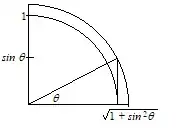
The inner sector has area $\frac{\theta \cdot 1^2}2 = \frac\theta2$. The outer circle has radius $\sqrt{1+\sin^2 \theta}$, so the outer sector has area $\frac{\theta(1 + \sin^2 \theta)}2$. The triangle has base $1$ and height $\left(\sqrt{1+\sin^2\theta}\right)\sin \theta$,so its area is $\frac 12\left(\sqrt{1+\sin^2\theta}\right)\sin\theta$. As the inner sector is contained in the triangle, which is contained in the outer sector, we have $$\theta \le \left(\sqrt{1+\sin^2\theta}\right)\sin\theta \le \theta(1 + \sin^2 \theta)\\\frac \theta{\sqrt 2}\le\frac \theta{\sqrt{1+\sin^2\theta}} \le \sin \theta \le \theta\sqrt{1+\sin^2\theta}\le\sqrt2 \theta$$ Which gives $$\lim_{\theta \to 0}~ \sin \theta = 0$$ And dividing by $\theta$, we get
$$\frac 1{\sqrt{1+\sin^2\theta}} \le \frac {\sin \theta}\theta \le \sqrt{1+\sin^2\theta}$$ which gives $$\lim_{\theta \to 0} \frac{\sin \theta}\theta = 1$$
- 46,288
-
Thank you! I was pondering this question some more, and I had more or less decided that this part of the proof implicitly depends on the limiting ratio of sin(x) and its corresponding arc. This provides some added difficulty for me, because the reason I was studying this geometric proof was that I was attempting to avoid some potential circularity in my trig knowledge. Thank you for your time and effort in making this post :) – Math Enthusiast Jul 30 '19 at 01:41
-
A comment does not necessarily answer or adress the main question directly (and often it is not the case, because if it was, it would rather be an answer). Comments are often made to help the OP finding an answer or having a better understanding of what is going on, sometimes on sidesubjects. Plus, the statement I gave tells the OP a rigourous reason about the thing you said everyone missed. And yes, in order to apply it here, you have to know that sine is differentiable, but then I will just let you read the beginning of that comment again. @PaulSinclair – nicomezi Jul 30 '19 at 05:11
-
@nicomezi Didn't you mean "you have to know that $f(x)=\sqrt{1-x^2}$ is differentiable" instead? – Redbox Apr 21 '21 at 21:34
-
@nicomezi I think you are trying to linearize the arc (given by a part of $f(x)=\sqrt{1-x^2}$), so $f(x)=\sqrt{1-x^2}$ should be linearized, not $g(\theta )=\sin\theta$. – Redbox Apr 22 '21 at 09:15
-
@nicomezi But you wrote "Any smooth curve can be locally approximated by a straight line when you look at it close enough" This is linearization. – Redbox Apr 22 '21 at 09:36
-
@nicomezi "No effort"? It was exactly what you were writing about, see https://en.wikipedia.org/wiki/Linearization – Redbox Apr 22 '21 at 09:43
-
Ok let's try one last time then. I am not linearizing any function IN PARTICULAR. In the comments following the one you quoted, do you see any mention of the sinus function or any other ? No there are not, because I was just giving an overal idea of why we can approximate smooth curves by straight lines. In the last comment, I talk about the sine function because the person just above me did, and if you read it, it says that my previous ones where not to prove anything about the sinus, and for the same reason it is also mentionned in my first comment below this answer. I hope it is clear now. – nicomezi Apr 22 '21 at 09:54
-
@nicomezi Yes, you were not talking about linearizing any particular function. But it can be rigorously proved that the arc can be locally replaced by a line segment because of the fact that $f(x)=\sqrt{1-x^2}$ is smooth, without any need to prove that $\sin$ is differentiable. When you wrote "in order to apply it here, you have to know that sine is differentiable" I thought that your sentence was not quite correct. – Redbox Apr 22 '21 at 18:45
-
I can perfectly understand where your misunderstanding came from, I myself had a hard time putting my thoughts back together to retrieve what I meant here. The only reason I got aggressive is because I felt like you just stuck to your starting logical point without really reading what I answered. Also I am sick at the moment (not covid but still very annoying). I apologize for my lack of patience. Have a nice day/night. @MrPink – nicomezi Apr 23 '21 at 05:04
-