Solution as of 31.12.19
Summarizing statement
The two solutions proposed here (P by pregunton, and W by myself) follow two different strategies and lead to different solutions
P: calculates the series elements for each $mod(n,k)=0,1,...,(k-1)$ separately and then uses a switching function which selects each of these series from a general expression. The continuation to real (and complex) values of $n$ is then performed for the switching function.
W: here the basic starting point is the solution of the recursion relation which matches the initial conditions. The solution is tken to be a finite Fourier sum.
The results of the two approaches do not concide apart from integer arguments.
My reworked solution
The main differences are
(1) the intial conditions are now adapted to the standard values
(2) the solution to $$A(n) = A(n-k)$$ is now based on a real Fourier sum. It leaves some free parameters at our discretion which can be used to adapt the solution to a more specific one as e.g. to that of pregunton.
(3) the solution is now real on the real axis
Abstract
This solution for the $k$-fold faculty is in principle complete and straightforward. It combines linear recursion, Fourier sums and linear algebra. Examples for $k=1..5$ are given. Hints to the OEIS database are given for the (sub-)sequences encountered.
Derivation of the solution
Let $a_{k}(n)$, the $k$-fold factorial of $n$ be defined by the recursion
$$a_{k} (n) = n a_{k} (n-k)\tag{1}$$
with the inital conditions
$$a_{k}(0) = 1, a_{k}(m) = m, m=1,...,k-1\tag{2}$$
Now, since $(1)$ for integer $n$ is a linear homogeneous difference equation of order $k$ its solution is a linear combination of $k$ linearly independent solutions.
We can find a particular solution letting with some parameter $\lambda$
$$a_{k} (n) = \lambda^\frac{n}{k} b_{k}(1+\frac{n}{k})\tag{3}$$
Inserting this in $(1)$ we have
$$ \lambda^\frac{n}{k} b_{k}(1+\frac{n}{k})= n \lambda^\frac{n-k}{k} b_{k}(1+\frac{n-k}{k})$$
or
$$ b_{k}(1+\frac{n}{k})= \frac{n}{\lambda} b_{k}(\frac{n}{k})\tag{4}$$
Letting $\lambda=k$ the simplified recursion $(4)$ converts into the defining recursion for the $\Gamma$-function and we have
$$a_{k} (n)=A k^{\frac{n}{k}} \Gamma(1+\frac{n}{k})\tag{5}$$
with some constant $A$.
In order to find more solutions we employ the method of varying the "constant" writing
$$a_{k} (n)=A(n)k^{\frac{n}{k}}\Gamma(1+\frac{n}{k})\tag{6}$$
Inserting this into $(5)$ gives the recursion
$$A(n) = A(n-k)\tag{7a} $$
Obviously any function with period $k$ solves $(7a)$.
When it comes to periodic functions the most natural choice would be a Fourier series. We restrict the choice here to a finite Fourier sum:
$$A(n,k) =\sum_{m=0}^{k} c_{m} \cos(2 \pi m \frac{n}{k}) +s_0+\sum_{m=1}^{k} s_{m} \sin(2 \pi m \frac{n}{k})\tag{7b}$$
This expression contains $2k$ parameters. Since $k$ of them are defined by the initial conditions, $k$ are left undefined, and can be chosen arbitraryly. This reflects the fact that the extrapolation of a function defined for positive integers to real and complex values is to a high degree arbitrary.
Hence we can write down the general solution of $(1)$ as
$$a_{k}(n) = k^{\frac{n}{k}} \Gamma(1+\frac{n}{k})A(n,k)\tag{8}$$
(to be continued)
Examples
While $(8)$ together with $(2)$ give the complete solution to the problem it is still more or less implicit, and therefore we calculate explit formulae for some small values of $k$.
$k=1$
We have $a_1(n)=c_0 \Gamma(1 + n)$ and from $(2)$ follows $c_0=1$ so that
$$a_1(n) = \Gamma(1+n) = n!\tag{e1}$$
as expected.
$k=2$
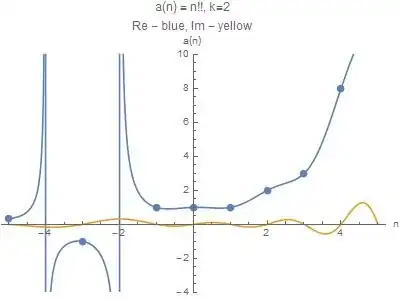
We have $a_2(n) = 2^{n/2} \Gamma \left(\frac{n}{2}+1\right) (c_1 \cos (\pi n)+c_0+s_1 \sin (\pi n))$.
The initial conditions lead to the equations $1=c_0+c_1, 1 = \sqrt{2} (c_0 - c_1)$ giving $c_0= \frac{1}{2}\left(1+\sqrt{\frac{2}{\pi}}\right),c_1 =\frac{1}{2}\left(1-\sqrt{\frac{2}{\pi}}\right)$.
Finally
Complex $n$:
$$a_2(n) = 2^{\frac{n}{2}-1} \Gamma \left(\frac{n}{2}+1\right) \left(2 s_1 \sin (\pi n)\\
+\sqrt{\frac{2}{\pi }} (1-\cos (\pi n))+(\cos (\pi n)+1)\right)\tag{e2a} $$
Graph:
Integer $n$:
For integer we have the simplification $n$ $e^{i \pi n}=(-1)^n$.
Since for even $n$: $\frac{1}{2}\left(\left(1+\sqrt{\frac{2}{\pi }}\right)+\left(1-\sqrt{\frac{2}{\pi }}\right) (-1)^n\right) = 1$ for even $n$ and $=\sqrt{\frac{2}{\pi }}$ for odd $n$ we can also write
$$a_2(n) = 2^{\frac{n}{2}}\Gamma \left(\frac{n}{2}+1\right)(\sqrt{\frac{2}{\pi }})^{\frac{1-(-1)^n}{2}}\tag{e2b} $$
A similar form was given in the OP.
The first few values are
$$\{a_2(n) \}_{n=0}^{n=11} = \{1,1,2,3,8,15,48,105,384,945,3840\}$$
This sequence is listed here https://oeis.org/A006882 as double factorials n!!: a(n) = n*a(n-2) for n > 1, a(0) = a(1) = 1.
$k=3$
This case is even more interesting since $n$ has three values $\mod(3)$
We have, to begin with,
$$a_{3}(n) = 3^{n/3} \left(c_0+c_1 e^{\frac{2 i \pi n}{3}}+c_2 e^{\frac{4 i \pi n}{3}}\right) \Gamma \left(\frac{n}{3}+1\right)\tag{e3a}$$
The inital conditions lead to these linear equations for the coefficients
$$
\begin{array}{c}
1=c_0+c_1+c_2 \\
1=\sqrt[3]{3} \left(c_0+e^{\frac{2 i \pi }{3}} c_1+e^{-\frac{1}{3} (2 i \pi )} c_2\right) \Gamma \left(\frac{4}{3}\right) \\
1=3^{2/3} \left(c_0+e^{-\frac{1}{3} (2 i \pi )} c_1+e^{\frac{2 i \pi }{3}} c_2\right) \Gamma \left(\frac{5}{3}\right) \\
\end{array}
$$
Real $n$:
The solution of which gives rise to
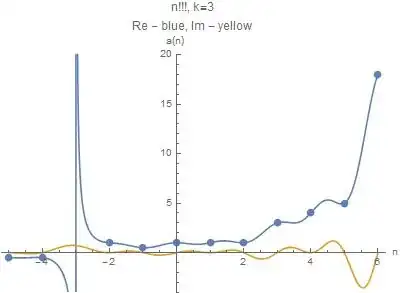
$$a_3(n) = 3^{n/3} \Gamma \left(\frac{n}{3}+1\right)\left( \frac{1}{3}\left(1+2 (-1)^n \cos \left(\frac{\pi n}{3}\right)\right)
\\
+\frac{1}{3} \left(1+(-1)^{2/3} e^{\frac{2 i \pi n}{3}}-\sqrt[3]{-1} e^{\frac{4 i \pi n}{3}}\right) \left(\frac{3^{5/6} \Gamma \left(\frac{1}{3}\right)}{ 4 \pi }\right)
\\
+\frac{1}{3}\left((-1)^{n+1} \left(\sqrt{3} \sin \left(\frac{\pi n}{3}\right)+\cos \left(\frac{\pi n}{3}\right)\right)+1\right)\left(\frac{6 \sqrt[6]{3} \Gamma \left(\frac{2}{3}\right)}{ 4 \pi }\right)\right)\tag{e3b} $$
Graph:
Integer $n$:
Simplifying according to the remainder$\mod(3)$ we have
$a_{3}(n) =
\left\{
\begin{array}{ll}
3^j \Gamma (j+1) & n=3j + 0 \; \;\;\{\}_{j=0}^{j=5}= \{1,3,18,162,1944,29160\},\; \text{https://oeis.org/A032031}\\
\frac{3^{j+\frac{3}{2}} \Gamma \left(\frac{2}{3}\right) \Gamma \left(j+\frac{4}{3}\right)}{2 \pi } & n=3j+1 \;\;\; \{\}_{j=0}^{j=5} = \{1,4,28,280,3640,58240\},\; \text{https://oeis.org/A007559}\\
\frac{3^{j+\frac{3}{2}} \Gamma \left(\frac{1}{3}\right) \Gamma \left(j+\frac{5}{3}\right)}{4 \pi } & n=3j+2 \;\; \; \{\}_{j=0}^{j=5}=\{1,5,40,440,6160,104720\}, \text{https://oeis.org/A034000}\\
\end{array}
\right.\tag{e3c} $
$k=4$
Real $n$:
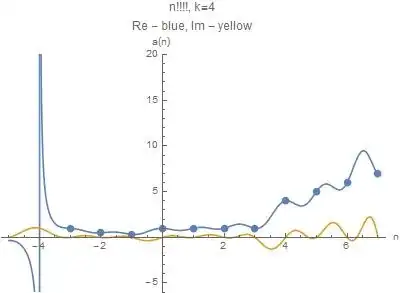
$$a_{4}(n) = \frac{2^{\frac{n}{2}-2}}{3\pi} \Gamma \left(\frac{n}{4}+1\right) \left(-3 \sqrt{\pi } \left(-1+e^{\frac{i \pi n}{2}}\right) \left(1+e^{i \pi n}\right)+3 \pi \left(1+e^{\frac{i \pi n}{2}}\right) \left(1+e^{i \pi n}\right)-\left(-1+e^{i \pi n}\right) \left(4 i e^{\frac{i \pi n}{2}} \left(\Gamma \left(\frac{5}{4}\right)-2 \Gamma \left(\frac{7}{4}\right)\right)+\Gamma \left(\frac{1}{4}\right)+8 \Gamma \left(\frac{7}{4}\right)\right)\right)$$
Graph:
Integer $n$:
$a_{4}(n) =
\left\{
\begin{array}{ll}
4^j \Gamma (j+1) & n=4j + 0 \; \;\;\{\}_{j=0}^{j=5}= \{1,4,32,384,6144,122880\},\; \text{https://oeis.org/A047053}\\
\frac{2^{2 j+\frac{7}{2}} \Gamma \left(\frac{7}{4}\right) \Gamma \left(j+\frac{5}{4}\right)}{3 \pi } & n=4j+1 \;\;\; \{\}_{j=0}^{j=5} = \{1,5,45,585,9945,208845\},\; \text{https://oeis.org/A007696}\\
\frac{2^{2 j+1} \Gamma \left(j+\frac{3}{2}\right)}{\sqrt{\pi }} & n=4j+2 \;\; \; \{\}_{j=0}^{j=5}=\{1,6,60,840,15120,332640\}, \text{https://oeis.org/A000407}\\
\frac{2^{2 j+\frac{3}{2}} \Gamma \left(\frac{1}{4}\right) \Gamma \left(j+\frac{7}{4}\right)}{3 \pi } & n=4j+3 \;\; \; \{\}_{j=0}^{j=5}=\{1, 7, 77, 1155, 21945, 504735\}, \text{https://oeis.org/A034176}\\
\end{array}
\right. $
$k=5$
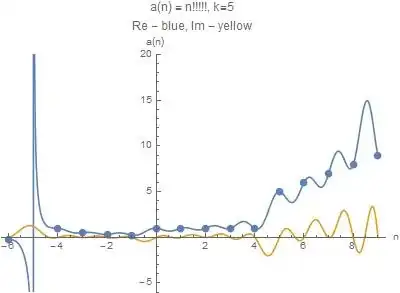
Real $n$: lengthy expression, dropped here
Graph:
Integer $n$:
$a_{5}(n) =
\left\{
\begin{array}{ll}
5^j \Gamma (j+1) & n=5j + 0 \; \;\;\{\}_{j=0}^{j=5}= \{1,5,50,750,15000,375000\},\; \text{https://oeis.org/A052562}
\\
\frac{\sqrt[10]{\frac{1}{2} \left(25-11 \sqrt{5}\right)} \;5^{j+\frac{11}{5}} \Gamma \left(\frac{9}{5}\right) \Gamma \left(j+\frac{6}{5}\right)}{8 \pi } & n=5j+1 \;\;\; \{\}_{j=0}^{j=5} = \{1,6,66,1056,22176,576576\},\; \text{https://oeis.org/A008548}
\\
\frac{\sqrt[10]{\frac{1}{2} \left(25+11 \sqrt{5}\right)}\; 5^{j+\frac{11}{5}} \Gamma \left(\frac{8}{5}\right) \Gamma \left(j+\frac{7}{5}\right)}{12 \pi } & n=5j+2 \;\; \; \{\}_{j=0}^{j=5}=\{1,7,84,1428,31416,848232\}, \text{https://oeis.org/A034323}
\\
\frac{5^j \Gamma \left(j+\frac{8}{5}\right)}{\Gamma \left(\frac{8}{5}\right)} & n=5j+3 \;\; \; \{\}_{j=0}^{j=5}=\{1,8,104,1872,43056,1205568\}, \text{https://oeis.org/A034300}
\\
\frac{\sqrt[10]{\frac{1}{2} \left(25-11 \sqrt{5}\right)}\; 5^{j+\frac{16}{5}} \Gamma \left(\frac{11}{5}\right) \Gamma \left(j+\frac{9}{5}\right)}{48 \pi } & n=5j+4 \;\; \; \{\}_{j=0}^{j=5}=\{1,9,126,2394,57456,1666224\}, \text{https://oeis.org/A034301}
\\
\end{array}
\right. $
Discussion
Simpler expressions for some $a_{k}(n)$ in terms of the Pochhammer symbol have been given in OEIS by G. C. Greubel, Aug 23 2019.
The expressions given here lead somewhat miraculously to integer numbers. The miracle can be solved by using the basic formula for the Gamma function $z \Gamma(z) = \Gamma(z+1)$ and the relation $\Gamma (z) \Gamma (1-z)=\pi \csc (\pi z)$.
I compared the results of the two solutions given up to now. For $k=3$, I found that they differ. That of pregunton (https://math.stackexchange.com/a/3488935/198592) agrees with OEIS A007661 "Triple factorial numbers a(n) = n!!!, defined by a(n) = n*a(n-3), a(0) = a(1) = 1, a(2) = 2. Sometimes written n!3." I call this the standard solution. Mine is different and not listed in OEIS. The reason is the different initial conditions. I had assumed that $a_3(2) = 1$, the "standard" is $a_3(2)=2$. For $k=2$ the standard is $a_2(0)=a_2(1)=1$, and consequently my series coincides with the standard. I don't quite understand at the moment why the generalization of the cases $k=1$ and $k=2$ should be a deviation from the constant initial conditions for all values below $k$ (my conditions $(2)$). And what which conditions would be "natural" for $k=4$ and higher $k$? I have found the answer here http://mathworld.wolfram.com/Multifactorial.html. The rule for the initial conditions is simply $a_{m}= m$ for $m=1..k+1$.


