The first question has an affirmative answer: a $P_n$-polygon exists for every $n \ge 0$. (Every polygon is both $P_0$ and $P_1$, I believe, but it's not necessary to prove that.) Constructing a $P_n$-polygon is straightforward; just work backward from a single path that demonstrates the property. More specifically:
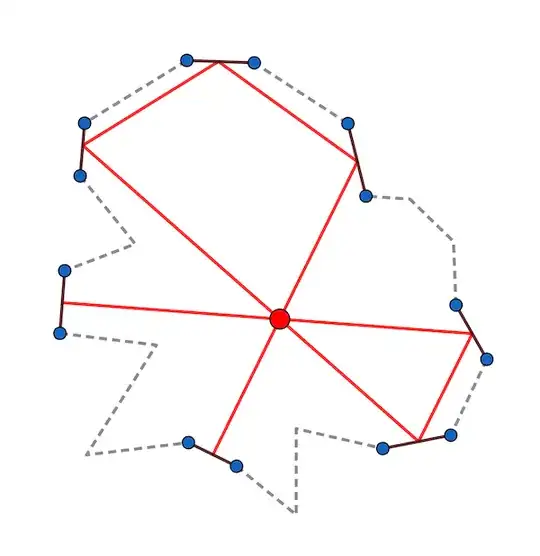
First draw a piecewise linear path (closed or not) that passes through the origin $n$ times and is otherwise non-self-intersecting. At each vertex of the path, place a small "bumper" perpendicular to the angle bisector at that vertex. These bumpers will form part of the polygon. (If the path is not closed, then the bumpers at the two endpoints should be perpendicular to the path at those points.) Finally, complete the polygon by connecting the bumpers (using piecewise linear paths) into a single loop enclosing the initial path, being careful not to cross any existing segments.
It's not necessarily obvious that the final step is possible; indeed, you can draw the initial path in such a way that it's not. But a little thought shows that as long as the "petals" (minimal portions of the initial path leaving from and returning to the origin) are convex and not nested, none of the bumpers will lie inside a petal, and so they can be safely connected to form the polygon. The figure below shows an example of this construction for $n=3$. Shooting a ray along any of the red segments (in either direction, starting at any point) will trace out the entire red path, which crosses the central point three times.
The second question seems much more difficult. I strongly suspect the answer is no (e.g., that there are $P_8$-polygons that aren't also $P_5$); but proving the negative requires exhibiting a $P_n$-polygon and understanding its billiard dynamics starting with every point and direction. The best approach is probably to use a highly symmetric example, in the hope that the dynamics become more tractable.

