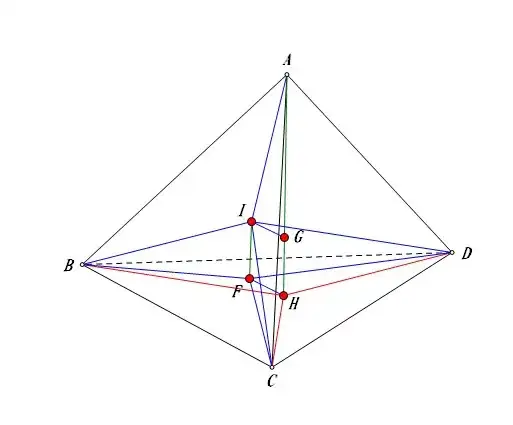
Let the point $I$ in tetrahedron $ABCD$. Find $\min\{IA + IB + IC + ID\}$.
I can't solve this problem, even in the case ABCD regular. Please help

Let the point $I$ in tetrahedron $ABCD$. Find $\min\{IA + IB + IC + ID\}$.
I can't solve this problem, even in the case ABCD regular. Please help
Summary
For regular tetrahedron, the answer isn't that hard to figure out because under very general assumptions, the point $I$ that minimize the sum of distances is unique.
A regular tetrahedron has many axis of rotation symmetry, all of them pass through the centroid. By the uniqueness of $I$, $I$ lies on the intersection of all these axis of rotation symmetry and hence must coincides with the centroid.
Similar arguments work for any tetrahedron which has more than one axis of rotation symmetry.
Existence and Uniqueness of I
Let $S = \{ \vec{x}_1, \vec{x}_2, \ldots, \vec{x}_m \}$ be any collection of $m \ge 3$ distinct points in $\mathbb{R}^n$ such that no three of them are collinear. Let $d_S: \mathbb{R}^n \to \mathbb{R}$ be the sum of distances to points in $S$:
$$d_S(\vec{p}) = \sum_{i=1}^{m} |\vec{x}_i - \vec{p}|$$
It is clear $d_S(\vec{p})$ is a continuous function in $\vec{p}$. In fact, it is $C^{\infty}$ over $\mathbb{R}^{n} \setminus S$ with gradient:
$$ \vec{\nabla} d_S(\vec{p}) =\; -\sum_{i=1}^{m} \hat{n}_i(\vec{p}) \;\stackrel{def}{=}\; -\sum_{i=1}^{m}\frac{\vec{x}_i-\vec{p}}{|\vec{x}_i-\vec{p}|}\tag{*1}$$
Notice $d_S(\vec{p}) \to \infty$ as $|\vec{p}| \to \infty$ and bounded below by $0$ over $\mathbb{R}^n$. $d_{S}$ achieves its absolute minimum at some finite $\vec{p}_{min}$. What we want to show is this $\vec{p}_{min}$ is unique.
For any two $\vec{p}_1, \vec{p}_2 \in \mathbb{R}^n$ and $\vec{x}_i \in S$, it is easy to check:
$$\frac{|\vec{x}_i - \vec{p}_1| + |\vec{x}_i - \vec{p}_2|}{2} \ge \left| \vec{x}_i - \frac{\vec{p}_1+\vec{p}_2}{2}\right|$$ and the equality holds if and only if $\vec{p}_1$ and $\vec{p}_2$ lies on a ray start at $\vec{x}_i$. Since no three of $\vec{x}_i$ are collinear and $m \ge 2$, there is at least one $\vec{x}_i \in S$ which makes above inequality strict. This implies:
$$\frac{d_S(\vec{p}_1) + d_S(\vec{p}_2)}{2} > d_S(\frac{\vec{p}_1+\vec{p}_2}{2})\tag{*2}$$
i.e. $d_S$ is a strictly convex function. If $d_S(\vec{p}) = d_S(\vec{p}_{min})$ for any other $\vec{p}$, then $(*2)$ will leads to the contradiction that $d_S(\frac{\vec{p} + \vec{p}_{min}}{2}) < d_S(\vec{p}_{min})$. As a result, the point $\vec{p}_{min}$ that minimize $d_{S}(\cdot)$ is unique.
Apply this to a non-degenerate tetrehedron $T = \left<ABCD\right>$, we get the uniqueness of $I$.
Where can $I$ be?
If $\vec{p}_{min} \notin S$, then being an absolute minimum, $\vec{p}_{min}$ satisfies:
$$\vec{\nabla} d_{S}(\vec{p}) = \vec{0}\tag{*3}$$
Conversely, if any $\vec{p} \notin S$ satisfies $(*3)$, then $\vec{p}$ cannot be a local maximum nor saddle point because $d_S$ is convex. Using the strict convexity of $d_S$, it is not hard to show $\vec{p}$ is actually the unique absolute minimum $\vec{p}_{min}$.
In short, $\vec{p}_{min}$ either belongs to $S$ or a point $\notin S$ which satsifies $(*3)$.
Apply this to non-degenerate tetrahedron $T = \left<ABCD\right>$ again. It is easy to see
$$\vec{\nabla} d_{S}(\vec{p}) \neq \vec{0}\quad\text{ for }\quad \vec{p} \in \mathbb{R}^3 \setminus ( \operatorname{int}(T) \cup S )$$ because the unit vectors $\vec{n}_i(\vec{p})$ in $(*1)$ falls into some half space and can never add up to $\vec{0}$.
This means for the non-degenerate tetrahedron $T$, $I$ is either:
For the second case, I'm not aware of any analytic expression which will tell you where $I$ is. However, there is a simple algebraic/geometric criterion to tell us whether $I$ coincides with one of the vertices.
Consider the vertex $A$, if it satisfies one (and hence both) of following equivalent conditions:
One can show that $A$ is a local minimum of $d_T$ and hence $I = A$. If $A$ doesn't satisfy these conditions, then one can show that $A$ cannot be a local minimum of $d_T$ and we need to look for I elsewhere.
In the case where none of the vertices are $I$, then $I$ falls inside the interior of $T$ and satisfy:
$$-\vec{\nabla} d_T(I) = \vec{n}_A(I) + \vec{n}_B(I) + \vec{n}_C(I) + \vec{n}_D(I) = \vec{0}$$
Similar to the geometric criterion above, this has the geometric interpretation that at $I$, the four solid angles span by any 3 of the unit vectors $\vec{n}_A(I), \vec{n}_B(I), \vec{n}_C(I), \vec{n}_D(I)$ all equal to $\pi$.
Both of these are direct analogues of the 2 dimension results about Fermat Torricelli point. Namely:
Given a triangle $ABC$ and a point $I$ that minimize $IA + IB + IC$.
I only can solve regular case, here is the solution:
$H$ and $F$ are one the plane $BCD$, $H,F$ is the foot of $A,I$,
$G$ is on $AH$ and $GH=IF=q,IG=FH=p,\angle FHB=\theta,BH=HD=HB=b,AH=h $
$AI=\sqrt{p^2+(h-q)^2},BF^2=p^2+b^2-2pbcos(\theta),FD^2=p^2+b^2-2pbcos(\dfrac{2\pi}{3}-\theta),FC^2=p^2+b^2-2pbcos(\dfrac{2\pi}{3}+\theta)$
$AI+BI+CI+DI=\sqrt{p^2+(h-q)^2}+\sqrt{p^2-2pbcos(\theta)+b^2+q^2}+\sqrt{p^2+b^2-2pbcos(\dfrac{2\pi}{3}-\theta)+q^2}+\sqrt{p^2+b^2-2pbcos(\dfrac{2\pi}{3}+\theta)+q^2}=f(p,q,\theta)$
we note that $p,q$ is independent, so we take $p$ first to let $f_{p}=f_{p_{min}}$
$f'_{p}=\dfrac{2p}{\sqrt{p^2+(h-q)^2}}+\dfrac{2p-2bcos(\theta)}{\sqrt{p^2-2pbcos(\theta)+b^2+q^2}}+\dfrac{2p-2bcos(\dfrac{2\pi}{3}-\theta)}{\sqrt{p^2+b^2-2pbcos(\dfrac{2\pi}{3}-\theta)}}+\dfrac{2p-2bcos(\dfrac{2\pi}{3}+\theta)}{\sqrt{p^2+b^2-2pbcos(\dfrac{2\pi}{3}+\theta)+q^2}}=0$
here we proof that $g(x)=\dfrac{2x-2m}{\sqrt{x^2-2mx+m^2+q^2}}$ will be mono increasing function. because:
$g'(x)=\dfrac{q^2}{(x^2-2mx+m^2+q^2)^{\frac{3}{2}}}>0 \to f'_{p}$is mono increasing function also . luckily $f'_{p}(0)=0$, so we have only one root. it is trivial that $\sqrt{p^2-tp+s}$ will be increasing function when $p$ is big, so $ p=0 \to f_{p_{min}}$ and again we are lucky to clean $\theta$ also. now $f=3\sqrt{b^2+q^2}+h-q$, $b,h$ is known so you can find final result.