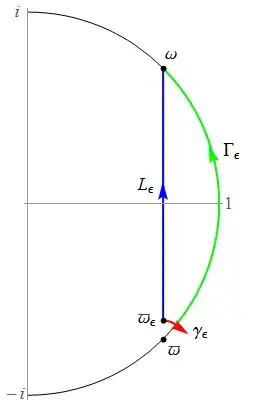
A simple solution by C.I. Valean to the wonderful and very useful generalization proposed by Sangchul Lee (see the last part of their post)
Let's prove that
$$\int_{-1}^{1} \frac{\arctan (a x)}{1+x} \log \left( \frac{1 + a^2 x^2 }{1 + a^2} \right) \textrm{d}x = \frac{2}{3} \arctan^{3}(a), \ a \in \mathbb{R}$$
or alternatively,
$$
\int_0^{1} \frac{x\arctan (a x)}{1-x^2} \log \left( \frac{1 + a^2}{1 + a^2 x^2 } \right) \textrm{d}x = \frac{1}{3} \arctan^{3}(a), \ a \in \mathbb{R}.$$
First, we observe that the second integral form is obtained by considering the first integral, which we split at $x=0$, writing as $\displaystyle \int_{-1}^{1}=\int_{-1}^0+\int_0^{1}$, then we let $x \mapsto -x$ in the first integral, which we further combine with the second one.
Let's denote our main integral by $\displaystyle I(a)=\int_{-1}^{1} \frac{\arctan (a x)}{1+x} \log \left( \frac{1 + a^2 x^2 }{1 + a^2} \right) \textrm{d}x$, and then differentiating it with respect to $a$, we write
$$I'(a)=\int_{-1}^1\left(-\frac{2 a (1-x) \arctan(a x)}{\left(1+a^2\right) \left(1+a^2 x^2\right)}+\frac{\displaystyle x \log \left(\frac{1+a^2 x^2}{1+a^2}\right)}{(1+x) (1+a^2 x^2)}\right)\textrm{d}x$$
$$=-\frac{2a}{1+a^2} \underbrace{\int_{-1}^1\frac{\arctan(a x)}{1+a^2 x^2}\textrm{d}x}_{\displaystyle 0 \text{ - the function is odd}}-\frac{1}{1+a^2}\left(\underbrace{\int_{-1}^1\frac{2ax\arctan(ax)}{1+a^2 x^2}\textrm{d}x+\int_{-1}^1\frac{\displaystyle \log \left(\frac{1+a^2 x^2}{1+a^2}\right)}{1+a^2 x^2}\textrm{d}x}_{\displaystyle 0 -\text{ following integration by parts of either integral} }\right)$$
$$\small +\frac{a^2}{1+a^2}\underbrace{\int_{-1}^1\frac{\displaystyle x\log \left(\frac{1+a^2 x^2}{1+a^2}\right)}{1+a^2 x^2}\textrm{d}x}_{\displaystyle 0 \text{ - the function is odd} }-\frac{1}{1+a^2}\underbrace{\int_{-1}^1\frac{\displaystyle \log \left(\frac{1+a^2 x^2}{1+a^2}\right)}{1+x}\textrm{d}x}_{\displaystyle J(a)}=-\frac{1}{1+a^2}J(a). \tag1$$
Next, differentiating the integral $J(a)$ with respect to $a$, we get
$$J'(a)=\frac{2a}{1+a^2}\int_{-1}^1 \frac{x-1}{1+a^2 x^2}\textrm{d}x=\frac{2a}{1+a^2}\underbrace{\int_{-1}^1 \frac{x}{1+a^2 x^2}\textrm{d}x}_{\displaystyle 0 \text{ - the function is odd}}-\frac{2a}{1+a^2}\int_{-1}^1 \frac{1}{1+a^2 x^2}\textrm{d}x$$
$$
=-2\frac{\arctan(a x)}{1+a^2} \biggr|_{x=-1}^{x=1}=-4\frac{\arctan(a)}{1+a^2},$$
from which, by integration, we can obtain that
$$\int_0^a J'(t) \textrm{d}t =J(a)-J(0)=J(a)=-4 \int_0^a \frac{\arctan(t)}{1+t^2}\textrm{d}t$$
$$=-2 \arctan^2(t) \biggr|_{t=0}^{t=a}=-2\arctan^2(a). \tag2$$
Combining $(1)$ and $(2)$, we get that $\displaystyle I'(a)=2 \frac{\arctan^2(a)}{1+a^2}$, and then we finally arrive at
$$\int_0^a I'(t) \textrm{d}t=I(a)-I(0)=I(a)=\int_{-1}^{1} \frac{\arctan (a x)}{1+x} \log \left( \frac{1 + a^2 x^2 }{1 + a^2} \right) \textrm{d}x$$
$$
=2 \int_0
^a \frac{\arctan^2(t)}{1+t^2}\textrm{d}t=\frac{2}{3}\arctan^3(a),$$
and the solution is complete.
A note: The generalization can be extremely useful as an auxiliary tool during some calculations with integrals and series.
End of story
Another form of the given generalization:
$$\color{red}{\int_{-1}^{1} \frac{\operatorname{arctanh} (a x)}{1+x} \log \left( \frac{1 - a^2}{1 - a^2 x^2 } \right) \textrm{d}x = \frac{2}{3} \operatorname{arctanh}^{3}(a), \ a \in (-1,1)}.$$
A more advanced form of the initial integral
$$\color{blue}{\small\int_{-1}^{1} \frac{\arctan (a x)\log(|x|)}{1+x} \log \left( \frac{1 + a^2 x^2 }{1 + a^2} \right) \textrm{d}x=2\int_0^{1} \frac{x\arctan (a x)\log(x)}{1-x^2} \log \left( \frac{1 + a^2}{1 + a^2 x^2 } \right) \textrm{d}x} $$
$$\color{blue}{=-\left(2\arctan^2(a)+\frac{1}{2}\log^2(1+a^2)\right) \int_0^a \frac{\arctan(x)}{x}\textrm{d}x}$$
$$\color{blue}{+4\arctan(a)\int_0^a \frac{\arctan^2(x)}{x}\textrm{d}x-2\int_0^a \frac{\arctan^3(x)}{x}\textrm{d}x}$$
$$\color{blue}{\small+2 \left(\int_0^a \frac{\log(1+x^2)}{x} \textrm{d}x \right) \left(\int_0^a \frac{\arctan(x)}{x}\textrm{d}x\right)-2\int_0^a \frac{\arctan(y)}{y}\left(\int_0^y \frac{\log(1+x^2)}{x} \textrm{d}x \right) \textrm{d}y}$$
$$\color{blue}{\small +(\log(1+a^2)-2\log (|a|)) \int_0^a \frac{\arctan(x) \log(1+x^2) }{x} \textrm{d}x-\frac{1}{2}\int_0^a \frac{\arctan(x)\log^2(1+x^2)}{x}\textrm{d}x}$$
$$\color{blue}{+2\int_0^a \frac{\arctan(x)\log (|x|) \log (1+x^2)}{x} \textrm{d}x, \ a \in \mathbb{R} \setminus \{0\}.}\ \ \ (\clubsuit)$$
The proof is obtained by the same key parametrization and then following almost the same steps as in the proof above. The use of special functions notation was avoided on purpose - this form may allow you easily see how to derive other tough integrals.
Setting $a=1$ in $(\clubsuit)$, we get a bunch of known /manageable integrals, and then obtain that
$$\color{purple}{\int_0^{1} \frac{x\arctan (x)\log(x)}{1-x^2} \log \left( \frac{1 +x^2}{2} \right) \textrm{d}x}$$
$$\color{purple}{=\frac{49 }{128}\pi \zeta (3)+\frac{1}{96} \pi \log ^3(2)+\frac{3}{128} \pi ^3 \log (2)+\frac{\pi ^4}{32}-\frac{1}{256}\psi ^{(3)}\left(\frac{1}{4}\right)}$$
$$\color{purple}{+2 \Im\biggr\{\operatorname{Li}_4\left(\frac{1+i}{2}\right)\biggr\}}.$$
Impressively, one of the larger generalizations involves forms like $$\color{green}{\int_{-1}^{1} \frac{\arctan (a x) f(bx)}{1+x} \log \left( \frac{1 + a^2 x^2 }{1 + a^2} \right) \textrm{d}x},\ \ \ (\spadesuit)$$
where we expect $f(x)$ to be a well-behaved even function, and this allows us to consider the strategy in the main proof above, and then get a reduction to a sum of two key integrals. Further, more profound generalizations are being explored.