- The following folklore theorem is in the book by Brannan and Boyce, 3rd edition. It should be named The Fundamental Theorem of (linear autonomous) ODEs due to its central role, elegance, effectiveness, and full generality. The novelty here is: the generalized eigenvectors are directly used instead of the eigenvectors. The bigger value of the multiplicity of eigenvalues, the simpler calculation is needed.
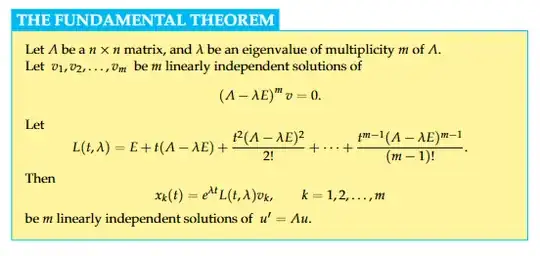
Adapted to your ODE, $u'=Au$ with
$$A =\pmatrix{1&1&1 \\ 2&1&-1 \\ -3&2&4}.$$
The characterization polynomial is $P(\lambda)=-(\lambda-2)^3$, so $\lambda=2$ is a unique eigenvalue, and of multiplicity $m=3$. We now calculate
$$A-2E =\pmatrix{-1&1&1 \\ 2&-1&-1 \\ -3&2&2},\quad
(A-2E)^2 =\pmatrix{0&0&0 \\ -1&1&1 \\ 1&-1&-1},$$
and $(A-2E)^3=0$. The generalized eigenvalues $v_1$, $v_2$, $v_3$ are exactly solutions of $(A-2E)^3v=0$, and can be chosen as simple as desired:
$$v_1=\pmatrix{1\\0\\0},\quad v_2=\pmatrix{0\\1\\0},\quad v_3=\pmatrix{0\\0\\1}.$$
Next,
\begin{align*}
L(t)&=E+t(A-2 E)+\dfrac{t^2(A-2E)^2}{2!}\\
&=\pmatrix{1&0&0 \\ 0&1&0 \\ 0&0&1}+
t\pmatrix{-1&1&1 \\ 2&-1&-1 \\ -3&2&2}+
\dfrac{t^2}{2}\pmatrix{0&0&0 \\ -1&1&1 \\ 1&-1&-1}\\[3mm]
L(t)&=\pmatrix{
1-t&t&t \\
2t-t^2/2&1-t+t^2/2&-t+t^2/2 \\
-3t+t^2/2&2t-t^2/2&1+2t-t^2/2}
\end{align*}
Hence,
$$u_1(t)=e^{2t}L(t)v_1=e^{2t}
\pmatrix{1-t\\2t-t^2/2\\-3t+t^2/2},$$
$$u_2(t)=e^{2t}L(t)v_2=e^{2t}
\pmatrix{t\\1-t+t^2/2\\2t-t^2/2},$$
$$u_3(t)=e^{2t}L(t)v_3=e^{2t}
\pmatrix{t\\-t+t^2/2\\1+2t-t^2/2},$$
and
$$u=\pmatrix{x\\y\\z}=C_1u_1(t)+C_2u_2(t)+C_3u_3(t).$$
Note: Denote $C=(C_1,C_2,C_3)^T$ and a fundamental matrix
$$X(t)=e^{2t}L(t)=e^{tA}$$
and the evolution matrix
$$U(t,s)=X(t)X^{-1}(s)=e^{(t-s)A}=e^{2(t-s)}L(t-s)$$
then we can rewrite
\begin{align*}
u(t)&=X(t)C=e^{tA}C\\
&=U(t,s)u(s)=e^{(t-s)A}u(s).
\end{align*}
Of course, there are other ways with more or less calculation, such as finding $e^{tA}$ by Fulmer's method, or Putzer's algorithm.
To compare with the way of using Jordan chains (check this Wolfram Alpha link https://www.wolframalpha.com/input?i=%5B%5B1%2C1%2C1%5D%2C%5B2%2C1%2C-1%5D%2C%5B+-3%2C2%2C4%5D%5D)
The characterization polynomial is $-(\lambda-2)^3$, so $\lambda=2$ is a unique eigenvalue. Now
$$A-2E =\pmatrix{-1&1&1 \\ 2&-1&-1 \\ -3&2&2}$$
so $(A-2E)w_1=0$ give the (only) eigenvector
$w_1=\pmatrix{0\\-1 \\1}.$
The next generalized eigenvector in the chain is from $(A-2E)w_2=w_1$ is given by
$w_2=\pmatrix{-1 \\-1\\0}.$
Similarly, the next generalized eigenvector in the chain is from $(A-2E)w_3=w_2$ is given by
$w_3=\pmatrix{-2 \\-3\\0}.$
Finally,
$$u(t)=C_1e^{2t}w_1+C_2e^{2t}(tw_1+w_2)+C_3e^{2t}\left(\frac{t^2}{2}w_1+tw_2+w_3\right)$$
or
$$u(t)=Y(t)C$$
with another (not normal) funcdamental matrix
$$Y(t)=e^{2t}\pmatrix{
0 &-1 &-2-t \\
-1&-1-t&-3-t-t^2/2 \\
1 &t &t^2/2}.
$$

