Short Answer. Expanding @orangeskid's answer, let
$$ F(x) := \frac{1}{\Psi_{\infty}(0)^2} - x - \frac{1}{\Psi_{\infty}(0)} \sum_{k=1}^{\infty} (-1)^{k} \frac{2k^2 \operatorname{sinhc}(\pi\sqrt{k^2 + 3})}{(k^2 + 1)(k^2 + 2)} x^{k^2+2}, $$
where $\operatorname{sinhc}(x) = \frac{\sinh x}{x}$ and
$$ \Psi_{\infty}(0) = \frac{\operatorname{sinhc}(\pi\sqrt{p+1})}{\operatorname{sinhc}(\pi\sqrt{p})}. $$
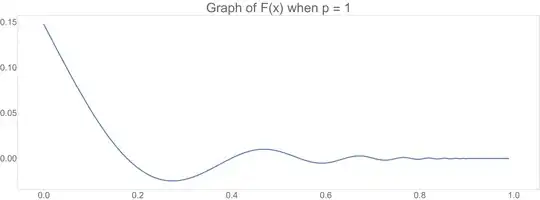
Although the above series converges only for $x \in [0, 1)$, we can prove that $F$ extends to an absolutely continuous function on $[0, 1]$ by setting $F(1) = 0$ and satisfies
$$ \int_{0}^{1} F(x) x^{n^2} \, \mathrm{d}x = 0 $$
for any $ n = 1, 2, \ldots$ Below is the graph of $f(x)$ on $[0, 1]$:
Proof of the claim.
Step 1. Consider a sequence $-\frac{1}{2} < \alpha_1 < \alpha_2 < \ldots$. Also, we define the function $f_n$ by
\begin{align*}
f_n(x)
&:= \frac{
\begin{vmatrix}
1 & x^{\alpha_1} & \cdots & x^{\alpha_n} \\
\langle 1, t^{\alpha_1} \rangle & \langle t^{\alpha_1}, t^{\alpha_1} \rangle & \cdots & \langle t^{\alpha_n}, t^{\alpha_1} \rangle \\
\vdots & \vdots & \ddots & \vdots \\
\langle 1, t^{\alpha_n} \rangle & \langle t^{\alpha_1}, t^{\alpha_n} \rangle & \cdots & \langle t^{\alpha_n}, t^{\alpha_n} \rangle
\end{vmatrix}
}{
\begin{vmatrix}
\langle t^{\alpha_1}, t^{\alpha_1} \rangle & \cdots & \langle t^{\alpha_n}, t^{\alpha_1} \rangle \\
\vdots & \ddots & \vdots \\
\langle t^{\alpha_1}, t^{\alpha_n} \rangle & \cdots & \langle t^{\alpha_n}, t^{\alpha_n} \rangle
\end{vmatrix}
},
\end{align*}
where $\langle g(t), h(t) \rangle = \int_{0}^{1} g(t)h(t) \, \mathrm{d}t$ denotes the inner product on $L^2([0,1])$. Then, as explained in @orangeskid's answer, for $\alpha > -\frac{1}{2}$ with $\alpha \notin \{\alpha_1, \alpha_2, \ldots\}$,
$$ x^{\alpha} = f_n + (x^{\alpha} - f_n) $$
is an orthogonal decomposition of $x^{\alpha}$, where $x^{\alpha} - f_n \in V_n := \operatorname{span}(x^{\alpha_1}, \ldots, x^{\alpha_n})$ and $f_n \perp V_n$. Since $V_n$ is increasing in $n$, this implies that $f_n$ converges in $L^2([0,1])$. Moreover,
$$ \|f_n\|^2
= \operatorname{dist}(t^{\alpha}, V_n)^2
= \frac{G(t^{\alpha}, t^{\alpha_1}, \ldots, t^{\alpha_n})}{G(t^{\alpha_1}, \ldots, t^{\alpha_n})}, $$
where $G(v_1, \ldots, v_n) = \det[\langle v_i, v_j \rangle]$ is the Gram determinant.
Step 2. We can expand the determinant in the numerator along the first row and compute the coefficients using Cauchy determinants. After a bit of computations, it turns out that
\begin{align*}
f_n(x) = x^{\alpha} - \sum_{k=1}^{n} \frac{\psi_{n,k}(\alpha_k)}{\psi_{n,k}(\alpha)} x^{\alpha_k},
\end{align*}
where $\phi_{n,k}(\alpha)$ is the rational function in $\alpha$ given by
$$ \psi_{n,k}(\alpha)
:= (\alpha_k - \alpha) \Psi_n(\alpha)
\qquad\text{and}\qquad
\Psi_n(\alpha)
:= \frac{\prod_{j=1}^{n} (\alpha_j + \alpha + 1)}{\prod_{j=1}^{n} (\alpha_j - \alpha)}. $$
A similar computation also shows that
$$ \| f_n \|^2
= \frac{\prod_{j=1}^{n} (\alpha - \alpha_j)^2}{(2\alpha+1)\prod_{j=1}^{n} (\alpha + \alpha_j + 1)^2}
= \frac{1}{(2\alpha+1)\Phi_n(\alpha)^2}. $$
Step 3. Now let us specialize to the case where $(\alpha_k)$ is of the form $\alpha_k = k^2 + p$. Then Euler's reflection formula for the gamma function and Stirling's approximation show that
\begin{align*}
\prod_{j=1}^{n} (j^2 - q)
= \frac{(n-\sqrt{q})!(n+\sqrt{q})!}{(-\sqrt{q})!\sqrt{q}!}
= (n!)^2 \operatorname{sinc} (\pi \sqrt{q}) \prod_{j=n+1}^{\infty} \frac{j^2}{j^2 - q},
\end{align*}
where $\operatorname{sinc}(x) = \frac{\sin x}{x}$ is the (unnormalized) sinc function and $s! = \Gamma(s+1)$. Plugging this to $\Phi_n(\alpha)$, we get
\begin{align*}
\Psi_{n}(\alpha)
&= \frac{\operatorname{sinhc}(\pi\sqrt{p+\alpha+1})}{\operatorname{sinc}(\pi\sqrt{\alpha - p})}
\prod_{j=n+1}^{\infty} \frac{j^2 + p - \alpha}{j^2 + p + \alpha + 1}.
\end{align*}
and
\begin{align*}
\psi_{n,k}(\alpha_k)
&= \lim_{s \to k} \left( k^2 - s^2 \right) \Psi_{n}(s^2 + p) \\
&= (-1)^{k-1} 2k^2 \operatorname{sinhc}(\pi\sqrt{\smash[b]{k^2 + 2p + 1}})
\prod_{j=n+1}^{\infty} \frac{j^2 - k^2}{j^2 + k^2 + 2p + 1}.
\end{align*}
Note that both $\Psi_n(\alpha)$ and $\psi_{n,k}(\alpha_k)$ converges as $n \to \infty$:
\begin{gather*}
\Psi_{\infty}(\alpha)
:= \lim_{n\to\infty} \Psi_{n}(\alpha)
= \frac{\operatorname{sinhc}(\pi\sqrt{p+\alpha+1})}{\operatorname{sinhc}(\pi\sqrt{p-\alpha})},
\\[0.5em]
\lim_{n\to\infty} \psi_{n,k}(\alpha_k)
= (-1)^{k-1} 2k^2 \operatorname{sinhc}(\pi\sqrt{\smash[b]{k^2 + 2p + 1}}).
\end{gather*}
Moreover, it is clear from the formula above that
$$ |\psi_{n,k}(\alpha_k)| \leq \frac{2k^2}{\pi\sqrt{k^2 + 2p + 1}} e^{\pi\sqrt{k^2 + 2p + 1}}$$
for all $1 \leq k \leq n$. Therefore, by the dominated convergence theorem, for each $x \in [0, 1)$,
\begin{align*}
f(x)
&:= \lim_{n\to\infty} f_n(x) \\
&= x^{\alpha} - \lim_{n\to\infty} \frac{1}{\Psi_n(\alpha)} \sum_{k=1}^{n} \frac{\psi_{n,k}(\alpha_k)}{k^2 + p - \alpha} x^{k^2 + p} \\
&= \bbox[color:navy;border:1px dotted navy;padding:3px]{x^{\alpha} + \frac{1}{\Psi_{\infty}(\alpha)} \sum_{k=1}^{\infty} (-1)^{k} \frac{2k^2}{k^2 + p - \alpha} \operatorname{sinhc}(\pi\sqrt{\smash[b]{k^2 + 2p + 1}}) x^{k^2+p}.}
\end{align*}
Of course, this $f(x)$ must coincide with the $L^2$-limit of $f_n$. Therefore, for each $n = 1, 2, \ldots,$
$$ \int_{0}^{1} f(x)x^{n^2+p} \, \mathrm{d}x
= \lim_{N \to \infty} \int_{0}^{1} f_N(x)x^{n^2+p} \, \mathrm{d}x
= 0. $$
Below is the graph of $f(x)$ for $x \in [0, 1)$ when $\alpha = 0$ and $p = 1$.
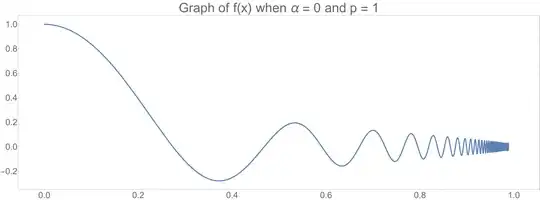
Step 4. The function $f$ is almost good, but the issue is that $f$ seems suffering from the discontinuity at $x = 1$. To make amend of this, we now fix $\alpha = 0$, so that the corresponding $f$ is given by
$$ f(x)
= 1 + \frac{1}{\Psi_{\infty}(0)} \sum_{k=1}^{\infty} (-1)^{k} \frac{2k^2}{k^2 + p} \operatorname{sinhc}(\pi\sqrt{\smash[b]{k^2 + 2p + 1}}) x^{k^2+p}. $$
Then
$$ \int_{0}^{1} f(x) \, \mathrm{d}x
= \langle f, 1 \rangle
= \| f \|^2 + \underbrace{\langle f, 1-f \rangle}_{=0}
= \frac{1}{\Psi_{\infty}(0)^2}. $$
Using this, we define $F : [0, 1] \to \mathbb{R}$ as
\begin{align*}
F(x)
&= \int_{x}^{1} f(t) \, \mathrm{d}t \\
&= \int_{0}^{1} f(x) \, \mathrm{d}x - \int_{0}^{x} f(x) \, \mathrm{d}x \\
&= \bbox[color:navy;border:1px dotted navy;padding:3px]{\frac{1}{\Psi_{\infty}(0)^2} - x - \frac{1}{\Psi_{\infty}(0)} \sum_{k=1}^{\infty} (-1)^{k} \frac{2k^2 \operatorname{sinhc}(\pi\sqrt{\smash[b]{k^2 + 2p + 1}})}{(k^2 + p)(k^2 + p + 1)} x^{k^2+p + 1}.}
\end{align*}
Then $F$ is absolutely continuous on all of $[0, 1]$. Also, performing integration by parts,
\begin{align*}
0
= \int_{0}^{1} f(x)x^{n^2+p} \, \mathrm{d}x
&= [ -F(x)x^{n^2+p} ]_{0}^{1} + (n^2 + p - 1)\int_{0}^{1} F(x) x^{n^2+p-1} \, \mathrm{d}x
\end{align*}
and hence
$$ \int_{0}^{1} F(x) x^{n^2+p-1} \, \mathrm{d}x = 0, \qquad n = 1, 2, \ldots $$
So by choosing $p = 1$, the main claim follows.


