88

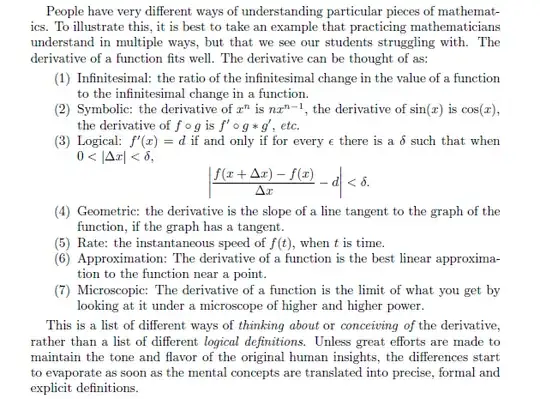
In Thurston's superb essay On proof and progress in mathematics, he makes this observation:
enter image description here

Of course there is always another subtlety to be gleaned, but I would like to at least think that I have absorbed the main intuition behind each element of the above list. However:
enter image description here

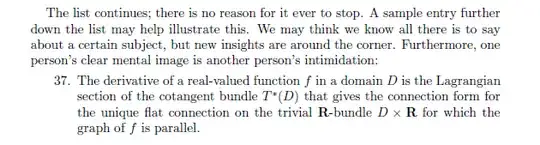
Differential geometry is not my strong suit, unfortunately, so I have had trouble trying to unravel this even at a formal level. Manifolds and vector bundles themselves I am comfortable with, but with connections and connection forms I have trouble moving between formalism and intuition, and "Lagrangian section" is not a term I've come across (though I can find its definition online).

So, I have some questions about Thurston's 37th conception of the derivative:

  • To use Thurston's words: can someone "translate into precise, formal, and explicit definitions" making the "differences start to evaporate" between 37 and the differential of a smooth map?

  • What is the intuition behind it - why should the notion of "Lagrangian section" appear here, what does it mean (intuitively) when a connection makes the graph of $f$ parallel, etc.?

My hope is also for answers that are as accessible to as many people as possible, though of course, any explanation has to assume some level of background knowledge.

Volk
  • 2,970
Zev Chonoles
  • 133,510
  • 36
    But isn't it obvious? ;) – Emily Jul 22 '13 at 20:05
  • 1
    Zev, I'm just curious since you haven't responded to my "tour de force" :) What, if anything, would you like me to try to clarify? And I hope you'll eventually get over your fear/dislike of connections. They're important and quite natural ... At the easiest level of a surface in $\mathbb R^3$, the Riemannian connection gives the twisting seen by an inhabitant of the surface. But I'm confident you know all this. – Ted Shifrin Aug 01 '13 at 14:42
  • I love that section. You might also be interested in Grothendieck's definition of a group: see the post on it by Terence Tao: http://terrytao.wordpress.com/2009/10/19/grothendiecks-definition-of-a-group/ (which also contains a similar exercise for groups). – ShreevatsaR Aug 17 '13 at 02:41
  • 1
    I wonder about the 24th way of thinking about derivative – Buddha Sep 09 '14 at 09:04

2 Answers2

84

Zev, I honestly think Thurston's tongue was firmly implanted in his cheek when he wrote this. So the key point is that a connection on a vector bundle gives you (a) a means of differentiating sections (generalizing the covariant derivative for a Riemannian manifold as a connection on the tangent bundle) and (b) a notion of parallelism (generalizing the notion of parallel transport of tangent vectors).

As you suggested, the differential of $f\colon D\to\mathbb R$ gives you a $1$-form, hence a section of the cotangent bundle $T^*D$. With the standard symplectic structure on $T^*D$, Lagrangian sections (i.e., ones that pull back the symplectic $2$-form to $0$) are precisely closed $1$-forms. [This is tautological: If $q_i$ are coordinates on $D$, a $1$-form on $D$ is given by $\omega = \sum p_i\,dq_i$ for some functions $p_i$. By definition, $d\omega = \sum dp_i\wedge dq_i$, and this is (negative of) the pullback by the section $\omega$ of the standard symplectic form $\sum dq_i\wedge dp_i$ (with canonical coordinates $(q_i,p_i)$ on $T^*D$).]

Now, a connection form on a rank $k$ vector bundle $E\to M$ is a map $\nabla\colon \Gamma(E)\to\Gamma(E\otimes T^*M)$ (i.e., a map from sections to one-form valued sections) that satisfies the Leibniz rule $\nabla(gs) = dg\otimes s + g\nabla s$ for all sections $s$ and functions $g$. In general, one specifies this by covering $M$ with open sets $U$ over which $E$ is trivial and giving on each $U$ a $\mathfrak{gl}(k)$-valued $1$-form, i.e., a $k\times k$ matrix of $1$-forms; when we glue open sets these matrix-valued $1$-forms have to transform in a certain way in order to glue together to give a well-defined $\nabla$.

OK, so Thurston takes the trivial line bundle $D\times\mathbb R$. A connection is determined by taking the global section $1$ and specifying $\nabla 1$ to be a certain $1$-form on $D$. The standard flat connection will just take $\nabla 1 = 0$ and then $\nabla g = dg$. I'm now going to have to take some liberties with what Thurston says, and perhaps someone can point out what I'm missing. Assume now that our given function $f$ is nowhere $0$ on $D$. We can now define a connection by taking $\nabla 1 = -df/f$. Then the covariant derivative of the section given by the function $f=f\otimes 1$ [to which he refers as the graph of $f$] will be $\nabla(f\otimes 1) = df - f(df/f) = 0$, and so this section is parallel.

Slightly less tongue-in-cheek, parallelism is the generalization of constant (in a vector bundle, we cannot in general say elements of different fibers are equal), and covariant derivative $0$ is the generalization of $0$ derivative.

Ted Shifrin
  • 127,912
3

Alright, this is a very old question with a very popular and comprehensive answer. However, after puzzling over this for a bit I think I have a slightly different approach to Prof. Shifrin's which I, probably incorrectly, believe may be closer to what Thurston had in mind. Consider the trivial $\mathbb{R}$-line bundle;

$$ \pi:D\times\mathbb{R} \rightarrow D$$

The sections of this bundle take values, not in $\mathbb{R}$ but in $D\times\mathbb{R}$. So, the "graph" of some function $f \in C^{\infty}(D)$, which can be defined as;

$$\tilde{f}(p)=[p,f(p)]$$

for some point $p \in D$ is simply a section of our trivial $\mathbb{R}$ bundle.

In order for this section to be "parallel" we need the following to hold;

$$\nabla\tilde{f}\space\big|_p=[p,0]$$

That is, we need the fiber component of the covariant derivative of our section $\tilde{f}$ to be equal to $0$ for all $p\in D$. Now, in order to consider the connection one-form $\omega$ on this bundle we will consider our trivial bundle as a principal bundle with structure group $\mathbb{R}$ under addition. Therefore, the Lie algebra of our group is, again, $\mathbb{R}$. So, we will have;

$$\text{proj}_2(\nabla_X\tilde{f})=0$$

Where $\text{proj}_2$ is the projection of the fiber component.

$$0=\text{proj}_2(\text{hor}(d\tilde{f}(X)))$$

$$=\text{proj}_2(d\tilde{f}(X)-\text{ver}(d\tilde{f}(X)))$$

Here, I have used the fact that the tangent vectors of our total space can always be decomposed as a direct sum of vertical vectors along the fibers and horizontal vectors which project down to tangent vectors on the base manifold. Because the vertical vectors are along the fibers, which are each the Lie group $\mathbb{R}$, they can be generated by the Lie algebra via differentiation of the curves created by the exponential map. Therefore,

$$0=df(X)-\text{proj}_2([0_{TM},\frac{d}{dt}(f+\exp(t\omega(X))])$$ $$=df(X)-\frac{d}{dt}(f+\exp(t\omega(X))$$ $$=df(X)-\omega(X)$$

$$\boxed{\therefore\omega = df}$$

So, if we let $\omega = df$ then the "graph" of $f$ must be a parallel section of the trivial bundle. Additionally, the curvature of our connection is given by;

$$F^{\nabla}=d\omega+[\omega,\omega]$$

which, because the structure group $\mathbb{R}$ is abelian, reduces to;

$$F^{\nabla}=d\omega$$

We then vacuously arrive at;

$$F^{\nabla}=d\omega=d(df)=0$$

So the connection is flat, as desired.

Volk
  • 2,970
  • First, please do not use $d$ for points in $D$ when exterior derivatives are flying around in plain view. But I get your point that Thurston actually did intend to have $df$ be the connection form itself. By the way, the curvature of any connection on any line bundle is always zero. – Ted Shifrin Jul 13 '25 at 23:47
  • 1
    @TedShifrin That's fair... using $d$ for points in $D$ is a bit confusing in this context. I'll make an edit. In regards to your last statement about the curvature of the connections on a line bundle, I'm a bit confused... Couldn't we have, for example, the bundle $\mathbb{R} \rightarrow \mathbb{R}^2$ with the connection form being $\omega=x\space dy$. This would imply that $F^{\nabla}=d\omega=dx \wedge dy$... Or am I missing something obvious? – Volk Jul 14 '25 at 17:14
  • 1
    Well, I typed too quickly. Any real line bundle on a simply connected space is orientable, hence trivial. But of course trivial bundles can have non-flat connections if the base space has dimension $>1$. – Ted Shifrin Jul 14 '25 at 17:35
  • @TedShifrin Lol okay... Just getting a sanity check. Thank you for the feedback! – Volk Jul 14 '25 at 17:50
  • 1
    This seems to be the correct answer tbh. Thurston was probably thinking of $D \times \mathbb R$ as an affine/principal bundle, not a vector bundle as in the accepted answer. This is more philosophically correct anyway, since the derivative of $f$ is independent of translation (adding a constant function). – Frank Oct 18 '25 at 20:38