The answer to your question is "yes" : knowing the length of line segment AB is enough. Why that ?
Consider the following picture I have made with Matlab, with a certain choice of coordinates I am going to explain.
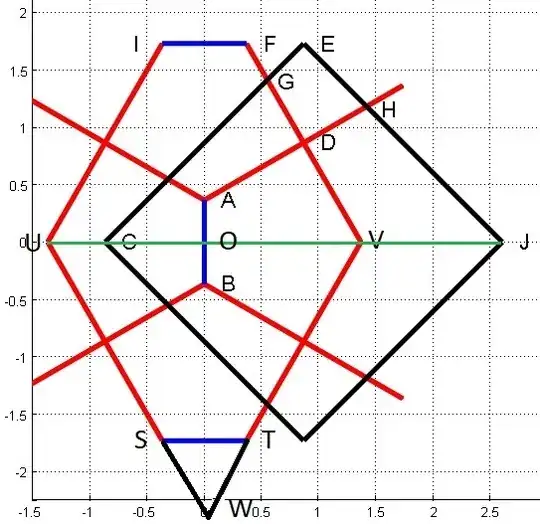
The origin $O$ is the center of the elongated hexagon. The $x$ and $y$ axes are given by $OV$ and $OA$. The axis graduation is going to be a consequence of the following choice : I have considered that the "arms" of "red cross" with center $D$ have unit length, i.e., $DA=DF=b=\cdots=1$. The same for the 3 other crosses, of course.
From there, we are going to show that
$$a:=AB=\sqrt{3}-1\tag{1}$$
Explanation : Triangles $STW$ and $UVW$ are equilateral with resp. sidelengths $a$ and $a+2$. Therefore, $UV=a+2 \implies OV=1+\frac{a}{2}$. But $OV$ can be computed in another way, as the sum of the projections of unit length segments $AD$ and $DV$ onto the horizontal axis, giving ;
$$OV=\cos(\frac{\pi}{6})+\cos(\frac{\pi}{3})=\frac{\sqrt{3}}{2}+\frac{1}{2}$$
Equating the two expressions for $OV$, we get (1).
The polar angles (angles wrt horizontal axis) of straight lines $AD, FD, CE$ are resp. $\frac{\pi}{6}, -\frac{\pi}{3}, \frac{\pi}{4}$.
Let $p=\cos\frac{\pi}{6}=\frac{\sqrt{3}}{2} \ ; \ k=p-\frac{1}{2}$.
It is not difficult from there to obtain the following coordinates :
$$A(0,k), B(0,-k), C(-p,0), D(p,p)$$
$$E(p,2p), F(k,2p), I(-p,2p), J(3p,0) \tag{2}$$
(in particular, from (2), we obtain : $c=DE=\sqrt{6}$ confirming your relationship $c=\sqrt{6}b$).
(1) allows different calculations, in particular coordinates of $G$ and $H$ (for example, for $G$, by considering it as the intersection of lines $DF$ and $CE$). Knowing these coordinates, one is able to compute the lengths you denote by $d_1$ and $d_2$.
The computation of lengths $f_1$ and $f_2$ follows the same logic.
Edit (2023/01/22)
I just realized that this paving of the plane is plainly a Voronoi diagram ! Here is how (I can give more details if you are interested); setting $r=\sqrt{3}$, we have for example the Voronoi cells'centers :
$$P,P'=(\pm \frac12(3-r), 0), \ \ Q,Q'=(0,\pm \frac32(r-1))$$
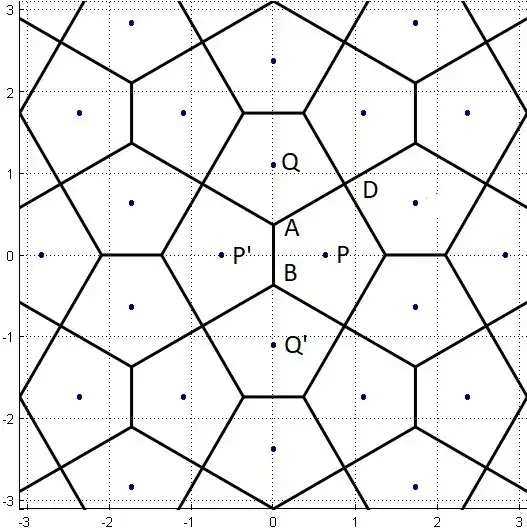
Here is the corresponding Matlab program :
 clear all;close all;hold on;
 axis equal;
 r=sqrt(3);
 d=(3-r)/2; %  attempt other values
 a=2;
 axis([-a,a,-a,a]);
 X=[];Y=[];S=[-1,1];
 for x=-a:a
    for y=-a:a
       m=mod(x+y,2);
       X=[X,x*r+m*d*S];
       Y=[Y,y*r+(m-1)*d*S];
    end;
 end;
 scatter(X,Y,30,'filled');
 g=voronoi(X,Y);
 set(g,'color','k','linewidth",2);


