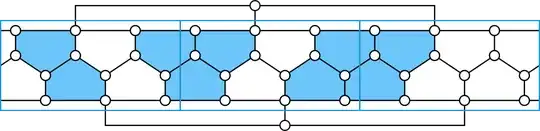
Let us prove that for any integer $k\geq8$ there exists a 3-connected
pentagulation with a cycle of length $k$.
First, how can we construct a 3-connected pentagulation with a large number of vertices. To do this, take the dodecahedral graph and put a new dodecahedral graph inside some face of it. This process can go on as long as you like.
Now consider three cases.
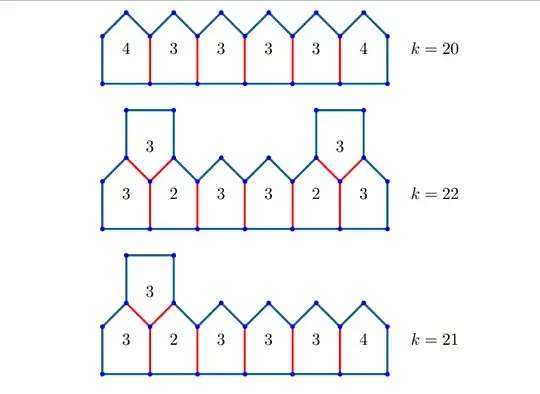
- Let $k=3s+2=4+3(s-2)+4$. Choose a sufficiently large 3-connected pentagulation and in it consider a chain of $s$ faces where each face has exactly one edge in common with its neighbor. The edges of this chain give a cycle of length $3s+2$.
- Let $k=3s$. Choose a chain of $s-1$ faces. Then add to the first face of this chain a face that has by one common edge with two adjacent faces of our chain.
- Let $k=3s+1$. If $s\geq5$, then it is similar to case 2. The cases $k=10$ and $k=13$ are special.
The figure illustrates the cases $k=20,21,22$. Inside each face there is the number of edges of that face included in the cycle.
Addendum.
I find it useful to give another universal reasoning.
- First note that the interior of a triangle can be divided into pentagons as shown in the figure.
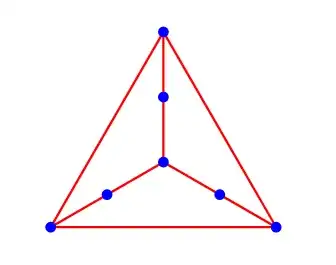
Now let's inscribe in each of the three pentagons the dodecahedral graph.
Let us call this graph $P$. The graph $P$ is a planar $3$-connected graph.
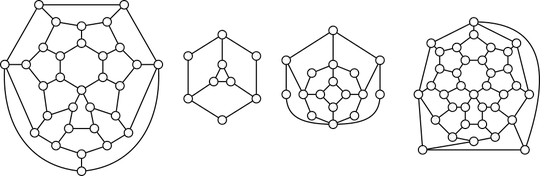
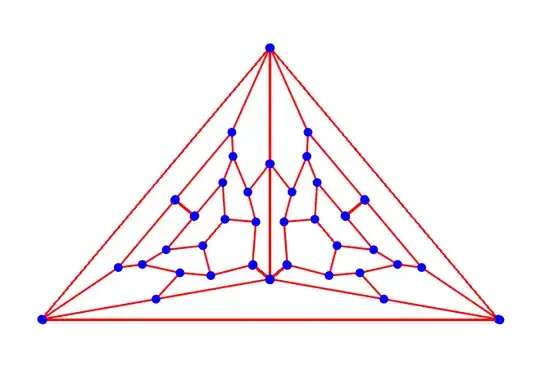
Another way to partition a triangle into pentagons can be found here (we will call it $Q$).
For completeness, here is the $Q$ figure.
- Now let $C_k$ ($k\geq3$) be an arbitrary cycle whose vertices form a regular $k$-gon in the plane. Triangulate the interior and exterior of this cycle. Then in each triangle we inscribe graph $P$ or $Q$. The result is a $3$-connected pentagulation with cycle $C_k$.
Note of February 21. I corrected one inaccuracy in my answer.
One more remark.
In point 1 it is actually enough to inscribe the dodecahedral graph into only two of the three pentagons, the result is a graph with $37$ vertices, which is isomorphic to the graph $Q$.