5

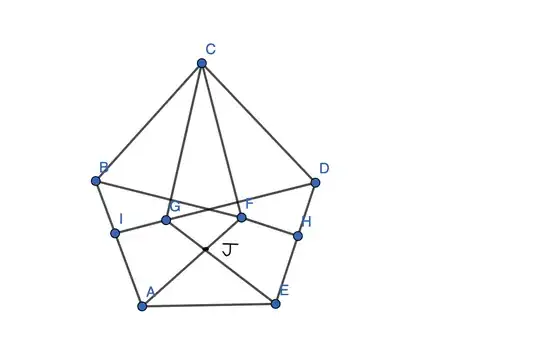
In the figure below, all line segments between two distinct points are of length 2, except line segments involving I,H, or J are not necessarily 2. Also, $\angle FHE = \angle GIA = 90^\circ$. Find the areas of quadrilaterals $FJHE, GIAJ, BIGC,GJFC, FHDC$ and of triangle $AJE$.

a pentagon

I know how to find the area of the entire pentagon, and I think the three quadrilaterals $BIGC, GJFC, FHDC$ are congruent. I also think the two other quadrilaterals are congruent. Also, I think $\angle FCD = 30^\circ$. One can probably find a lot of angles via angle-chasing. For instance, $\angle AJE = 90^\circ$. But then if I assume $\angle GED = 60^\circ$ and try to apply the Pythagorean theorem twice in triangles $FJE$ and $FEH$, I get a contradiction. I'm not sure what I'm doing wrong.

user1127
  • 479
  • 3
    I assume that all lengths not involving H and I are 2. Basically you have a Moser spindle graph with all lengths the same, but with FH and GI added. Note that if FH and GI are perpendicular to DE and AB respectively, then they are not extensions of BF and DG, i.e. B-F-H and D-G-I are not straight lines. The diagram is misleading in that respect. – Jaap Scherphuis May 24 '23 at 14:30
  • Presumably lengths involving $J$ are also not 2, like $JG, JF, JE, JA$. – Calvin Lin May 24 '23 at 15:26
  • @user1127 No, we're just asking for clarity on "all line segments between two distinct points are of length 2". For example, is $IB = IA = IG = 2$? (Japp's comment) Is $JA = JE = AE = 2$? (my comment). $\quad$ There is a configuration where the "Main lines" are all of length 2, comprising of 2 equilateral triangles stacked on their bases, and then rotated slightly. – Calvin Lin May 26 '23 at 14:22
  • Can you put the edit where it's appropriate, and not at the very end? In general, you want that information up front when it's relevant, instead of reading your proof attempts then realizing that there's more information. – Calvin Lin May 26 '23 at 20:37
  • Is $AE=2$? It doesn't look so in the figure. Are $CGA$ aligned? And CFE? – Intelligenti pauca May 27 '23 at 11:41
  • @Intelligentipauca yes to your first question and no to your other questions. – user1127 May 29 '23 at 19:09
  • If no other constraints are known, then the figure is not uniquely defined and no definite answer is possible. – Intelligenti pauca May 29 '23 at 20:01
  • I uploaded here an interactive diagram: https://www.geogebra.org/m/zkar2zyb – Intelligenti pauca May 29 '23 at 20:08
  • Unless I misinterpreted your words. Is it $BF=DG=AF=EG=2$? – Intelligenti pauca May 30 '23 at 13:22
  • @Intelligenti pauca : I think yes. It seems to me you think that $B,F,H$ are collinear and that $I,G,D$ are collinear, but the question does not say so. – mathlove May 30 '23 at 15:05

2 Answers2

1

Hint: Note that in $\triangle ACE$, $AE=2, AC=CE=2\sqrt 3$. Thus, $AG=2\sqrt 3-2$, $GI=\sqrt 3-1$.
Also, $\angle JAE=\arccos \frac{1}{2\sqrt 3}-\frac{\pi}{6}$. This should be enough to find the required areas.

Vasili
  • 11,817
  • 1
  • 19
  • 31
  • But isn’t angle ACE =30, forcing angle GJF to be 90 and yielding a contradiction to your claim about angle JAE? – user1127 May 26 '23 at 13:38
  • @user1127 No, $ACE$ isn't 30 degrees. Can you use cosine rule to determine $ \cos \angle ACE$? $\quad$ Likewise, why must $ \angle GJF = 90^\circ$? – Calvin Lin May 26 '23 at 14:26
  • No, $\angle ACE$ is about $33.6^\circ$ – Vasili May 26 '23 at 16:13
  • @CalvinLin actually, I think the above answer is incorrect; how did they know that $AG. = 2\sqrt{3}-2$? I think this assumes that $A,G,C$ are collinear. Then by symmetry, $C,F,E$ would be collinear. But then angle $GCF$ would be 30 degrees, a contradiction. In other words, $AG$ is not an angle bisector. We know $\angle CAE = \arccos 1/(2\sqrt{3})$ – user1127 May 26 '23 at 20:31
  • (Responding because you mentioned me. If you have concerns about the proof, you should ask them directly) I wasn't evaluating/proofreading the answer. I was only responding to determining $\angle ACE$. $\quad$ If they found $\angle GEA$, then they could get $GA$ without any assumptions about $AGC$. – Calvin Lin May 26 '23 at 20:33
  • @Vasili could you explain how you got that $GA = 2\sqrt{3}-2$? You don't seem to have computed $\angle GEA$ anywhere. – user1127 May 26 '23 at 21:50
1

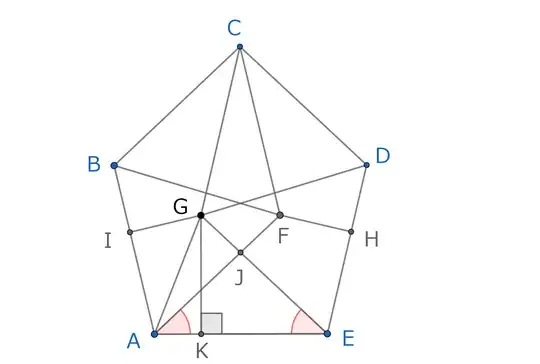
enter image description here

Since $AC=2\sqrt 3$, we have $\angle{CAE}=\arccos\bigg(\frac{1}{2\sqrt 3}\bigg)$, so $$\angle{JAE}=\angle{CAE}-\angle{CAJ}=\arccos\bigg(\frac{1}{2\sqrt 3}\bigg)-\frac{\pi}{6}=\angle{JEA}$$

Let $\alpha:=\arccos(\frac{1}{2\sqrt 3})-\frac{\pi}{6}$.

Let $K$ be a point on $AE$ such that $GK\perp AE$.

Then, we get $$KE=2\cos\alpha,\qquad GK=2\sin\alpha,\qquad AK=2-KE=2-2\cos\alpha$$

So, we have $$\tan\angle{GAK}=\frac{GK}{AK}=\frac{\sqrt 3+\sqrt{11}}{2}$$ which implies $$\angle{GAK}=\arctan\bigg(\frac{\sqrt 3+\sqrt{11}}{2}\bigg)$$

Applying the law of cosines to $\triangle{AGE}$, we obtain $$GA=\sqrt{2^2+2^2-2\cdot 2^2\cos\alpha}=\sqrt{\frac{18-2\sqrt{33}}{3}}$$

So, we get $$\begin{align}GI&=GA\sin(60^\circ+\alpha-\angle{GAK})=\frac{\sqrt 3+\sqrt{11}}{6} \\\\IA&=\sqrt{GA^2-GI^2}=\frac{13-\sqrt{33}}{6}\end{align}$$

Now, let us find the areas of the quadrilaterals.

$$\begin{align}\color{red}{\text{Area}(FJEH)=\text{Area}(GJAI)}&=\text{Area}(GIA)+\text{Area}(GAE)-\text{Area}(AJE) \\\\&=\frac{GI\times IA}{2}+\frac 12\times 2\times 2\times\sin\alpha-\frac 12\times 2\times\tan\alpha \\\\&=\frac{\sqrt 3+5\sqrt{11}}{36}+\frac{3\sqrt{11}-\sqrt 3}{6}-\frac{3\sqrt 3-\sqrt{11}}{2} \\\\&=\color{red}{\frac{41\sqrt{11}-59\sqrt 3}{36}}\end{align}$$


Using $$IB=2-IA=\frac{\sqrt{33}-1}{6},\quad BG=\sqrt{IG^2+IB^2}=\frac{2}{3}\sqrt 3$$ we get $$\begin{align}\color{blue}{\text{Area}(DHFC)=\text{Area}(BIGC)}&=\text{Area}(BIG)+\text{Area}(CBG) \\\\&=\frac{IB\times IG}{2}+\frac{BG}{2}\sqrt{2^2-\bigg(\frac{BG}{2}\bigg)^2} \\\\&=\frac{\sqrt{11}+5\sqrt 3}{36}+\frac{\sqrt{11}}{3} \\\\&=\color{blue}{\frac{5\sqrt 3+13\sqrt{11}}{36}}\end{align}$$


$$\begin{align}\color{orange}{\text{Area}(GJFC)}&=\text{Area}(CBAF)-\text{Area}(GJAI)-\text{Area}(BIGC) \\\\&=2\times\frac{2^2\sqrt 3}{4}-\frac{41\sqrt{11}-59\sqrt 3}{36}-\frac{5\sqrt 3+13\sqrt{11}}{36} \\\\&=\color{orange}{\frac{126\sqrt 3-54\sqrt{11}}{36}}\end{align}$$


$$\text{Area}(AJE)=\frac 12\times 2\times\tan\alpha=\frac{3\sqrt 3-\sqrt{11}}{2}$$


We have the followings :

  • $AG=\sqrt{\frac{18-2\sqrt{33}}{3}}$

  • $A,G,C$ are not collinear.

  • $\angle{FCD}=\angle{GCB}=\arcsin(\frac{\sqrt{11}}{6})\approx 33.56^\circ$

  • $\angle{AJE}=\frac{4\pi}{3}-2\arccos(\frac{1}{2\sqrt 3})\approx 93.58^\circ$

  • $BIGC$ is congruent to $DHFC$.

  • $BIGC$ is not congruent to $GJFC$.

  • $\angle{ACE}=\arccos(\frac 56)\approx 33.58^\circ$

mathlove
  • 155,494