35

I want to know the minimum number of lines needed to touch every square of an $n \times n$ grid. The only added rule is that the line has to pass inside the square, not on the edge/corner. I have found a solution for $n-1$ lines for all $2<n\le 10$ but not with fewer lines. I figure you can represent the lines by the squares they pass through, thus making a finite amount of "lines", but I don't have many further ideas. Here is an example of what I mean by "covering a square". The line just needs to pass through any part of the square: enter image description here

Here is also a solution for a $3 \times 3$ grid with 2 lines: enter image description here

RobPratt
  • 52,643
  • 11
    I am not sure if it is of any help, but we can at least define lower and upper bounds for the solution. The minimal number must be between $\frac{n^2}{2,n-1}$ and $n$. Since the most efficient line covers $2,n-1$ squares and there is a trivial solution of $n$ horizontal (or vertical) lines. – Daniel Cunha Aug 21 '23 at 17:10
  • 4
    see https://twitter.com/oliverslay/status/1130431837766127616 – vallev Aug 24 '23 at 15:01
  • 2
    If one enumerates all sets of squares corresponding to these lines it is then possible to write a linear program with binary variables ($=1$ for line used, $=0$ for line not used) with as constraints the requirement that each square is covered by at least one line, then find the minimum for specific values of $n$. – Fabius Wiesner Aug 29 '23 at 15:53
  • It might be interesting to consider the covered n-by-n grid as an 'all-ones' matrix. By 'stretching' it so it becomes a binary word of length $n^2$ composed by XOR of bit strings of the geometric line constraint. – vallev Aug 30 '23 at 10:02
  • 1
    @BillyJoe it would be interesting to see for what $n$ this would feasibly give the answer! – Bob Krueger Aug 30 '23 at 14:31
  • 1
    @BillyJoe, furthermore, the proof sketch by fedja is essentially a relaxation of the program you describe: assign weights to each square, and upper bound the total weight of the squares covered by a single line. Then the number of lines needed is at least the total weight of the grid divided by the maximum weight of a line. If your integer program is too slow, this relaxation may be faster. – Bob Krueger Aug 30 '23 at 15:07
  • @BobKrueger we have less than OEIS A141255 "discrete lines", e.g. $4492$ for $n=10$, $280916$ for $n=30$, so it might be feasible for small values of $n$. – Fabius Wiesner Aug 30 '23 at 16:52
  • 3
    Oh, it is great that nice problems do not lie vacant but they are permanently rediscovered. Exactly this problem occurred to me circa 1998. There was an intention to propose this as an IMO problem, but I could not find a general solution, so only wrote down the sole formulation many years later (see this collection of problems, page 5, Section 6, Problem 9, 2016). – Giedrius Alkauskas Nov 10 '23 at 16:44
  • 2
    You may be interested in the version where circles are used instead of lines. https://puzzling.stackexchange.com/questions/126173/circles-crossing-every-cell-of-an-nxn-grid – Dmitry Kamenetsky Apr 04 '24 at 01:04

4 Answers4

15

I have worked on and asked many others about this problem. I think this is a hard problem. According to the authors of the paper below, it is an open problem, as of 2013.

I claim to have a construction of $n-1$ lines for all $n$, but I never wrote it down formally. I believe this to be the correct answer, but lower bound proofs are quite difficult. For small $n$ (say, $n \leq 9$), I could prove a matching lower bound by some ad hoc arguments.

If you want to have an interactive go at this problem, check out my website: https://bob1123.github.io/website/linecovering.html.
Update (2023-11-09): https://bob1123.github.io/linecovering.html

A trivial lower bound is $n/2$. A better lower bound of $2n/3$ is known. See Eyal Ackerman and Rom Pinchasi. "Covering a chessboard with staircase walks." Discrete Mathematics 313.22 (2013): 2547-2551. They generalize from lines to "monotone paths," i.e. contiguous sets of squares which always move down (or stay the same) when going right or always move up (or stay the same) when going right. When covering with monotone paths, the $2n/3$ is tight, so to get to $n-1$ you need to exploit the special structure of lines.

I will note that the only follow-up I know of is Kerimov, Azer. "Covering a rectangular chessboard with staircase walks." Discrete Mathematics 338.12 (2015): 2229-2233. They generalize from $n \times n$ board to an $n \times m$ board.

CiaPan
  • 14,004
Bob Krueger
  • 6,627
  • 2
  • 16
  • 29
8

Consider a continuous function $w$ in $Q=[-1,1]^2$ and think of your grid as of $2n\times 2n$ grid of squares of size $1/n$. Then the sum of the values of $w$ along the squares intersecting a line $\ell$ is essentially $n\int_{\ell\cap Q} w(|dx|+|dy|)\le n\sqrt 2\int_{\ell\cap Q}w\,ds$ where $s$ is the length element on $\ell$. Now, the full sum is approximately $n^2\int_Q w$. Thus we have an asymptotic bound of $n$ times $\frac 1{\sqrt 2}\int_Q w$ divided by the supremum of $\int_{\ell\cap Q}w\,ds$ over all lines. Now take $w$ to be a smoothed version of $1/{\sqrt{1-|z|^2}}$ in the unit disk and $0$ outside (the function used to show that you cannot cover the unit disk by strips of total width less than $2$). Then the ratio of the integral to the supremum is ${2\pi}/\pi=2$ and we get $\sqrt 2 n$ versus expected $2n$, which is a loss of factor of $\sqrt 2$. Of course, the whole argument is a shameless plagiarism from Archimedes and it seems like there should be room for some improvement. :-)

fedja
  • 19,433
  • I'm not sure I follow "Then the sum of the values of $w$..." You are integrating $w$ over all squares which intersect $\ell$? Then you are approximating it by some integral over $\ell$? How exactly is the $\sqrt{2}$ coming about? I was also trying to think of a more visual way to give this argument (projecting to a sphere, then a cylinder), but I got stuck on how the $\sqrt{2}$ comes about precisely. – Bob Krueger Aug 30 '23 at 16:27
  • 1
    If I’m understanding correctly, this shows that you need at least $n/\sqrt{2}$ lines just to cover the cells within a circle inscribed in the square $n \times n$ grid. Right? – mjqxxxx Aug 30 '23 at 18:31
  • 1
    @BobKrueger Nope, I view it as a sort of Riemann sum: over a short stretch of $\ell$, it intersects $n(|\Delta x|+|\Delta y|)$ squares with essentially the same value (due to the continuity of $w$). $\sqrt 2$ comes from comparison $|dx|+|dy|$ to $ds$. Note that you incur that high penalty only of the diagonal lines, which can be used to improve the constants a bit. Playing on a computer with low degree symmetric polynomials gives $w$ that yield about $0.73n$, so I suspect that this technique can be pushed to $3/4$ or so but haven't really looked into the details yet. – fedja Aug 30 '23 at 18:33
  • @mjqxxxx Correct. – fedja Aug 30 '23 at 18:33
  • 1
    @mjqxxxx and that is best possible, because you can cover that disk with that many lines of slope 1. So improving this argument requires taking $w$ nonzero outside of the disk. – Bob Krueger Aug 30 '23 at 18:52
  • 1
    @BobKrueger The useful property of $w$ is that the line integral of $w$ over any line intersecting the circle is constant. We need a new function, $w'$, which has this same property for any line intersecting the whole square. This could perhaps be found with a particular inverse Radon transform. – Mike Earnest Aug 30 '23 at 19:07
  • A wild guess: what about $w(x,y) = |x-y|+c$ if $xy \geq 0$ and $w(x,y) = |x+y|+c$ if $xy \leq 0$? I'm trying to balanced that for constant $w$, the diagonals of the square maximize the line integral, so I'm trying to shift some of that weight towards the horizontal and vertical lines. But if someone could actually come up with a $w$ which has @MikeEarnest's property, then that seems optimal for this method. – Bob Krueger Aug 30 '23 at 19:24
8

I used the integer linear programming (ILP) approach suggested by @BillyJoe. Let $L$ be the set of discrete lines, let $S$ be the set of squares, and let $L_s \subseteq L$ be the subset of lines that cover square $s$. Let binary variable $z_\ell$ indicate whether discrete line $\ell$ is used. The (set covering) problem is to minimize $$\sum_{\ell\in L} z_\ell$$ subject to $$\sum_{\ell\in L_s} z_\ell \ge 1$$ for all $s\in S$. For $n\in\{3,\dots,12\}$, the minimum does turn out to be $n-1$. I used the list of lines generated here by @MikeEarnest, but only the maximal ones (with respect to set inclusion) are needed.

For $n=10$, the linear programming (LP) lower bound is just under $7$, so we don't get a short optimality certificate from a dual LP solution. The ILP solver returned the following solution with $9$ lines, where each square is labeled by the lines that cover it. For example, the top left square is covered by lines $2$ and $7$.

27    2    2    1    1    9    9    8    8    6 
47    7    2    2    1   19    1    8    6    6 
 4    7    7    2   29    9  168  168    6    3 
 4    4    7   79  269   26   68   13   13    3 
 5    4    4  679   67   28  238   23    1    1 
 5   56 4569  469    7  378   37    2    2    1 
 6    6   59   45  345   38    7    7    2    2 
 6    9    9    3 3458  458    5    7    7    2 
 9    9    3    3    8    4    5    5    7    7 
39    3    3    8    8    4    4    5    5   57 

Here are the results for $n \le 15$: \begin{matrix} n & \text{# lines} & \text{# maximal lines} & \text{LP} & \text{ILP} \\ \hline 1 & 1 & 1 & 1 & 1 \\ 2 & 12 & 4 & 1.3333333333 & 2 \\ 3 & 54 & 16 & 2 & 2 \\ 4 & 152 & 44 & 2.5882352941 & 3 \\ 5 & 338 & 116 & 3.3333333333 & 4 \\ 6 & 652 & 236 & 4 & 5 \\ 7 & 1138 & 484 & 4.6976744186 & 6 \\ 8 & 1864 & 820 & 5.3979238754 & 7 \\ 9 & 2882 & 1384 & 6.1142857143 & 8 \\ 10 & 4236 & 2164 & 6.8352769679 & 9 \\ 11 & 6058 & 3276 & 7.5793705947 & 10 \\ 12 & 8376 & 4668 & 8.290598175 & 11 \\ 13 & 11358 & 6632 & 9.0237713232 & [11,12] \\ 14 & 15044 & 8988 & 9.7587254886 & [11,13] \\ 15 & 19498 & 12128 & 10.499058033 & [12,14] \\ \end{matrix}

RobPratt
  • 52,643
3

I think Bob is right. (Thanks for providing the gadget!) The pattern I found for $n=15$ should give an idea about a feasible general pattern. Once all squares were covered, I removed every other line to exhibit the stair shapes. enter image description here
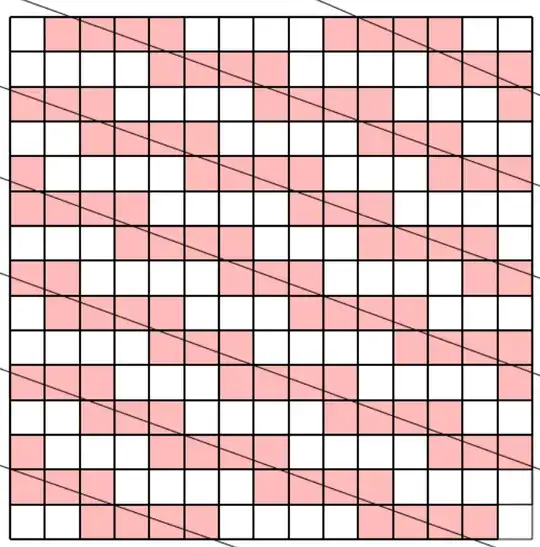
Going up from the bottom left (or going down from the top right), the pattern encountered is 1 2 1 - 1 2 1 - 1 2 1 - 1 2.
Going right from the bottom left (or going left from the top right), the pattern is 2 4 4 4 1. Both patterns together completely describe the covering.

So it looks like this only depends on n modulo 4 and is straightforward to iterate. To be complete: enter image description here
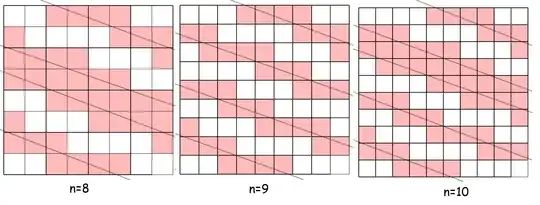
Of course this is not yet a rigorous proof, but it should be pretty clear how to formalize it if wanted. :)

EDIT: Even though it is obviously a very hard problem, it is linear in a certain sense, in a similar vein as the (very easy) Pick's theorem. Now, from playing around with the gadget, I have a stronger conjecture:

Trying to cover an $n\times n$ square with only $n-2$ lines, at least 4 cells will remain uncovered. Moreover, if exactly four cells remain, the only connected components formed by those are 1x1 (i.e. isolated cells) and/or 2x1. This would also mean (but I am a bit less sure about this) that no two of those four cells can be diagonally adjacent, i.e. share exactly 1 vertex.

It is this conjecture/finding which gave me the idea of 'linearity'. After all, there may be a hidden but rather easy mechanism hiding behind!

Wolfgang
  • 1,146
  • Yes of course. It is clearly optimal for patterns where n-2 lines are (almost) parallel of slope ~-1/3, because e. g. the n-2 cells on the rising diagonal starting at (0,2) (if bottom left is labeled with coordinates (0,0)) have to be covered by different lines. (Easiest to see when playing with the gadget). – Wolfgang Aug 26 '23 at 20:05
  • @Wolfgang I recall my $(n-1)$-line solution having two sets of lines at slope roughly $\pm 1$. It would be interesting if there are multiple `very different' $(n-1)$-line configurations, indicating how hard the problem is! – Bob Krueger Aug 26 '23 at 21:59
  • 1
    @BobKrueger yes we might call them "topologically different". My guess is that for each 'topology' (i.e. a set of given rough slopes, with for each slope a certain minimum number of lines with that slope), we can use the cells on certain subdiagonals to show that, supposing the topology admits a construction at all, the total cannot be less than $n-1$, but such a messy approach doesn't help for the general conjecture yet. – Wolfgang Aug 27 '23 at 15:42