20

Now cross-posted to MathOverflow (link).


Question: There is an equilateral triangle. Two players alternate turns placing non-overlapping equilateral triangles of the same size that touch the original one; contact needs to exist for at least one point. When a player cannot make such a placement, they lose. Which player has an optimal strategy, and what is it?

This question is a variation on the classic one about placing circles around an initial circle (for which player two wins e.g. using a mirroring strategy). The game is similarly solvable for a square.

The maximum number of equilateral triangles of the same size that can touch a single equilateral triangle of that size is twelve (alternatively phrased, the kissing number of an equilateral triangle is $12$). For this reason, the game ends after finitely many moves; in particular, it will be done within twelve moves. Therefore, one of the two players has an optimal strategy. What is it?

If this has been studied elsewhere – or already posed on MSE! – then please alert me. (My searches produced nothing.)

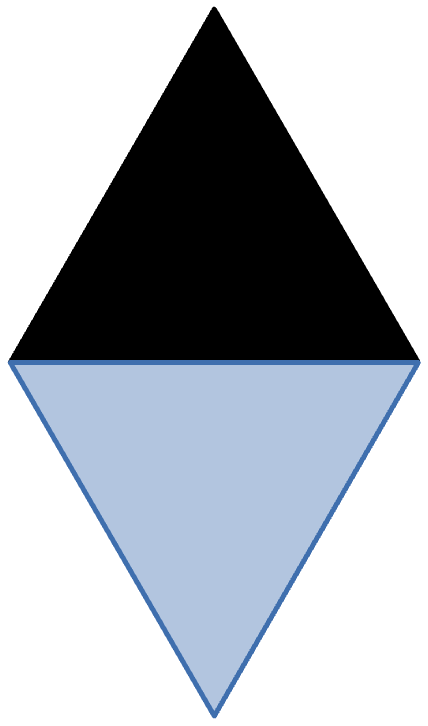
One of the principal difficulties appears to be a lack of exploitable symmetry. Given the solid black equilateral triangle to begin the game as below, suppose player one (blue) moves as follows:
enter image description here

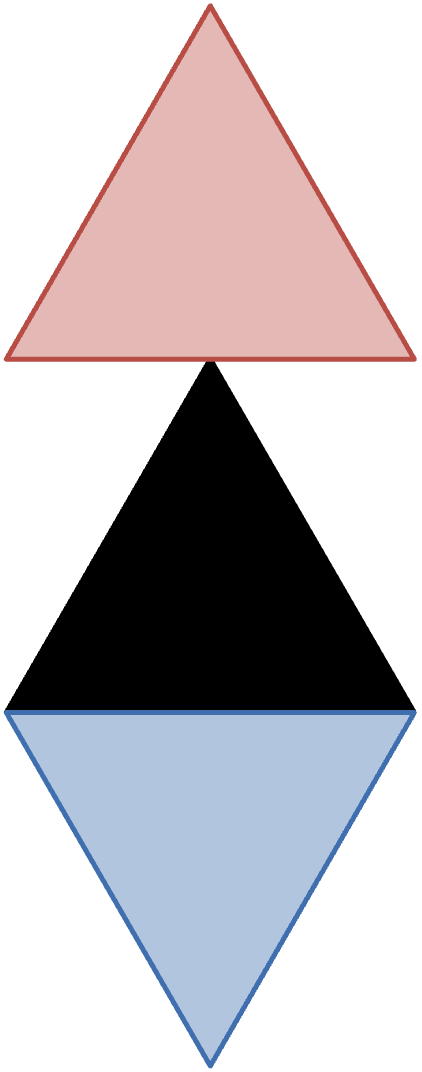
Initially, one might believe that player two's moves can now be reflected using some sort of mirror symmetry. However, player two (red) can now win the game as follows:
enter image description here

From this arrangement, we see that blue's subsequent moves can be mirrored by red, which means red cannot encounter an impossible placement unless blue did in the previous turn. Thus, we detect one strategy that is not optimal for player one. But I do not see a clear generalization or next step around how to form an optimal strategy for either player.

  • are new trangles triangles allowed to be rotated or displaced in any direction before placing them? – vallev Jun 20 '24 at 05:43
  • @vallev Yes, absolutely. – Benjamin Dickman Jun 20 '24 at 06:55
  • This is essentially an impartial combinatorial game in the sense of Winning Ways, made complicated by the fact that there are continuum many possible moves. In principle it can be solved by solving all possible subgames (a subgame would be the restriction of a position in this game to a contiguous region between two already-placed triangles) inductively from the smallest subgames first, piecing multiple subgames together using nim addition and Sprague-Grundy. – Xiaoyu He Jun 21 '24 at 22:58
  • As an example, in the play of the game you wrote out, after the two moves the game decomposes into two identical subgames, and it is known that the sum of two identical nimbers is 0 (a second player win). A generalization would be: if Red can respond to Blue's first move by leaving two equivalent subgames (in the sense of having the same nim value), then Red wins. – Xiaoyu He Jun 21 '24 at 23:01
  • @XiaoyuHe If you are able to write out a solution using "all possible subgames" and "nim addition and Sprague-Grundy," then I will welcome the response! – Benjamin Dickman Jun 22 '24 at 19:41
  • Unfortunately this is just a rough schema for how to go about it, I expect the actual calculation to be extremely tedious. – Xiaoyu He Jun 23 '24 at 01:03
  • Not only is it tedious, but it’s not clear what the result will be. The second player may, or may not, have a winning response to every possible first move. – mjqxxxx Jun 23 '24 at 06:34
  • perhaps a discrete version could be solved to find if there is a clear strategy – vallev Jun 26 '24 at 19:34
  • @vallev Ideas around discretizing the game to solve something similar for insight are welcome! – Benjamin Dickman Jun 26 '24 at 22:44
  • Down-voting this question today (?) ... why tho – Benjamin Dickman Mar 28 '25 at 22:22

0 Answers0