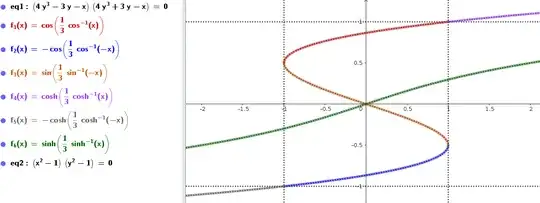
As noted in comments and in another answer, a nonzero complex number has three different cube roots, and simpler expressions for roots of the equation $-4\cdot x^3+3\cdot x-v = 0$ with $-1\le v\le 1$ can be obtained using trigonometric functions.
Verifying the expressions of roots
Let $\zeta = \frac{-1+\imath\cdot\sqrt{3}}{2}$; then $\zeta^2 = -\frac{1+\imath\cdot\sqrt{3}}{2}$, $\zeta^2+\zeta+1 = 0$, $\zeta^3 = 1$.
Let $\gamma = \sqrt{v^2-1}$ (there are two possible choices of $\gamma$) and $\alpha = \left(-v+\gamma\right)^{\frac{1}{3}}$ (there are three possible choices of $\alpha$); the choices of $\gamma$, $\alpha$ are made once for all occurrences. Then $\alpha^3+v = \gamma$, $\left(\alpha^3+v\right)^2 = \gamma^2 = v^2-1$, $\alpha^6+2\cdot v\cdot\alpha^3+1 = 0$.
Denote $\beta = \frac{1}{\alpha}$, then
$$ \beta = \frac{1}{\alpha} = \frac{1-\left(\alpha^6+2\cdot v\cdot\alpha^3+1\right)}{\alpha} = -\left(\alpha^5+2\cdot v\cdot\alpha^2\right) = -\left(\gamma+v\right)\cdot\alpha^2 $$
and one can verify that $\beta^3+v = -\gamma$; that is, choosing another sign for $\gamma$ exchanges possible values of $\alpha = \left(-v+\sqrt{v^2-1}\right)^{\frac{1}{3}}$ with corresponding values of $\beta = \left(-v-\sqrt{v^2-1}\right)^{\frac{1}{3}}$.
Now the expressions in the question can be rewritten as follows:
$$
\begin{align}
x_1 = \frac{1}{2}\cdot\left(\alpha+\beta\right) &= \frac{1}{2}\cdot\left(\alpha-2\cdot v\cdot\alpha^2-\alpha^5\right) \\
x_2 = \frac{1}{2}\cdot\left(\zeta\cdot\alpha+\zeta^2\cdot\beta\right) &= \frac{1}{2}\cdot\left(\zeta\cdot\alpha-\zeta^2\cdot\left(2\cdot v\cdot\alpha^2+\alpha^5\right)\right) \\
x_3 = \frac{1}{2}\cdot\left(\zeta^2\cdot\alpha+\zeta\cdot\beta\right) &= \frac{1}{2}\cdot\left(\zeta^2\cdot\alpha-\zeta\cdot\left(2\cdot v\cdot\alpha^2+\alpha^5\right)\right)
\end{align}
$$
By directly substituting each of these three expressions, expanding and simplifying through repeated use of the identities $\zeta^2 = -\left(\zeta+1\right)$ and $\alpha^6 = -\left(2\cdot v\cdot\alpha^3+1\right)$, one can verify that $x_1$, $x_2$, $x_3$ are roots of the cubic equation $-4\cdot x^3+3\cdot x-v = 0$. It is also possible to check that expressions for $x_1$, $x_2$, $x_3$ refer to three different roots (when the cubic equation has three distinct complex roots).
A solution using trigonometric or hyperbolic functions
The "trigonometric" approach can be made more general by choosing between trigonometric and hyperbolic functions.
A cubic equation of the form $z^3+3\cdot p\cdot z^2+6\cdot q\cdot z+2\cdot r = 0$ with $p,q,r\in\mathbb{R}$ can be transformed into one of the following forms:
- If $p^2=2\cdot q$ then $z=t-p$, $t^3=w=p^3-2\cdot r$: this case reduces to finding cube roots of $w$.
- If $p^2>2\cdot q$ then $z=2\cdot k\cdot t-p$, $4\cdot t^3-3\cdot t=w=\frac{3\cdot p\cdot q-p^3-r}{k^3}$ where $k=\sigma\cdot\sqrt{p^2-2\cdot q}$, $\sigma^2=1$.
- If $p^2<2\cdot q$ then $z=2\cdot k\cdot t-p$, $4\cdot t^3+3\cdot t=w=\frac{3\cdot p\cdot q-p^3-r}{k^3}$ where $k=\sigma\cdot\sqrt{2\cdot q-p^2}$, $\sigma^2=1$.
To solve the second and third cases above, one can check the sign of the term $\pm 3\cdot t$ and the absolute value of $w$ and choose an applicable identity from the following list:
- $t=\cos\eta$, $4\cdot t^3-3\cdot t=w=\cos\left(3\cdot\eta\right)$, $-1\le w\le 1$
- $t=\sin\eta$, $4\cdot t^3-3\cdot t=w=-\sin\left(3\cdot\eta\right)$, $-1\le w\le 1$
- $t=\cosh\eta$, $4\cdot t^3-3\cdot t=w=\cosh\left(3\cdot\eta\right)\ge 1$
- $t=\sinh\eta$, $4\cdot t^3+3\cdot t=w=\sinh\left(3\cdot\eta\right)\in\mathbb{R}$
Plotted in GeoGebra: