
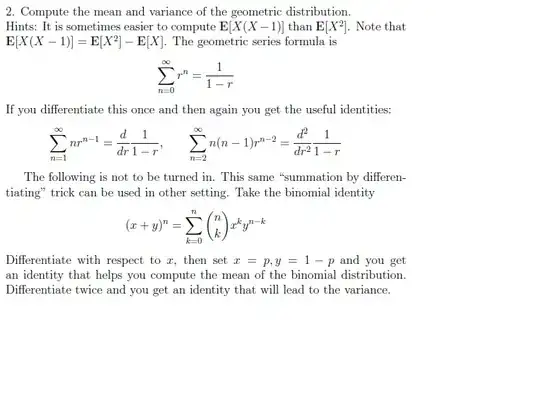
Can anyone help solving this question please? I tried but not sure of the steps to reach the conclusion.
Asked
Active
Viewed 2,582 times
1 Answers
2
Let the probability of success on any trial be $p\gt 0$. Let $X$ be the number of trials until the first success. Then $$\Pr(X=n)=(1-p)^{n-1}p.$$ For brevity, let $q=1-p$.. . We want $E(X)$, which is given by $$p +2qp+3q^2p +4q^3p+5q^4p+\cdots.\tag{1}$$ We need to evaluate this sum. There is a common factor of $p$. Recall the expansion of the function $\dfrac{1}{1-x}$. It is $$\frac{1}{1-x}=1+x+x^2+x^3+\cdots$$ (for $|x|\lt 1$). Now comes the crucial trick, differentiate both sides. We get $$\frac{1}{(1-x)^2}=1+2x+3x^2+4x^3+\cdots.\tag{2}$$ Putting $x=q$, and recalling that $q=1-p$, we get $$\frac{1}{p^2}=1+2q+3q^2+4q^3+\cdots.$$ Comparing with (1), we get $E(X)=p\cdot \frac{1}{p^2}=\frac{1}{p}$.
Now go back to (2), and differentiate again. We get $$\frac{2}{(1-x)^3}=(2)(1)+(3)(2)x+(4)(3)x^2+(5)(4)x^3+\cdots.\tag{3}$$ We now write down an expression for the expectation of $X(X-1)$, as suggested by the hint. It is $$(2)(1)pq +(3)(2)q^2p+(4)(3)q^3p+(5)(4)q^4p+\cdots.\tag{4}$$ Compare (4) with (3). You will have to do a certain amount of manipulation to finish.
André Nicolas
- 516,285
-
which one is the geometric distribution here you have taken? – manayay Sep 18 '13 at 17:08
-
We are looking at a random variable $X$ with geometric distribution. The distribution function of $X$ is given in the first displayed line of the answer. – André Nicolas Sep 18 '13 at 17:11
-
very true, but i am confused like as 3 is in x and 4 is in p, how can i compare them? – manayay Sep 18 '13 at 17:15
-
Ultimately we substitute $q=1-p$ for $x$. Certainly $p$ will never be $4$, since $0\lt p\le 1$. – André Nicolas Sep 18 '13 at 17:20
-
@ André Nicolas What is the mean and variance here? – manayay Sep 18 '13 at 21:10
-
E[X] is mean and E[X^2] - E[X] is variance , correct me.. – manayay Sep 18 '13 at 21:27
-
1$E(X)$ is the mean. There are various expresions for variance. A commonly useful one is $E(X^2)-(E(X))^2$. Since it was easiest to calculate $E(X^2-X)$, you can use $E(X^2-X)+E(X)-(E(X))^2$ for calculating the variance. – André Nicolas Sep 18 '13 at 21:36