3

The vertices of a cross-polytope can be chosen as the unit vectors pointing along each co-ordinate axis – i.e. all the permutations of $(±1, 0, 0,\dots, 0)$. The cross-polytope is the convex hull of its vertices.

Consider the section of a cross-polytope $β_n$ with vertices $(±1, 0, 0,\dots, 0)\in\mathbb{R}^n$ by the hyperplane $(1,1,\dots,1)\cdot\mathbf x=d$.
Its total edge length is constant for all $|d|<1$.

I verified it for $n=2,3,4$. I wonder if this is still true for higher dimensions.

For $n=2$, cross-polytope $β_2$ is a square of side length $\sqrt2$. The line $(1,1)\cdot\mathbf{x}=d$ cuts $β_2$ along a segment of constant length $\sqrt2$ for all $|d|<1$.

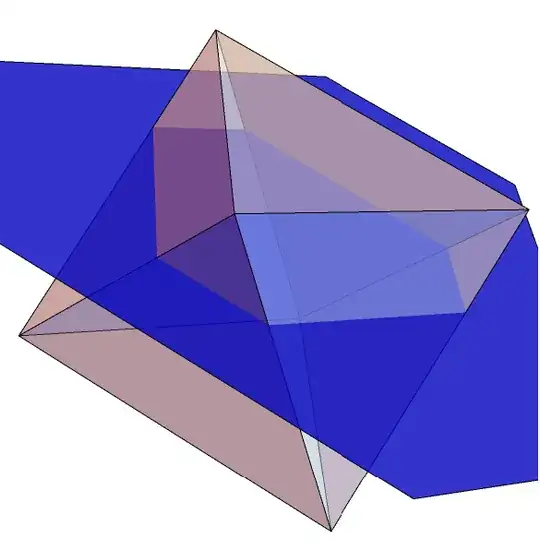
For $n=3$, cross-polytope $β_3$ is a regular octahedron of edge length $\sqrt2$. The plane $(1,1,1)\cdot\mathbf{x}=d$ cuts $β_3$ along a hexagon the length of whose perimeter is constant $3\sqrt2$ for all $|d|<1$.

For $n=4$, cross-polytope $β_4$ is a 16-cell of edge length $\sqrt2$. The hyperplane $(1,1,1,1)\cdot\mathbf x=d$ cuts $β_4$ along a solid with 8 triangle faces and 6 rectangle faces. Its total edge length is constant $12\sqrt2$ for all $|d|<1$.

hbghlyj
  • 6,799
  • 1
    Nice question. I'm sure it's true. If true then the total edge length is the total edge length of the simplex with side $\sqrt{2}$ (the zeroth slice), which is $n(n-1)\sqrt{2}/2$ so check your calculation for $n=4$. – Ethan Bolker Nov 12 '24 at 21:52
  • I think that at $d=1$ you always have the simplex with the standard basis vectors as vertices. All the "other edges" you see when $d < 1$ have shrunk to $0$. – Ethan Bolker Nov 12 '24 at 22:14
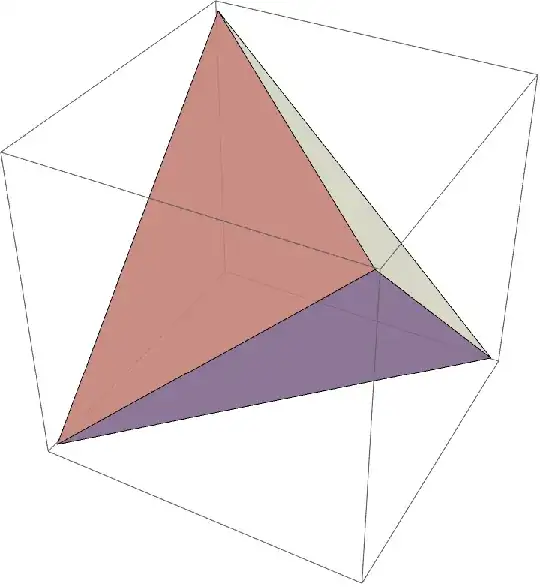
  • When $n=4$ The $d=1$ slice is the convex hull of $(1,0,0,0), (0,1,0,0),(0,0,1,0),(0,0,0,1)$ . That's a regular tetrahedron. – Ethan Bolker Nov 12 '24 at 22:21
  • I think that when $n=4$, the total edge length at $|d|<1$ is twice the total edge length at $d=1$. From the GIF, two edges seem to coincide into one edge when $|d|$ goes to 1. – hbghlyj Nov 12 '24 at 22:26
  • You're right, and so is @Dr.RichardKlitzing ;s answer. – Ethan Bolker Nov 12 '24 at 22:28

2 Answers2

2

Let x3o3o..o3o4o ($n$ nodes) be the $n$-D Coxeter-Dynkin diagram of the according regular cross-polytope or orthoplex. Then clearly x3o3o...o3o . ($n-1$ nodes) is the $(n-1)$-D Coxeter-Dynkin diagram of its (all equivalent) facets, then each being according regular simplices.

Note further that the opposite facet here generally happens to be a dually arranged simplex. As a Coxeter-Dynkin diagram this is just o3o3o...o3x (again $n-1$ nodes).

Further those two opposite facets (as bases) are connected by further simplexes (as sides), thus generalising the structure of an antiprism.

Esp. the facet parallel cross-section of the orthoplex then is given by y3o3o...o3z (still $n-1$ nodes), where those two edge sizes are related to the former by $z=x-y$.

And these extremally expanded simplexes x3o3o...o3x ($n-1$ nodes) generally do have $n!/(n-3)!$ edges, i.e. the here half-symmetric variant y3o3o...o3z would have $\frac12 n!/(n-3)!$ edges of size $y$ plus $\frac12 n!/(n-3)!$ edges of size $z=x-y$. This in turn makes clear that the total sum of edge length (in units of length $x$) is just $\frac12 n!/(n-3)!$, independent of sectioning depth (as long as neither $y$ nor $z$ are degenerate).

In contrast, the edge count of the regular $(n-1)$-D simplex x3o3o...o3o, i.e. the facet of the orthoplex, clearly is $\frac12 n!/(n-2)!$.

--- rk

0

Let the $n$-dimensional cross-polytope (orthoplex) have vertex set

$$ \{\pm e_1,\dots,\pm e_n\}\subset\mathbb R^n. $$

Edges in a cross-polytope: a vertex $+e_i$ is adjacent to $\pm e_j$ for every $j\neq i$, but not to $-e_i$. Equivalently: any two vertices are joined by an edge except an opposite pair $(+e_i,-e_i)$.

Fix two opposite $(n-1)$-simplex facets: the “near” facet spanned by $\{+e_1,\dots,+e_n\}$ and the “far” facet spanned by $\{-e_1,\dots,-e_n\}$. Take a hyperplane parallel to both facets that cuts the orthoplex; denote the section by $S$. Metric parameters are chosen so that distances measured toward the near facet contribute a length $y$, and toward the far facet contribute a length $z=x-y$ (with $0<y< x$, $0<z< x$).

1) Vertices of the section: $|V(S)|=n(n-1)$

Every edge connecting a vertex from the near facet to a vertex from the far facet is of the form

$$ (+e_i,\,-e_j),\qquad i\neq j, $$

since the only disallowed pair is the opposite $(+e_i,-e_i)$. The section $S$ meets each such edge in exactly one point (because the slicing hyperplane is parallel to the facets and lies strictly between them).

Thus vertices of $S$ are in bijection with ordered pairs $(i,j)$ with $i\neq j$:

  • $i$ = index of the near-facet endpoint ($+e_i$, “$y$–side”),
  • $j$ = index of the far-facet endpoint ($-e_j$, “$z$–side”).

Counting ordered pairs gives

$$ |V(S)|=n(n-1). $$

2) Edges of the section split into two types

Two vertices $(i,j)$ and $(i',j')$ of $S$ are joined by an edge in $S$ iff they share exactly one index (this is the standard adjacency of the rectified $(n-1)$-simplex):

  • Type $y$ (left index fixed): $(i,j)$—$(i,k)$ with $j\neq k$. Geometrically this varies the far endpoint while staying near $+e_i$, so its length scales as $y$.

  • Type $z$ (right index fixed): $(i,j)$—$(k,j)$ with $i\neq k$. This varies the near endpoint while staying far from $-e_j$, so its length scales as $z=x-y$.

3) Counting edges of each type

There are two equivalent ways to count; both are quick.

(A) By ordered triples. Choose an ordered triple of distinct indices $(i,j,k)$. This determines:

  • one type-$y$ edge $(i,j)$—$(i,k)$,
  • one type-$z$ edge $(i,j)$—$(k,j)$.

The number of ordered triples is

$$ n(n-1)(n-2)=\frac{n!}{(n-3)!}. $$

Hence the total number of edges in $S$ is $\frac{n!}{(n-3)!}$. The involution $(i,j)\leftrightarrow(j,i)$ bijects type-$y$ edges with type-$z$ edges, so they occur equally often:

$$ E_y=E_z=\tfrac12\,\frac{n!}{(n-3)!}. $$

(B) By “fixed index” degree sums. For type $y$: fix $i$. The vertices $(i,*)$ form a complete graph on $n-1$ nodes, giving $\binom{n-1}{2}$ type-$y$ edges for this $i$. Summing over $i=1,\dots,n$,

$$ E_y= n\binom{n-1}{2}= \frac{n(n-1)(n-2)}{2}=\tfrac12\,\frac{n!}{(n-3)!}. $$

By symmetry the same holds for type $z$.

4) Consequence for total edge-length

Since type-$y$ edges have length $y$ and type-$z$ edges have length $z=x-y$, the total edge-length (in units of $x$) is

$$ \frac{y}{x}\,E_y+\frac{z}{x}\,E_z =\frac{y}{x}\cdot \tfrac12\frac{n!}{(n-3)!}+\frac{x-y}{x}\cdot \tfrac12\frac{n!}{(n-3)!} =\tfrac12\,\frac{n!}{(n-3)!}, $$

independent of the slice depth (as long as $0<y,z<x$).

hbghlyj
  • 6,799