14

Let $a$ and $b$ be positive reals.

If $a+b=1$, any line segment can be divided into two smaller line segments, whose ratio the the original is $a$ and $b$ respectively.

A line divided into two parts.

If $a^2+b^2=1$, then there exists a triangle with side-lengths $a,b,1$, which can be divided into two similar triangles, whose ratio of similarity is $a$ and $b$ respectively.

A right-angled triangle divided into two right-angled triangles.

If $a^3+b^3=1$, does there exist a shape with this property?

It is unlikely that there is a polyhedron with this property (as such a polyhedron would answer this unanswered question). However, it seems plausible that there could a fractal solution (necessarily of Hausdorff dimension $3$).

I would appreciate any advice on what fields of mathematics I should study to help answer this question.

I previously asked a broader version of this question here, which this post rephrases in a more intuitive, geometric fashion.

To account for ChristopheBoilley's comments, I will formalise the desired object as a set $S\subset R$ with non-empty interior, together with similitudes $A,B$ with the desired ratios of similarity and $A≠B$, such that $A(S)\cup B(S)=S$ and the sets $A(S),B(S)$ are interior disjoint.

  • Could you precise the topological/measure theoretic framework? Do you assume that the shape is closed? bounded? convex? with nonempty interior? nonzero measure? And what do you require on the intersection of the subshapes? empty set? zero measure? empty interior? – Christophe Boilley Dec 11 '25 at 09:26
  • @ChristopheBoilley I would assume the intersection to have empty interior. – Kepler's Triangle Dec 11 '25 at 11:28
  • I do not see a reason to impose further conditions. Formally, I would express the desired object as a set $S\subset\mathbb{R}$ together with similitudes $A,B$ with the desired ratios of similarity and $A\ne B$, such that $A(S)\cup B(S)=S$ and the sets $A(S),B(S)$ are interior disjoint. – Kepler's Triangle Dec 11 '25 at 11:33
  • With such light conditions, there is an easy example: take $S=[0,1]\times {0}^2$ with $A$ the homothety centered on $(0,0,0)$ and $B$ centered on $(1,0,0)$. Then $A(S)\cap B(S)=[1-b,a]\times{0}^2$ with empty interior in $\mathbb R^3$. – Christophe Boilley Dec 11 '25 at 14:48
  • I would rather suggest that $S$ has nonzero measure and $A(S)\cap B(S)$ has zero measure. – Christophe Boilley Dec 11 '25 at 14:53
  • @ChristopheBoilley Thanks for the example. I would personally prefer to further require that $S$ has non-empty interior, but I think your formulation in terms of the measures makes sense and isolates the problem I am interested in. – Kepler's Triangle Dec 11 '25 at 16:00

1 Answers1

8

In the special case that $a$ and $b$ are equal, you can, in fact, do it with a rectangular cuboid as long as we choose the side lengths carefully. Note that any rectangular cuboid can have up to three distinct side lengths. For our purposes, let's denote those lengths $a$, $b$, and $c$ in descending order. We simply need the lengths to satisfy

$$a/2^{1/3} = b, \, b/2^{1/3} = c, \text{ and } 2\,a/2^{1/3} = c.$$

We then define two similarity transformations $f_1$ and $f_2$ that should fix opposite vertices and scale by the factor $2^{1/3}$. Each must also rotate through the angle $120^{\circ}$. To specify the fixed line of the rotation, let $\vec{u}$, $\vec{v}$, and $\vec{w}$ be the unit vectors from the vertex to the three adjacent vertices. The rotation should be about the line through the vertex in the direction of $\vec{u}+\vec{v}+\vec{w}$.

As a result, the side of length of $a$ maps to the side of length $b$ and the side of length $b$ maps to the side of length $c$. The side of length $a$ is replaced by two copies of the side of length $c$.

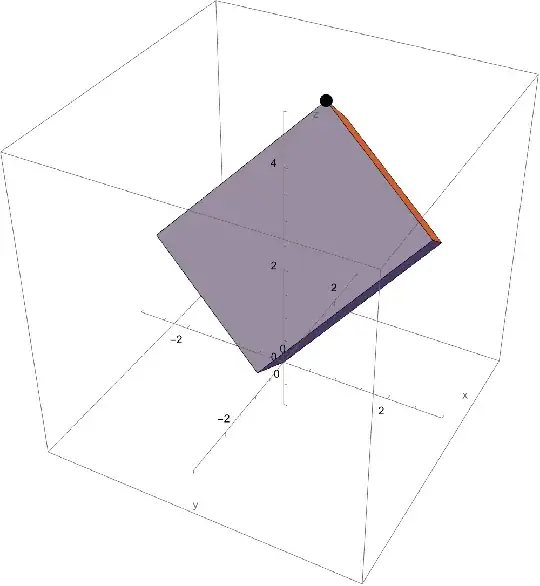
This situation is illustrated in the animation below where the fixed points are $(0,0,0)$ for one transformation and $(2,2,2)$ for the other.

I guess this could probably be generalized for your other question.
Groovy animation showing how the pieces fit together

I would guess that you would also be interested in Combinatorial topology of three-dimensional self-affine tiles by Christoph Bandt which describes quite completely the types of self-similar sets whose translates can be used to cover all of three-dimensional space.

The construction above, in fact, can be obtained from his theorem 2.3. That theorem implies that the only way to generate a self-similar set consisting of two copies of itself in 3D that tiles space by translates is to start with $$ \tilde{M} = \begin{pmatrix} 0 & 0 & \pm 2 \\ 1 & 0 & 0 \\ 0 & 1 & 0 \end{pmatrix}, $$

then conjugate that to a similarity matrix $M$, and finally form the IFS with similarities

$$\begin{aligned} f_1(x,y,z) &= M^{-1}\begin{pmatrix}x \\ y \\ z\end{pmatrix} \\ f_2(x,y,z) &= M^{-1}\begin{pmatrix}x \\ y \\ z\end{pmatrix} + \vec{v}, \end{aligned}$$ where $\vec{v}$ is a non-zero shift vector.

To form the example above, I conjugated $\tilde{M}$ to $$ M = 2^{1/3}\left( \begin{array}{ccc} -\frac{1}{2} & -\frac{\sqrt{3}}{2} & 0 \\ \frac{\sqrt{3}}{2} & -\frac{1}{2} & 0 \\ 0 & 0 & 1 \\ \end{array} \right) $$ and chose my shift vector to be $$ \vec{v} = \begin{pmatrix} 1 \\ 1 \\ 1\end{pmatrix}. $$

Mark McClure
  • 31,810