I have just come up with a geometric proof, but it is not strictly synthetic as I use Thales' theorem for ratio chasing.
The idea
Here's how I thought about the problem.
At first, I picked a random straight line $\ell$ intersecting the three sidelines of triangle $ABC$ at $P, Q, R$. Then I moved $\ell$ without rotating it. I observed that the centroid $\dfrac{1}{3}(P + Q + R)$ varied on a tangent line of the Steiner inellipse as $\ell$ slided. Any point on any tangent line of an ellipse is not an interior point of the ellipse.
A complete solution of a locus problem consists of two parts: (1) Any point that satisfies a property $\mathscr{P}$ must belong to a set (locus) $\mathscr{S}$; (2) Any point of $\mathscr{S}$ satisfies the property $\mathscr{P}$.
In this problem, $\mathscr{S}$ consists of every point not in the interior of the Steiner inellipse excluding 12 points through which any tangent line to the Steiner inellipse is parallel/identical to a sideline of triangle $ABC$.
For the 1st part, we will show that $\dfrac{1}{3}(P + Q + R)$ lies on a tangent line of the Steiner inellipse.
For the 2nd part, we will construct a straight line $\ell$ through a point in $\mathscr{S}$ such that $\dfrac{1}{3}(P + Q + R)$ is identical to the given point.
The proof
The proof here consists of three steps.
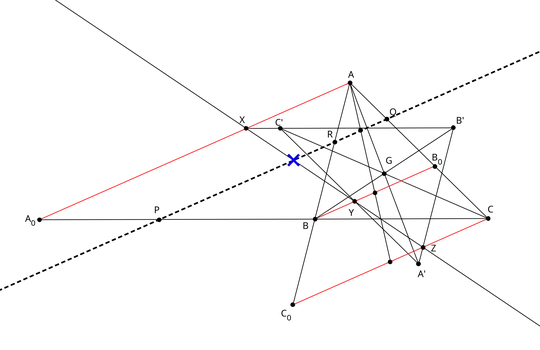
Step 1. Let $\ell_{A}, \ell_{B}, \ell_{C}$ be the straight lines passing through $A, B, C$ and parallel to $\ell$. These straight lines meet $BC, CA, AB$ at $A_{0}, B_{0}, C_{0}$ and $X = \dfrac{2A + A_{0}}{3}$, $Y = \dfrac{2B + B_{0}}{3}$, $Z = \dfrac{2C + C_{0}}{3}$. Prove that $\dfrac{1}{3}(P + Q + R), X, Y, Z$ are collinear.
This is done by using the midpoints of $QR, BB_{0}, CC_{0}$ and applying ERIQ theorem several times.
ERIQ theorem: Given 4 points $A, B, C, D$.
$E \in AD, F \in BC$ such that $\dfrac{\overline{AE}}{\overline{AD}} = \dfrac{\overline{BF}}{\overline{BC}}$.
$K \in AB, M \in CD, L \in EF$ such that $\dfrac{\overline{AK}}{\overline{AB}} = \dfrac{\overline{DL}}{\overline{DC}} = \dfrac{\overline{EL}}{\overline{EF}}$.
Then $K, L, M$ are collinear and $\dfrac{\overline{AE}}{\overline{AD}} = \dfrac{\overline{BF}}{\overline{BC}} = \dfrac{\overline{KL}}{\overline{KM}}$.
Step 2. Let $A^{\prime}B^{\prime}C^{\prime}$ be the image of $ABC$ under the point reflection centered at the centroid of triangle $ABC$. A straight line $\Delta$ intersects $B^{\prime}C^{\prime}, C^{\prime}A^{\prime}, A^{\prime}B^{\prime}$ at $X, Y, Z$. Prove that $\Delta$ is tangent to the Steiner inellipse of triangle $ABC$ (and of triangle $A^{\prime}B^{\prime}C^{\prime}$ as they share the same Steiner inellipse) if and only if $BY \parallel CZ$.
$B^{\prime}C^{\prime}$ intersects $AC, AB$ at $A_{b}, A_{c}$; $C^{\prime}A^{\prime}$ intersects $BA, BC$ at $B_{c}, B_{a}$; $A^{\prime}B^{\prime}$ intersects $CB, CA$ at $C_{a}, C_{b}$.
$M$ is the reflection of $Z$ across $C_{a}$; $B_{a}M$ intersects $A_{c}C_{a}$ at $N$.
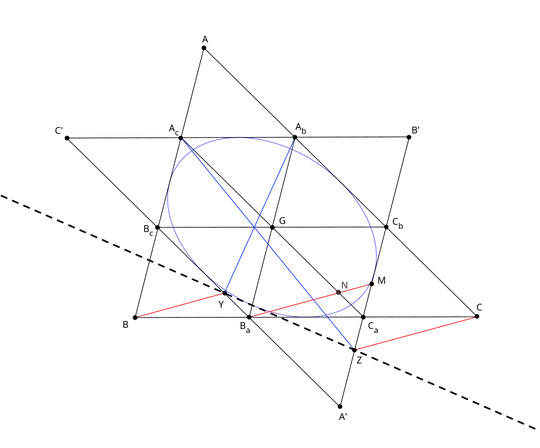
According to the Brianchon's theorem, $\Delta$ is tangent to the Steiner inellipse iff $A_{c}Z, A_{b}Y, B_{c}C_{b}$ are concurrent or parallel.
According to Thales' theorem, $A_{c}Z, A_{b}Y, B_{c}C_{b}$ are concurrent or parallel iff $\dfrac{\overline{A_{c}B_{c}}}{\overline{ZC_{b}}} = \dfrac{\overline{YB_{c}}}{\overline{A_{b}C_{b}}}$.
Apply Thales' theorem successively
$$
\begin{align*}
\dfrac{\overline{A_{c}B_{c}}}{\overline{ZC_{b}}} & = \dfrac{\overline{C_{b}C_{a}}}{\overline{ZC_{b}}} = \dfrac{\overline{C_{a}A^{\prime}}}{\overline{A^{\prime}M}} = \dfrac{\overline{NB_{a}}}{\overline{B_{a}M}} = \dfrac{\overline{NG}}{\overline{GC_{a}}}, \\
\dfrac{\overline{YB_{c}}}{\overline{A_{b}C_{b}}} & = \dfrac{\overline{YB_{c}}}{\overline{B_{c}B_{a}}}.
\end{align*}
$$
Hence $\dfrac{\overline{A_{c}B_{c}}}{\overline{ZC_{b}}} = \dfrac{\overline{YB_{c}}}{\overline{A_{b}C_{b}}}$ iff $\dfrac{\overline{YB_{c}}}{\overline{B_{c}B_{a}}} = \dfrac{\overline{NG}}{\overline{GC_{a}}}$.
$BY \parallel CZ$ iff $BY \parallel B_{a}M$. Moreover, $BY \parallel B_{a}M$ iff $\dfrac{\overline{YB_{c}}}{\overline{B_{c}B_{a}}} = \dfrac{\overline{NG}}{\overline{GC_{a}}}$.
Hence $\Delta$ is tangent to the Steiner inellipse iff $BY \parallel CZ$.
Similarly, one can show that $AX \parallel BY \parallel CZ$ iff $\Delta$ is tangent to the Steiner inellipse.
Step 3.
1st part. According to Step 1 and Step 2, $\dfrac{1}{3}(P + Q + R)$ lies on some tangent line $\tau$ of the Steiner inellipse such that $\tau$ intersects $BC, CA, AB$. Hence $\dfrac{1}{3}(P + Q + R) \in \mathscr{S}$.
2nd part. Pick an arbitrary point in $\mathscr{S}$. According to the definition of $\mathscr{S}$, there is a tangent line $\tau$ through the point that intersects $BC, CA, AB$.
Let $X, Y, Z$ be the intersections of $\tau$ and $B^{\prime}C^{\prime}, C^{\prime}A^{\prime}, A^{\prime}B^{\prime}$. $A_{0}, B_{0}, C_{0}$ are the intersections of $BC$ and $AX$, $CA$ and $BY$, $AB$ and $CZ$. Let $\ell$ be the straight line through the given point and parallel to $AX$. $\ell$ intersects $BC, CA, AB$ at $P, Q, R$.
The result in Step 2 implies $AX \parallel BY \parallel CZ$. The result in Step 1 implies the given point is identical to $\dfrac{1}{3}(P + Q + R)$.


