Almost an answer now: it just remains to write down the last integral and compute it.
In $\mathbb{R}^3$ the locus of points $P$ such that $\widehat{APB}$ is an obtuse angle is the ball having $AB$ as a diameter, from now on named $AB$-ball.
It follows that all the faces of $ABCD$ (with $A,B,C,D\in S^2$) are acute-angled iff the $AB$-ball$\cap S^2$ and the $CD$-ball$\cap S^2$ are disjoint, and the same applies to the couples $(BC,DA)$ and $(AC,BD)$.
Up to symmetry we may assume that $B,C,D$ all lie on the same parallel in the northern hemisphere and $A$ lies on the meridian $0$, but not necessarily in the northern hemisphere. The probability that the $BCD$-face is acute angled is $\frac{1}{4}$ by a very well-known simmetry argument, and the distribution of the latitude $\varphi$ of $BCD$ is also pretty simple, since the surface area of a spherical cap is directly proportional to its height, by one of Archimedes' lemmas.
Another chance is to assume, up to symmetry, that $A$ and $B$ are opposite points on the same parallel in the northern hemisphere. For any $d\in[0,2]$, the probability that $AB\leq d$ equals $d^2/4$.
If we assume that the $AB$ edge is fixed and its length is $d$, the probability that all the angles adjacent to $AB$ are acute is simply $\frac{d^2}{4}$. So, in general, the probability that all the angles adjacent to $AB$ are acute is $\int_{0}^{2}\left(\frac{x}{2}\right)^3\,dx =\frac{1}{2}$. The edges $AB$ and $CD$ are independent, so the probability that all the angles adjacent to $AB$ or $CD$ are acute is $\frac{1}{4}$. It only remains to impose that the spherical caps with base diameters $AB$ and $CD$ are disjoint.
If $AB=d$ the surface area of the spherical cap with base diameter $AB$ is $2\pi\left(1-\sqrt{1-\frac{d^2}{4}}\right)$. The geodetic distance (along the surface of the sphere) between the center of the spherical cap and any point on its boundary is $\arcsin\frac{d}{2}$. Two spherical caps are disjoint iff the geodetic distance between their centers exceeds the sum of their geodetic radii. Now an interesting fact: the distribution of the geodetic distance $\ell$ between the center of the $AB$-cap and the center of the $CD$-cap does not depend on the lengths of $AB$ or $CD$. By the previous observations, the probability that $\ell\leq k$ is $\sin^2\frac{k}{2}$. The density function for the distribution of the geodetic radius $r$ of the $AB$-cap is $2\sin x\cos x=\sin(2x)$. By naming $r'$ the geodetic radius of the $CD$-cap we have that the density function $f$ for the distribution of $r+r'$, supported on $[0,\pi]$, is given by a convolution. In particular
$$ f(x) = \frac{\sin(2s)-2x\cos(2s)}{4}\quad\text{with } s=\min(x,\pi-x) $$
and the probability that the $AB$ and $CD$-caps are disjoint equals
$$ \int_{0}^{\pi} f(x)\int_{x}^{\pi}\frac{1}{2}\sin(t)\,dt\,dx = \int_{0}^{\pi} f(x)\cos^2\left(\frac{x}{2}\right)\,dx = \frac{1}{2}.$$
The only perk it remains to tackle is the fact that the events $E_2=$"all the angles adjacent to $AB$ or $CD$ are acute" and $E_1$="the endpoints of $AB$ or $CD$ see the other edge under an acute angle" are not independent. If they were, the wanted probability would be $\frac{1}{8}$.
Let's devise a strategy. $E_1$ happens with probability $50\%$, and by assuming that $E_1$ holds (i.e. that the $AB$ and $CD$ caps are disjoint) we have that $E_2$ holds, or not, just according to the lengths of $AB$ and $CD$ and the angles that the $AB$-geodetic and the $CD$-geodetic form with respect to the geodetic joining their midpoints. This is an integral in a few variables, with all of them being independent and with reasonably simple distributions.
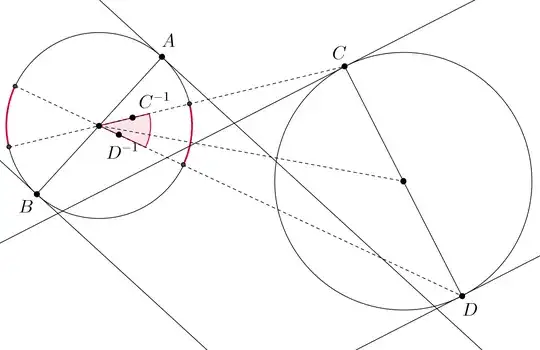
The analogue problem in $\mathbb{R}^2$ is to compute the probability that the $AB$-strip avoids $C$ and $D$ and the $CD$-strip avoids $A$ and $B$. This happens accordingly to the amplitudes of $\widehat{CMB}$ and $\widehat{ANB}$, with $M$ and $N$ being the midpoints of $AB$ and $CD$.
In the spherical case, if $CD=d$ then the probability that $A$ lies on the outside of the $CD$-strip is $1-\frac{d}{2}$, so the probability that both $A$ and $B$ lie outside of the $CD$-strip, assuming independence, is $\left(1-\frac{d}{2}\right)^2$. If we consider
$$ p=\int_{0}^{2}\int_{0}^{2}\frac{x}{2}\cdot\frac{y}{2}\cdot\left(1-\frac{x}{2}\right)^2\cdot\left(1-\frac{y}{2}\right)^2\int_{\arcsin(x/2)+\arcsin(y/2)}^{\pi}f(u)\,du\,dy\,dx\\= -\frac{121783}{23625}+\frac{121 \pi }{75}+\frac{3 \pi ^2}{160}\approx \frac{22}{223}$$
we get a probability which is slightly above $\frac{1}{12}$. This is due to the fact that once we fix the length of $AB$, the events $A$ lies on the outside of the $CD$-strip and $B$ lies on the outside of the $CD$-strip are not really independent, as we may easily realize when considering the cases in which $AB$ is pretty short.
On the other hand, we are getting closer. We need the spherical analogue of the relation between $\beta$ and $\ell, d,\alpha$ in the following configuration:
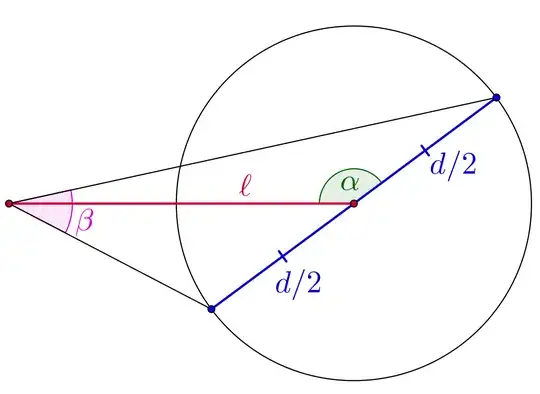
In the Euclidean case the area of the triangle is given by $\ell\frac{d}{2}\sin\alpha$ while the lenghts of the sides adjacent to $\beta$ are $\sqrt{\ell^2+\frac{1}{4}d^2\pm \ell d\cos\alpha}$, hence $\sin(\beta)\sqrt{\left(\ell^2+\frac{d^2}{4}\right)^2-\ell^2 d^2\cos^2\alpha}=\ell d\sin(\alpha)$ and
$$ \sin \beta =\frac{\sin\alpha}{\sqrt{\left(\frac{\ell}{d}+\frac{d}{4\ell}\right)^2-\cos^2\alpha}}.$$
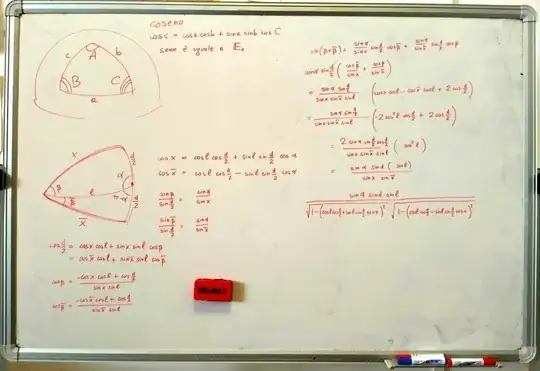
With a bit of work, through the spherical versions of the sine and cosine rules I got that
$$ \sin\beta = \frac{\sin\alpha\sin d\sin\ell}{\sqrt{1-\left(\cos\ell\cos\frac{d}{2}+\sin\ell\sin\frac{d}{2}\cos\alpha\right)^2}\sqrt{1-\left(\cos\ell\cos\frac{d}{2}-\sin\ell\sin\frac{d}{2}\cos\alpha\right)^2}}$$
which is enough to write down the wanted probability as an explicit (but quite terrifying) quintuple integral, with the variables being $r,r',\ell\geq r+r',\alpha,\alpha'$.


