23

On a chessboard, it is possible to arrange bishops, knights and rooks beating one another in “rock—paper—scissors” way. A simple variant is shown below.
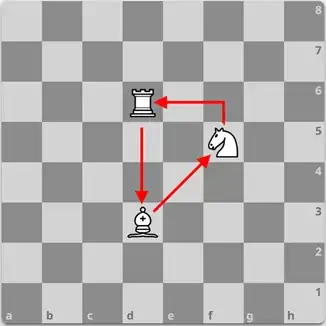
The bishop, the knight, and the rook beating one another in rock—paper—scissors way

The bishop beats the knight (but not vice versa), the knight beats the rook (but not vice versa), and the rook beats the bishop (but not vice versa).

I am looking for not only triplets (bishop → knight → rook), but all possible cycles of arbitrary length (e.g., bishop → knight → rook → bishop → knight → rook etc.). See the picture with an example below.

enter image description here

I don't know the solution to the following problem.

On an $8\times 8$ chessboard, what is the maximum number of pieces (bishop, knight, rook) such that each bishop attacks at least one knight and is attacked by at least one rook, each knight attacks at least one rook and is attacked by at least one bishop, and each rook attacks at least one bishop and is attacked by at least one knight?

I am very grateful to RobPratt for this clarification of the problem.

Following Ethan Bolker's advice, I add the following precision:

  • For the sake of simplicity, I am looking for cycles with the only one direction of attacks: bishop → knight → rook (and not the reverse direction: rook → knight → bishop).

  • Color of the pieces does not matter (like in the eight queens puzzle, or other mathematical chess problems).

  • 4
    Do you accept brute force computer-aided proofs? Is so, this is about finding the largest directed properly colored cycle in some colored multi digraph, where the vertex set is each square of the box, an each color class shows where one of the pieces can attack, that doesn't seem that hard to program – Bruno Andrades Jul 27 '25 at 13:05
  • Thank you very much, Bruno. I will accept any proofs including brute force computer-aided ones. – Alexander Poddiakov Jul 27 '25 at 13:26
  • 2
    Does this mean that all the bishops must beat all the knights (and similarly for the other pairs) or you are looking for disjoint cycles? Can the cycle go the other way (bishop beats rook, rook beats knight, knight beats bishop)? Can you solve your problem for smaller boards? Please [edit] to clarify this interesting question. – Ethan Bolker Jul 27 '25 at 13:37
  • Dear Ethan, thank you very much for your questions about possible variants of puzzle’s requirements. I have edited the text. – Alexander Poddiakov Jul 27 '25 at 14:41
  • 1
    The mention of disjoint cycles is confusing because your second example has cycles that are not disjoint. Does the following description match what you want? Maximize the number of pieces (bishop, knight, rook) such that each bishop attacks at least one knight and is attacked by at least one rook, each knight attacks at least one rook and is attacked by at least one bishop, and each rook attacks at least one bishop and is attacked by at least one knight. – RobPratt Jul 27 '25 at 15:40
  • 1
    @BrunoAndrades It's not quite that simple, because pieces block vision (for rooks and bishops), i.e. the cells that can be attacked by a piece may depend on where other pieces are placed. – anankElpis Jul 27 '25 at 17:26
  • Dear RobPratt, thank you very much. I have changed the question using your description. – Alexander Poddiakov Jul 27 '25 at 17:42
  • @anankElpis you're super right! I missed that, nice catch – Bruno Andrades Jul 27 '25 at 17:59
  • 1
    Have you considered allowing pawns? Thanks to their asymmetry you can easily include pawn→pawn→...→pawn chains of different lengths (once you pre-define their direction, either upwards or downwards the board). – CiaPan Jul 28 '25 at 06:45
  • Thank you for the interesting idea, @CiaPan. It can be the next problem to be solved. In the first variant of the problem, I wrote: (2) What are solutions for all possible combinations of K types of pieces (3 ≤ K ≤ 6) including, for example, pawns, queens, and kings? (There are 6 types of pieces in chess: pawns, bishops, knights, rooks, queens, and kings.) – Alexander Poddiakov Jul 28 '25 at 06:49
  • Concerning @CiaPan’s question about the possibility of inclusion of pawns: in the 1st variant of the puzzle, I wrote about its possible generalization. What are solutions for all possible combinations of K types of pieces (3 ≤ K ≤ 6) including pawns, queens, and kings? The next level is consideration not of single pieces but cycles of arrangements of White (several White pieces) and Black (several Black pieces). Arrangements of White and arrangements of Black can beat one another in rock—paper—scissors way [Intransitively winning chess players positions, https://arxiv.org/abs/2212.11069 ] – Alexander Poddiakov Jul 28 '25 at 07:13
  • 2
    It might be more in line with the originial idea to also require rooks to not attack knights or other rooks, and similarly for the other pieces. That way, you'd only have attacks in the cycle rook -> bishop -> knight -> rook. Though that makes the problem much harder. – anankElpis Jul 28 '25 at 07:55
  • @anankElpis, yes, the requirement to consider cycles in which bishops attack only knights (and not other pieces), knights attack only rooks (and not other pieces), rooks attack only bishops (and not other pieces) is closer to my main idea. Yet I couldn't point it. Thank you for your idea of this requirement. – Alexander Poddiakov Jul 28 '25 at 12:39

1 Answers1

30

The maximum number of pieces, obtained via integer linear programming, turns out to be $64$:

 ♞ ♜ ♞ ♞ ♞ ♞ ♜ ♞
 ♜ ♝ ♜ ♝ ♝ ♜ ♝ ♜
 ♞ ♜ ♝ ♞ ♞ ♝ ♜ ♞
 ♞ ♝ ♞ ♞ ♞ ♞ ♝ ♞
 ♞ ♝ ♞ ♞ ♞ ♞ ♝ ♞
 ♞ ♜ ♝ ♞ ♞ ♝ ♜ ♞
 ♜ ♝ ♜ ♝ ♝ ♜ ♝ ♜
 ♞ ♜ ♞ ♞ ♞ ♞ ♜ ♞

I used two sets of binary decision variables: \begin{align} x_{pij} &= \begin{cases} 1 &\text{if piece $p$ is in cell $(i,j)$} \\ 0 &\text{otherwise} \end{cases} \\ y_{piji'j'} &= \begin{cases} 1 &\text{if piece $p$ is in cell $(i,j)$ and can move to cell $(i',j')$} \\ 0 &\text{otherwise} \end{cases} \end{align}


With the additional requirements that bishops attack only knights, knights attack only rooks, and rooks attack only bishops, the maximum number of pieces turns out to be $30$: \begin{matrix}N&.&N&.&B&.&.&R\\.&B&.&N&.&N&.&B\\.&R&.&.&B&.&N&.\\.&B&.&N&.&N&.&N\\N&.&N&.&N&.&B&.\\.&N&.&B&.&.&R&.\\B&.&N&.&N&.&B&.\\R&.&.&B&.&N&.&N\\\end{matrix}

RobPratt
  • 52,643
  • 1
    Conveniently, due to symmetry it is only necessary to check ten pieces to confirm the correctness of the solution. – David K Jul 27 '25 at 19:06
  • 7
    Could you give more details on the integer linear programming? – Taladris Jul 28 '25 at 05:06
  • 1
    @Alex, the knight on a8 hits the rook on b6 hits the bishop on b7 hits the knight on a8. – Gerry Myerson Jul 28 '25 at 07:14
  • 1
    @Gerry, right you are! I am blind. – Alexander Poddiakov Jul 28 '25 at 07:20
  • What solver are you using for this? The ones I've tried cannot handle such large instances. – anankElpis Jul 28 '25 at 21:12
  • 1
    @anankElpis I use the MILP solver in SAS: https://documentation.sas.com/doc/en/pgmsascdc/v_065/casmopt/casmopt_milpsolver_overview.htm – RobPratt Jul 29 '25 at 00:22
  • Mind in motion: Tatiana Bonch-Osmolovskaya’s answers created without programming.

    Rob Pratt’s answer, and its painting with graphs by Bonch-Osmolovskay – at https://drive.google.com/file/d/1BDZlL0YO-apqFp98Opbx6suWnmfGKMMT/view?usp=sharing

    Tatiana Bonch-Osmolovskaya’s own answers (with 25, 27, and 22 pieces) – at https://drive.google.com/file/d/1c0_tnkzJ8qj8gb7QK--FL1Sqm3hHOdl5/view?usp=sharing

    She writes: "Maybe I originally went not for quantity, but for beauty and symmetry – and look what a completely centrally symmetrical pattern with a number of internal mirror symmetries!".

    – Alexander Poddiakov Aug 13 '25 at 07:43
  • The title of my previous comment (Mind in motion) is a reference to Barbara Tversky’s book “Mind in Motion: How Action Shapes Thought” https://www.learningandthebrain.com/blog/mind-in-motion-how-action-shapes-thought-by-barbara-tversky/ – Alexander Poddiakov Aug 13 '25 at 07:46
  • "Circle dances on a chessboard" (a presentation on results): https://www.researchgate.net/publication/395119730 . A popular article: https://www.trv-science.ru/?p=444601 (in Russian) – Alexander Poddiakov Sep 01 '25 at 03:12