Let me add another approach:
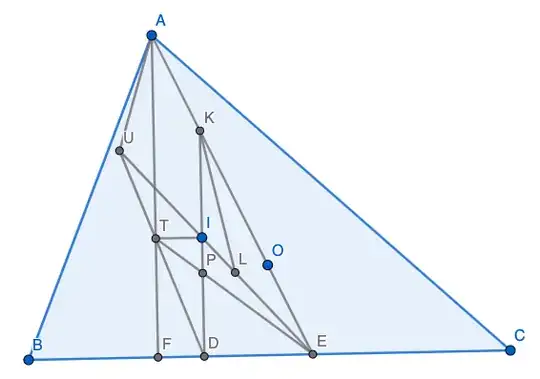
As above, say $F=AT\cap BC$ is the projection of $A$ on $BC$. Let also $K=DI\cap AO$ and note $m(\angle KIA)=m(\angle IAF)=m(\angle KAI)$ since, as above $AI$ also bisects $\angle TAO$. Hence $KA=KI$ and to show $UA=UI$ it suffices to show $KU$ passes through the midpoint of $AI.$
Then, if $L\in EI$ is such that $KL$ is the internal bisector of $\angle DKE$ - i.e. $KL$ is parallel to $AI$ - to show $KU$ passes through the midpoint of $AI$ it suffices to show $(KA, KI: KU, KL)$ is a harmonic bundle so moving everything on the line $UE$ we want to show the cross-ratio $(U,L:I,E)$ is harmonic.
Now consider the intersection $P=TE\cap ID$ and recall the following fact: if $XYZT$ is any quadrilateral with $W=XZ\cap YT$ the intersection of the diagonals, and $V=XY\cap ZT$ and $R,S$ are the points where $WV$ meets $XT$ and respectively $YZ$ the the cross-ratio $(W,V:R,S)$ is always harmonic.
In our case, consider the quadrilateral $TDEI$ with $P$ playing the role of $W$ and $U$ playing the role of $V$. Since $TI$ and $DE$ are parallel it suffices to show $PL$ and $DE$ are themselves parallel and the conclusion follows from the above result.
Now, we see that $PL \parallel DE$ iff $\frac{IL}{LE} = \frac{IP}{PD}$. However, $$\frac{IL}{LE} = \frac{KI}{KE} = \frac{KA}{KE},$$where the first equality is from the angle bisector theorem and the second equality is from $KI=KA$. We also have $$\frac{IP}{PD} = \frac{TI}{DE} = \frac{FD}{DE},$$where the first equality is from $\triangle TIP \sim \triangle EDP$ and the second equality is from $KD \parallel AF$. Therefore, it suffices to prove that $\frac{KA}{KE} = \frac{FD}{DE}$, which is evident because $KD \parallel FA$.


The circle with diameter $AI$ goes through $I$, $T$ and the projections of $I$ on $AB$ and $AC$. It is orthogonal to the incircle.
– Jack D'Aurizio Aug 04 '25 at 19:12