Here is a solution which is heavy on Euclidean geometry, but completely elementary.
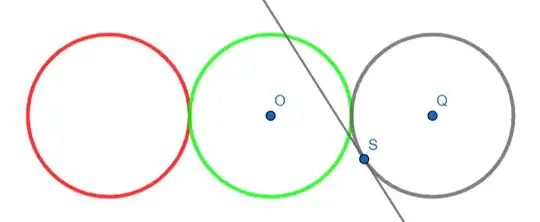
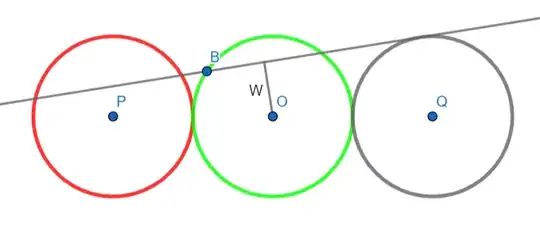
Let $P,Q,O$ be the centres of the red, green and black circles, respectively. We will show the stronger statement as observed in the comments that $d(AB,O)$ and $d(BC,O)$ are identically distributed.
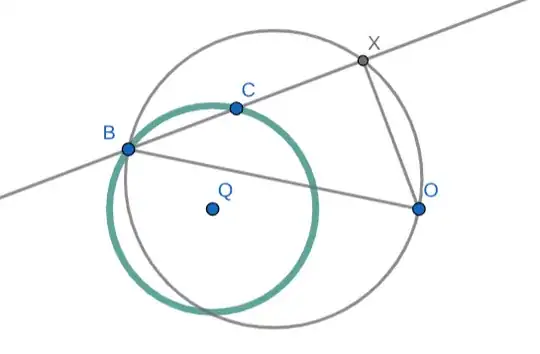
First, let $X$ be the foot of the altitude from $O$ to $BC$, so that
$$d(BC,O)=OX=OB\lvert\sin\theta\rvert,$$
where $\theta=\angle OBC=(\frac\pi2-\angle QBO)-\frac12\angle BQC$. For fixed $B$ and random $C$, we have $\angle BQC$ is uniformly distributed mod $2\pi$, so $\theta$ is uniformly distributed mod $\pi$.
We now aim to show that $d(AB,O)$ has the same distribution. Let $Z$ be the tangency point of the red and green circles. For $A,B$ picked independently and uniformly at random, let $B'$ be on the green circle such that $\angle APZ=\angle BQB'$ as directed angles; it is clear that $A,B'$ are also independent and uniform.
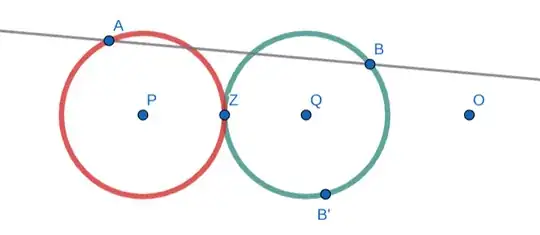
From here on we view $B'$ as fixed and $A$ as uniformly random. Now the orientation-preserving isometry sending $\triangle APZ$ to $\triangle BQB'$ must be a rotation, say centred at $D$; then $DP=DQ$ implies that $DZ$ is the common tangent to the two circles, and $DZ=DB'$ implies that $DB'$ is also a tangent to the green circle. (In particular, $D$ is constant as $A$ varies.)
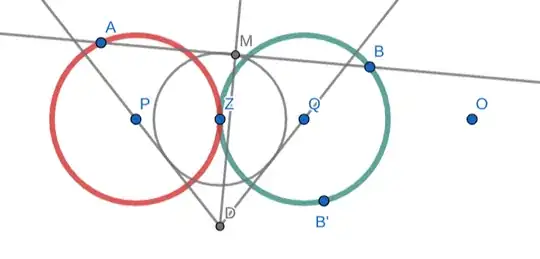
Next, let $M$ be the midpoint of $AB$, so that $DA=DB$ implies that $DM$ is the perpendicular bisector of $AB$. Now $\triangle DPQ\sim\triangle DBA$ implies that $\triangle DZP\sim\triangle DMA$, so by spiral similarity we have $\triangle DZM\sim\triangle DPA$. Hence $ZM=PA\frac{DZ}{DP}$ is constant, and $\angle DZM=\angle DPA$ is uniform mod $2\pi$, so $M$ is distributed uniformly on a fixed circle $\omega$ centred at $Z$. Taking $A=Z$ shows that $\omega$ contains the midpoint of $ZB'$, so that $\omega$ is tangent to $DP$ and $DQ$.
Let $N$ be the foot of the altitude from $O$ to $DM$, so that $MN=d(AB,O)$. Now the above discussion allows us to forget about points $A,B$ and the two circles.
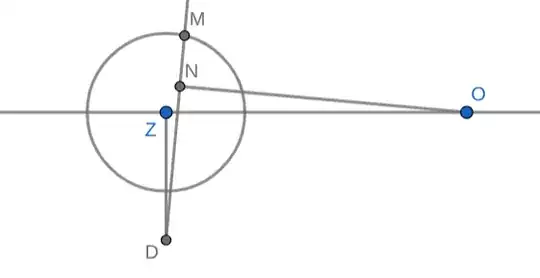
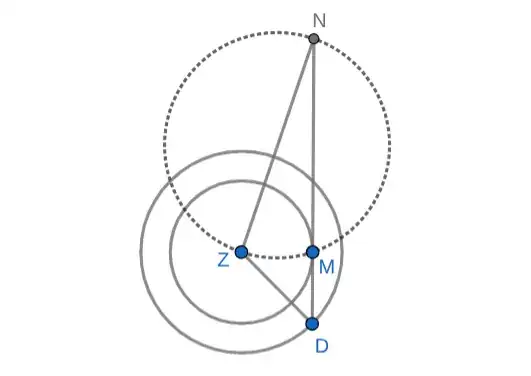
To recap, we now have $M$ chosen uniformly on the circle $\omega$, and we want the distribution of the length $MN$. We do this by a coordinate change: instead of fixing $D,O$ and rotating $M$ around $Z$, we will fix $M$ and rotate $D,O$ around $Z$:
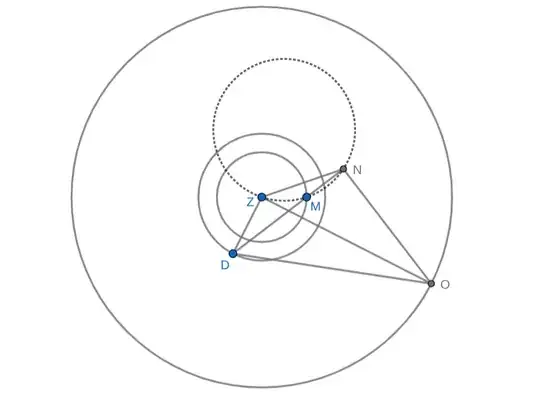
We have $\angle DZO=\angle DNO=\frac\pi2$ implies that $DZNO$ is cyclic, so $\angle ZND=\angle ZOD$ is constant. Hence in these coordinates, $N$ lies on a fixed circle $\Omega$ passing through $Z,M$. Let $\delta$ denote the diameter of $\Omega$; now note that for any $\alpha\in[0,\frac\pi2]$, the set of $D$ for which $MN\ge\delta\cos\alpha$ has total angular measure exactly $4\alpha$:
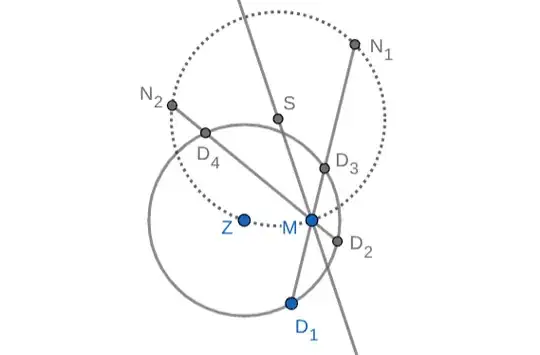
Indeed, with $S$ as the centre of $\Omega$, let $N_1,N_2$ be on $\Omega$ such that $\angle N_1MS=\angle N_2MS=\alpha$. Then the set of admissible points $D$ are given by arcs $D_1D_2$ and $D_3D_4$, with total angular measure
$$\begin{align*}
\angle D_1ZD_2+\angle D_3ZD_4&=2(\angle D_1D_3D_2+\angle D_3D_2D_4)\\
&=2\angle D_1MD_2\\
&=4\alpha.
\end{align*}$$
Hence as $D$ varies uniformly on its circle, $MN$ is distributed as $\delta\cos\alpha$, with $\alpha$ uniform in $[0,\frac\pi2]$. This is the same distribution as $\delta\sin\beta$, with $\beta$ uniform in $[0,\pi]$.
Finally, we will compute the value of $\delta$. Note that when $DM$ is tangent to $\omega$, we have $\delta=ZN$ by Thales's theorem, since $\angle ZMN=\frac\pi2$:
Bringing back the original diagram, we see that this happens precisely when $A=Z$ and $B=B'$:
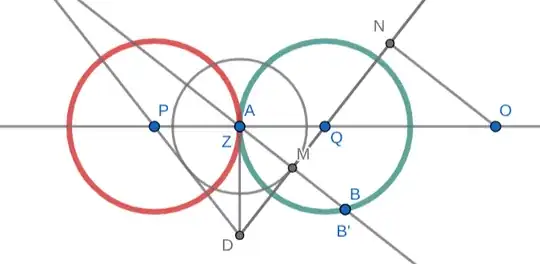
Now $\triangle QAM\sim\triangle QON$ implies that $ON=AM\frac{QO}{QA}=2AM=AB'$. Hence $ANOB'$ is a parallelogram, so $\delta=ZN=AN=OB'$.
In conclusion, $d(AB,O)$ is distributed as $OB'\sin\beta$, with $B'$ uniform on the green circle and $\beta$ uniform in $[0,\pi]$, and we are done.