Draw your quadrilaterals on the Argand diagram of the complex plane, so that each point corresponds to a complex number.
Then any polygon $WXYZ$ is cyclic iff $\frac{(w-x)(y-z)}{(x-y)(z-w)} \in \mathbb R$. This follows from the usual angle-chasing, and the fact that the (directed) angle between two vectors is the complex argument of their quotient.
In your first diagram, naming the other points $E, F, G,$ and $H$, we're given that $ABFE, BCGF, CDHG, DAEH,$ and $EFGH$ are cyclic. Then
$$\frac{(a-b)(f-e)}{(b-f)(e-a)}\cdot\frac{(c-g)(f-b)}{(b-c)(g-f)}\cdot\frac{(c-d)(h-g)}{(d-h)(g-c)}\cdot\frac{(a-e)(h-d)}{(d-a)(e-h)}\cdot\frac{(f-g)(h-e)}{(e-f)(g-h)} \in \mathbb R$$
which upon simplifying and adding some factors of $-1$ as appropriate,
$$\frac{(a-b)(c-d)}{(b-c)(d-a)} \in \mathbb R$$
This is probably easier to visualise with a drawing. Labeling an edge in blue when it appears on top of the fraction, and in red on the bottom:
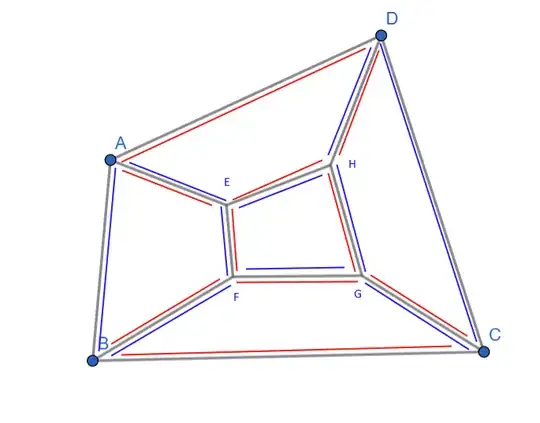
... every quadrilateral that we know to be cyclic has two blue edges and two red edges in alternating colours, every interior edge appears exactly once in each colour (so in the product, they cancel out), and the edges that don't cancel are exactly the sides of the exterior quadrilateral, showing that it is cyclic.
Can you label any partition of the quadrilateral in this way? Yes! As noted in the other answer, the graph of this partition is bipartite. You can partition it into two sets $V_1$ and $V_2$ such that every edge goes from one to the other. Then, for each quadrilateral, traverse it in a clockwise order, labelling an edge in blue when it goes from $V_1$ to $V_2$ and in red when it goes from $V_2$ to $V_1$. If it's an interior edge, it'll be cancelled out by the quadrilateral on the other side, which we traverse in the opposite direction. If it's an exterior edge, it'll be left with one blue label when it goes clockwise from $V_2$ to $V_1$ and one red otherwise (the opposite of the usual order, as if the large quadrilateral were inside-out).
There's a related result you can show if the polygons are not just cyclic, but pairs of harmonic conjugates. That is when $\frac{(w-x)(y-z)}{(x-y)(z-w)} = -1$. If you can partition a quadrilateral $ABCD$ into pairs of harmonic conjugates in this way, then $AC$ and $BD$ are also harmonic conjugates.


