24

Suppose I have a (non-self-intersecting, nondegenerate) polyhedron in $\mathbb{R}^3$ none of whose faces are convex or meet one another at 180º angles. Such polyhedra turn out to exist, such as this modification to a cube with two "spikes" extruding from opposite corners:

cube with spikes such that every face is concave

The above example has $12$ faces: six concave quadrilaterals and six concave hexagons. Is this the minimum? I can show that at for simply connected polyhedra there must be at least $6$ faces, but I suspect one can do better than this fairly weak bound.

RavenclawPrefect
  • 19,199
  • 3
  • 43
  • 112
  • 1
    Can you put spikes on two corners of a tetrahedron, for ten sides? – Empy2 Sep 05 '25 at 13:41
  • A pyramid with arrowhead base has five sides. Can a four-sided spike make the other sides concave? – Empy2 Sep 05 '25 at 14:23
  • @Empy2: I believe the first one works - I had the same thought and came back here to edit. Your second suggestion is interesting; I believe the spike face straddling the concave edge of the pyramid will have trouble, but maybe there’s a way around this? – RavenclawPrefect Sep 05 '25 at 16:58

3 Answers3

13

Grünbaum and Szilassi "Geometric realizations of special toroidal complexes", Contributions to Discrete Mathematics, 2009, https://cdm.ucalgary.ca/article/view/61986/46681, fig.20, shows a toroidal polyhedron with eight hexagonal faces, all of which are non-convex. They credit it to a 1988 German diploma thesis of Schwörbel.

It appears to be possible to collapse one face and get something with seven non-convex faces. I think if you try to collapse two faces it will become degenerate (certain edges forced to coincide).

Update in response to comments:

Tom Lowe posted this image (https://mathstodon.xyz/@TomL/115177969024433153), better than I can draw:
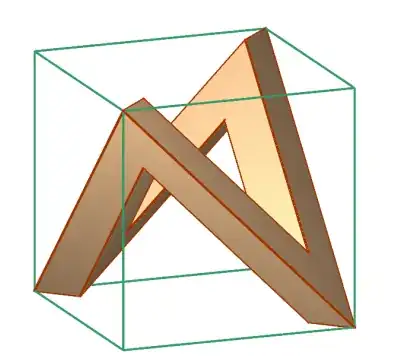
Schwörbel's non-convex hexagonal octahedron

It is what you get if you inscribe a tetrahedron T in a cube, and then remove the intersections of T with the two tetrahedra T+ and T- vertically offset from it by a small amount up and down. Now suppose that, in this construction you replace T+ by a tetrahedron T* where you vertically offset only the lower left vertex of T, upwards, leaving the other three vertices (coinciding with cube vertices) in place. Again, remove from T the intersections with the two tetrahedra T* and T-.

The resulting shape will have the same two short collinear edges, along the bottom edge of T. The top two short collinear edges will collapse to sharp pointed vertices. The V-shaped hexagonal face on the right side of the image will collapse to a V-shaped pair of edges. The two square-cross-section beams of the torus, behind this face, will collapse to have a triangular cross-section. And the two collinear lower middle edges, along the bottom edge of T+, stay collinear along the bottom edge of T* but now along a tilted line through the lower right cube corner and the slightly-raised lower left corner of T*.

If you count Schwörbel's shape as a polyhedron (some people might not because of the pairs of faces that meet in two edges rather than a single edge or vertex), I think this modified shape also counts as a polyhedron, with seven non-convex faces.

David Eppstein
  • 276
  • 1
  • 6
  • Great resource! if you look at fig. 1, it is easier to see how fig. 20 can be constructed: make the notch deep enough (more than half) and add a similar notch on the opposite edge on the bottom, so the two notches intersect. But I really can't see how you may "collapse one face"... you'd identify several vertices at once, how can that happen with keeping the non-convexity of each face? – Wolfgang Sep 12 '25 at 14:37
  • The four "outer" faces are spanned by edges of the tetrahedron, so it would be one of the 4 inner faces to be collapsed. That just looks impossible. – Wolfgang Sep 12 '25 at 14:42
  • Could you please add the picture in your post? The link might become invalid at some point and I can also not easily open it on mobile. – M. Winter Sep 13 '25 at 07:50
  • So do I understand it right that equivalently, it suffices to only modify 3 vertices? In fact, it would be sufficient to collapse the right "V" shape to the pair of tetrahedron edges. So apart from that "V", only two faces would change, the light brown one and the corresponding hidden one. After that, the two "inner edges" close to the bottom wouldn't be aligned anymore, but that doesn't hinder the non convexity of the faces. Nice! – Wolfgang Sep 19 '25 at 11:35
8

Apparently not the minimal number of faces, but still an interesting case, involves the nonconvex equilateral pyritohedron.

enter image description here

The faces are twelve equilateral, congruent pentagons like a regular dodecahedron, but here each pentagon is altered from a regular one by folding two adjacent sides across the diagonal spanning them like pressing an oil can inwards.

The "oil-canned" pentagon may be joined with a regular one to form a hexagonal lozenge that tiles the plane. In addition, the acute dihedral angles of the above figure are supplementary to those of a regular dodecahedron ($\arctan 2$ for this pyritohedron versus $180°-\arctan 2$ for the regular dodecahedron). These properties guarantee that the nonconvex equilateral pyritohedron alternating with the regular dodecahedron will tile space. The tiling has the same symmetry as the ordinary cubic one.

Oscar Lanzi
  • 51,942
8

I got a 9-hedron.

Take your spiked cube and consider the space inside a spike and outside the cube. Then you have three concave faces on the spike part, and three convex quadrilateral faces from the cube part.

Then carve a hole around the remaining vertex of the cube, along a translated version of the faces of the spike. That will crop the quadrilateral faces from the cube into hexagonal concave faces and gain three more concave faces.