53

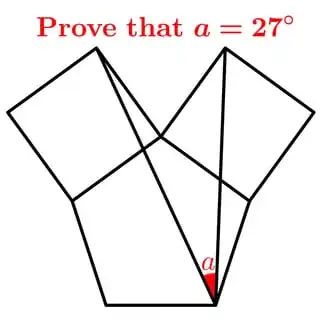
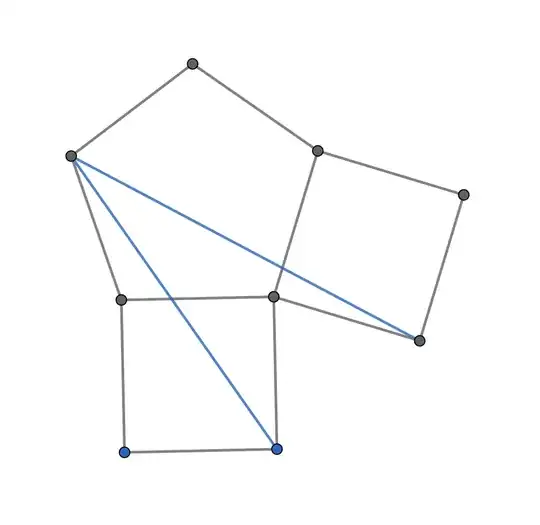
The figure shows a regular pentagon and two squares sharing adjacent sides of the pentagon. Some vertices are connected by straight lines as shown.

A regular pentagon and two squares

We would like to prove that angle $a$ is exactly $27°$.

The most mysterious thing of the question is that the two straight lines do NOT form any nice angle (i.e. rational) beside angle $a$ . This makes it surprisingly difficult to find the value of $a$ by basic geometry, despite the simple construction of this figure.

Yet, since the value of $a$ is indeed, again, surprising nice, my colleagues and I believe that there must be a basic geometric proof for it.

Unfortunately, we haven't been able to find such proof yet. This question has hounded us for months, so I would like to share it to you all and we are looking forward to your amazing proof.

Chris So
  • 681
  • 2
  • 9
  • Why are you outlawing trtigonometry (aka analytical geometry)? $~27^\circ~$ is such a non-special angle that it is hard to imagine a purely geometric proof. I question what the problem composer's intent is. – user2661923 Sep 11 '25 at 19:53
  • 2
    @user2661923, it is quite special as it is commensurable with $\pi$. – Alexey Sep 11 '25 at 19:58
  • @Alexey what does "commensurable with $~\pi$" signify? – user2661923 Sep 11 '25 at 20:03
  • 4
    $27^0 = 3 \pi / 20$. – almost_okay Sep 11 '25 at 20:07
  • @user1664025, see the comment above. – Alexey Sep 11 '25 at 20:10
  • 2
    @user2661923: Technically "commensurable" means something like "measurable with the same device", practically you can think of it as meaning "has a rational ratio with" – Henrik supports the community Sep 11 '25 at 20:32
  • 4
    Do you have a proof already (trigonometric or otherwise)? If so, please include it, so that people don't waste time duplicating your effort or explaining things you already understand. Plus, it'll let us know for sure that the result is actually true. (For what it's worth, a quick GeoGebra sketch indicates that the angle is exactly $27^\circ$, even at $15$-digit rounding.) – Blue Sep 11 '25 at 20:44
  • 2
    27° = 108°/4 might be relevant. – Intelligenti pauca Sep 11 '25 at 20:56
  • This figure reminds (unfolding) this polyhedron... thats all :) – Jean Marie Sep 11 '25 at 22:27
  • @Blue GeoGebra-wise, yes it's exactly 27° even at 15° rounding. Meanwhile we haven't got a Geometric proof for it which we are so desperate for (and trigonometric proof is quite difficult to give an exact 27° here we guess) – Chris So Sep 12 '25 at 05:00
  • @user2661923 Trigonometry is definitely acceptable if one can show that it is EXACTLY 27°, which we believe being not that easy to be accomplished here. Also, mysteriously being exactly 27° makes us believe that there must be some inspiring geometric facts behind, that we are so eager to find out – Chris So Sep 12 '25 at 05:13
  • I can give a semi-proof of exactness aided by Wolfram alpha: assuming that the angle is set at the origin, the two points are $e(1/5)+e(2/5)+e(7/20)$ and $e(1/5)+e(2/5)+e(3/20)$, where $e(x) = e^{2\pi i x}$. Alpha finds an exact expression for the $20$th power of the ratio of these two values as the (real) number $\frac12(159695\sqrt{5}-461373)+60\sqrt{5(4727465 - 2046638\sqrt{5})}$. This implies that the angle must be an integral multiple of $\frac\pi{20}$ and from easily-obtained bounds it's obvious that it must be $\frac{3\pi}{20}$. – Steven Stadnicki Sep 12 '25 at 18:33
  • Incidentally, what's the origin of this problem? Did you discover that $a=3\pi/20$ yourself or did you come across this elsewhere? – Steven Stadnicki Sep 12 '25 at 22:06
  • 2
    I have found here the same question asked 4 years ago, but without solution... – Jean Marie Sep 12 '25 at 23:05
  • Brainstorming: I'd construct a third square to the left, extend the far edges of the squares to so they intersect (there's a "kite" between any two squares-- and the far sides will form a larger pentagon). I'd construct lines everywhere I could including the other vertices of the squares, from the vertices of the larger pentagon (which would bisect $\alpha$ FWIW). I strongly believe you will get four angles congruent to $\alpha$ and the line up with the pentagon angle (but off-set by a wedge maybe) so $\alpha = \frac {108}{4}$. – fleablood Sep 13 '25 at 16:18
  • This reminds me of the "Langley's adventitious angles" problem: https://en.wikipedia.org/wiki/Langley%27s_Adventitious_Angles – J. Heller Sep 15 '25 at 20:52
  • 1
    @J.Heller We have several questions about Langley's puzzle: https://math.stackexchange.com/q/6942/207316 – PM 2Ring Sep 15 '25 at 21:13

18 Answers18

18

Here is a solution using complex numbers geometry.

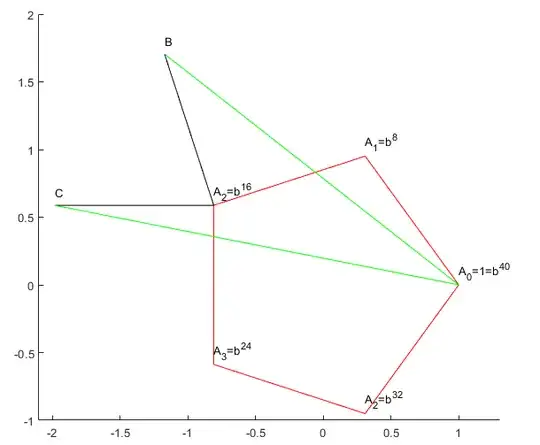
Let us "install" the given figure into a coordinate system with origin in the center of the pentagon and main vertex $A_0$ in $(1,0)$ as shown on Fig. 1, where :

$$b:=e^{2i \pi/40}\tag{1}$$

The polar angle of $b^3$ is $3 \pi/20 \ ( = 27°)$, the angular value we should obtain for $\angle BA_0C$.
enter image description here

Fig. 1.

Let us convert point $B$ into its complex form. Let us use for that relationship $\vec{A_2B}=R(\vec{A_2A_1})$ where $R$ is the $+\pi/2$ rotation :

$$B \leftrightarrow \beta:=\underbrace{b^{16}}_{A_2} + \underbrace{i}_R\underbrace{(b^8-b^{16})}_{A_1-A_2}$$

Or, under a different form :

$$B \longleftrightarrow \beta= b^{16} + b^{10}(b^8-b^{16}) = b^{16}+b^{18}+b^6$$

Remark : we have used various relationships such as

$$b^{10}=i, \ \ b^{20}=-1, \ \ b^{40}=1\tag{2}$$

For similar reasons, relationship $\vec{A_2C}=R^{-1}(\vec{A_2A_3})$ gives :

$$C \longleftrightarrow \gamma:=b^{16} - i(b^{24}-b^{16})$$

With simplifications :

$$C \longleftrightarrow \gamma= b^{16}+b^{14}-b^6$$

Therefore, vectors $\vec{A_0B}$ and $\vec{A_0C}$ have the complex representation :

$$\begin{cases}\vec{A_0B} \longleftrightarrow (\beta-1)\\\vec{A_0C} \longleftrightarrow (\gamma-1)\end{cases}$$

We still have to express with complex numbers that angle $(\vec{A_0B},\vec{A_0C})$ has value $3 \pi/20$ :

$$(\beta-1)b^3 \stackrel{?}{=} k(\gamma - 1)\tag{3}$$

where $k$ is a real number.

Otherwise said, we have to show that complex number

$$z:=\frac{(\beta-1)b^3}{(\gamma - 1)} \stackrel{?}{\in} \mathbb{R} \tag{4}$$

First solution : condition above can be expressed in the following way :

$$ z \stackrel{?}{=} \bar{z}\tag{5}$$

Let us give explicit expressions for $z$ and $\bar{z}$:

$$\begin{cases}z&=&\frac{(b^{16}+b^{18}+b^6-1)b^3}{(b^{16}+b^{14}-b^{6}-1)}&=&\frac{N}{D}\\ \bar{z}&=&\frac{(-b+b^{19}-b^{11}+b^{17})}{(-b^4-b^6+b^{14}-1)}&=&\frac{N'}{D'}\end{cases}$$

Remark : the expression of $\bar{z}$ is obtained by taking the conjugation of all the terms in $z$ knowing that the conjugate of $b^k$ is $b^{40-k}=-b^{20-k}$.

Relationship (4) amounts to the equivalent question for the following polynomial $$\underbrace{ND'-N'D}_{P(b)} \stackrel{?}{=} 0.\tag{6}$$

Expanding the LHS of (6):

$$P(b)=-b^{47} - b^{45}- b^{35} - b^{33} - b^{25} + b^{23} - b^{15} - b^{13} + b^7 + b^3 \stackrel{?}{=}0$$

which is indeed true due to a remarkable cancellation of all its terms ($-b^{47}$ with $b^7$, $-b^{45}$ with $- b^{25}$, etc.) (refer to formulas (2) above) $\square$

Second solution

Based on a simplification of the expression of $z$ using SAGE (a public domain Computer Algebra System) with the following code :

x = polygen(ZZ, 'x')
mp = x^16 - x^12 + x^8 -x^4 + 1
K.<b> = NumberField(mp)
z = (b^18+b^16+b^6-1)*b^3/(b^16+b^14-b^6-1)
z = z.coordinates_in_terms_of_powers() 
print(q)

where the field extension $K.<b>$ (alias $\mathbb{Q}[b]$) is classically described using the minimal polynomial of $b$, i.e., $mp(x) = x^{16} - x^{12} + x^8 - x^4 + 1$ (see remark 1 below).

Running this program gives the result :

$$z= -b^{13} + b^7$$

which is indeed a real number :

$$z=-2i b^{10}\left( \frac{b^{3}-b^{-3}}{2i}\right)=2 \sin(3 \pi/40) \color{red}{\in \mathbb{R}}$$

Remarks :

  1. As $b$ is a primitive $40$th root of unity, its minimal polynomial is the so-called cyclotomic polynomial of order $40$, denoted $\Phi_{40}(x)$. Its coefficients can be obtained from the SAGE instructions below :

    from sage.rings.polynomial.cyclotomic import cyclotomic_coeffs print(cyclotomic_coeffs(40))

  2. This second solution has been inspired by Steven Stadnicki's answer.

  3. PM 2Ring has given a similar SAGE program that I find excellent (more concise than mine) ; it can be uploaded here. I reproduce it here:

K.<b> = CyclotomicField(40)
print(K)
print(K.defining_polynomial())
z = (b^18+b^16+b^6-1)*b^3/(b^16+b^14-b^6-1)
print(z)
q = SR(z):#type conversion to complex
print(q)
print(q.real(), q.imag())
Jean Marie
  • 90,941
  • 5
    Beautiful answer. – Ataulfo Sep 14 '25 at 23:23
  • 1
    This is why people love complex numbers! – Vincent Sep 15 '25 at 08:13
  • @Vincent I just added a second solution using the power of a CAS. – Jean Marie Sep 15 '25 at 09:01
  • You can link live Sage code here via SageMathCell, eg https://sagecell.sagemath.org/?z=eJzz1rNJslOwVXCuTM7JL8nPzUx2y0zNSdEwMdDk5Sooyswr0fBGsPRSUtMy8zLz0uML8nMq84DKE3M0NIHyyhAFyXBTkBUAzQIq4eWqAtqjkRRnaKYNJCyAhJmuoaaClkJSnLGCPkLGRBciA7O1Cqy5EKg5OAjMgQgXIlh6Rakgd-goFOpl5iamA10EANF6Pxc=&lang=sage – PM 2Ring Sep 16 '25 at 19:08
  • @PM 2Ring A big thank : your program is very straightforward and elegant ; I hadn't thought to place the issue into this cyclotomic field. – Jean Marie Sep 16 '25 at 20:09
18

A trigonometric solution is possible, with the help of a CAS (Mathematica, in my case). We can start from: $$ \cos72°={\sqrt5-1\over4},\quad \cos126°=-\sqrt{5-\sqrt5\over8},\quad \cos162°=-\sqrt{5+\sqrt5\over8},\quad \cos108°={1-\sqrt5\over4}. $$ Using the bisection formula twice, from the last equality one also gets: $$ \cos27°= \sqrt{\frac{1}{2} \left(1+\sqrt{\frac{5-\sqrt{5}}{8}}\right)}. $$ Setting the side of the pentagon to be unit, we can then find (see figure below) with the cosine rule: $$ BD={\sqrt5+1\over2},\quad GH=2\sqrt{5-\sqrt5\over8} $$ $$ BG^2=\frac{1}{2} \left(5+\sqrt{5}+\sqrt{2 \left(5+\sqrt{5}\right)}\right) $$ $$ BH^2=\frac{1}{2} \left(5+\sqrt{5}\right)+\sqrt{5+2 \sqrt{5}} $$ and finally: $$ \cos(\angle HBG)=\frac{1}{2} \sqrt{2+ \sqrt{\frac{5-\sqrt{5}}{2} }} $$ which is the same as $\cos27°$ given above.

enter image description here

17

A "Synthetic" Solution

color-coded picture with more things labeled

Consider a rotation with center $O$ by $72^\circ$. This rotation maps the pentagon onto itself and sends the left square in the original diagram to the right square. Of the two lines in the original diagram meeting at angle $a$, call the left one $\ell_1$ and the right one $\ell_2$. The proof's thesis is equivalent to demonstrating that $\ell_2$ and the image of $\ell_1$ in our rotation (which is line $AE$ in the below diagram) meet at an angle $72^\circ-27^\circ=45^\circ$. This is equivalent to the intersection between these two lines lying on the circumcircle of the right square, which we'll call $\omega_2$. Since the line between the second intersections of $AD$ and $\ell_2$ with $\omega_2$ is parallel to side $BC$ by symmetry, this is the same as proving that lines $AD$ and $AE$ are isogonal in $\angle BAC$.

Now, consider the isogonal conjugate of point $D$ with respect to triangle $ABC$. By angle chasing, one can prove that this point is the intersection of line $CO$ and the angle bisector of $\angle CBO$. Let's call this point $W$.

By the Angle Bisector Theorem, we know that $\frac{OW}{WC} = \frac{OB}{BC}$. Since $O$ is the center of the pentagon, $OB=OE$ and $BC=CA$. Therefore, $\frac{OB}{BC} = \frac{OE}{CA}$. Notice that $OE \parallel AC$. From this follows that $W$ lies on the line segment between $E$ and $A$ since it sends one into the other via an homothety. This implies that lines $AD$ and $AE$ are isogonal with respect to $\angle BAC$, which is what we needed to prove.

zonta enrico
  • 171
  • 3
  • You should add a picture to illustrate your solution. – Duong Ngo Sep 15 '25 at 13:24
  • Sorry. I was not able to load the image due to skill issue . The triangle ABC is made by 3 of the 4 vertex of the right square, and shares the side BC with the Pentagon. E is the furthest vertex of the Pentagon to BC and D is the furthest (except E) vertex of the Pentagon from A. The two angles we need to prove are equal are DAB and EAC and reflecting one of those art the perp. bisector of BC gives us the cyclicity we needed. – zonta enrico Sep 15 '25 at 13:26
  • People often forget the exclamation mark when uploading images. In fact, the answer textbox handles it all. It looks like this [![enter image description here][1]][1] – Duong Ngo Sep 15 '25 at 13:35
  • 3
    I made a diagram to try and follow your argument, so I made an edit to add the image. Please check I haven't made any mistakes. Here's a link in case the edit hasn't been approved yet. – Tesseract Sep 15 '25 at 15:23
  • 1
    Yes, It seems all right, thanks a lot! It didn't let me insert an Image since my account is still too new and from android I was struggling to create a link and gave up. – zonta enrico Sep 15 '25 at 18:40
  • [+1] Good idea to use isogonality. But I have found difficult to see what you call left square vs. right square. For example, when you refer to a $72°$ rotation : is it in fact a $-72°$ rotation (in the conventional direct orientation) ? Same thing for left line vs. right line. Could it be possible that you modify a little your text ? – Jean Marie Sep 16 '25 at 05:28
  • 3
    @zontaenrico Beautiful solution! I'd found the point $W$ but I hadn't noticed the isogonal conjugation. I've added a bit more detail to your first paragraph, as well as added a slightly busier picture. (Tesseract's picture is still in the text of the answer, as link [1].) Feel free to revert either of the edits if you wish. – Carl Schildkraut Sep 16 '25 at 08:57
15

Really grateful for recieving all of your amazing tactics to this question!

And big thanks to Mr. Bùi Văn Cường from Facebook who has provided his fabulous proof involving only basic geometry. I would like to share the proof to all of you here.


I. Preliminary Construction

enter image description here

Let $P$ be a point on $CF$ such that $AC=AP$ .

$\angle ACP=45°+36°=81°$

$\angle CAP=180°-81°-81°=18°$

Reflect $B$ along $AF$ to $Q$ , such that rhombus $AQFB$ is formed.

Considering the exterior angles of pentagon $ABCDE$ and square $BCGF$ ,

$\angle ABF=72°+90°=162°$

$\angle QAB=180°-\angle ABF=18°$

Thus, $\angle QAP=\angle BAC=36°$ .

With $AQ=AB$ and $AP=AC$ , we have $\triangle QAP \cong \triangle BAC$ .

enter image description here

$\angle PQF=\angle AQF-\angle AQP=162°-108°=54°$

$\angle DAP=\angle EAB-\angle EAD-\angle PAB=108°-36°-18°=54°$

Together with $QF=QP$ and $AP=AD$ , we have

$$\triangle FQP \sim \triangle PAD$$


II. Key Similar and Congruent Pairs

enter image description here

Claim: $\triangle ACH \sim \triangle DPF$ .

$\angle QPF=(180°-\angle PQF)\div2=63°$

$\angle DPF=\angle QPF+\angle APQ+\angle DPA=63°+36°+63°=162°$

$\angle ACH=\angle ACD+\angle DCH=72°+90°=162°$

Since $\triangle FQP \sim \triangle PAD$ (proven in I), we have

$$DP:PF=AP:QF=AC:CH$$

Thus, we have $\triangle DPF \sim \triangle ACH$ .

enter image description here

One shall also easily prove that $\triangle ABG \cong \triangle DCF$ .

Together with $\triangle DPF \sim \triangle ACH$ , we have

$$\angle BGA=\angle CFD=\angle CHA$$


III. Aid of Concyclicity

enter image description here

In isosceles triangle $DCG$ , we have $\angle CGD=\angle CDG=9°$ .

Extend $GD$ to point $R$ such that $\angle RHD=9°$ .

$\angle GDH=\angle CDH-\angle CDG=45°-9°=36°$

$\angle DRH=\angle GDH-\angle RHD=36°-9°=27°$

Lastly, note that

$\angle AGR=45°+9°-\angle BGA=54°-\angle BGA$

$\angle AHR=45°+9°-\angle CHA=54°-\angle CHA$

Since $\angle BGA=\angle CHA$ (proven in II), we then have $\angle AGR=\angle AHR$ .

Thus, $A,G,H$ and $R$ are concyclic.

Hence, $\angle GAH=\angle GRH=27°$ .

Chris So
  • 681
  • 2
  • 9
  • +1. This is the simplest solution so far! BTW, what software did you use to make the figures? It looks like TikZ, is it? – Pranay Sep 16 '25 at 20:05
  • 1
    @Pranay I used Geogebra for making the figures – Chris So Sep 17 '25 at 02:11
  • 1
    @Pranay In Geogebra you can write labels between dollar signs like $A$ to get a Latex-looking $A$. Which is why a Geogebra diagram can end up looking like Tikz output. – Silverfish Oct 15 '25 at 19:46
  • @Silverfish. Ah, I see. I didn't know about this feature. That's indeed why I thought it was TikZ. – Pranay Oct 15 '25 at 20:16
  • 1
    @Pranay It's very helpful to make Geogebra output look more "professional"! – Silverfish Oct 15 '25 at 21:05
10

This is an alternative ending to the proof in the very nice solution credited to Mr. Bùi Văn Cường.

After the step in which it is proved that angles $\angle AHC$ and $\angle AGB$ in the figure below are congruent, extend $HC$ and $GB$ to meet at $J.$

pentagon and two squares as in the question, extended as described above

Since $\angle AHJ \cong AGJ$ and $G$ and $H$ both lie on the same side of $AJ,$ the two angles are inscribed in the same circle through $A,$ $J,$ $G,$ and $H.$ But $\angle GAH$ and $\angle GJH$ are inscribed in the same circle and intercept the same arc $GH,$ so $\angle GAH \cong GJH.$

By simple angle chasing we find that the measure of $\angle GJH$ is $27^\circ.$ Therefore the measure of $\angle GAH$ is $27^\circ.$

David K
  • 111,757
  • 2
    Very nice ending of using the two proven equal angles directly without constructing extra 9°! Like it so much! – Chris So Sep 17 '25 at 02:08
  • This is definitely a better ending to Bui's lovely proof. His R isn't a standard straight-edge & compass construction. ;) I notice that the little BJ triangle is isosceles, but I don't know if that helps. Also, the angle from the circumcentre to J is -45°. – PM 2Ring Sep 18 '25 at 00:59
8

Here is a solution that requires almost no calculation.

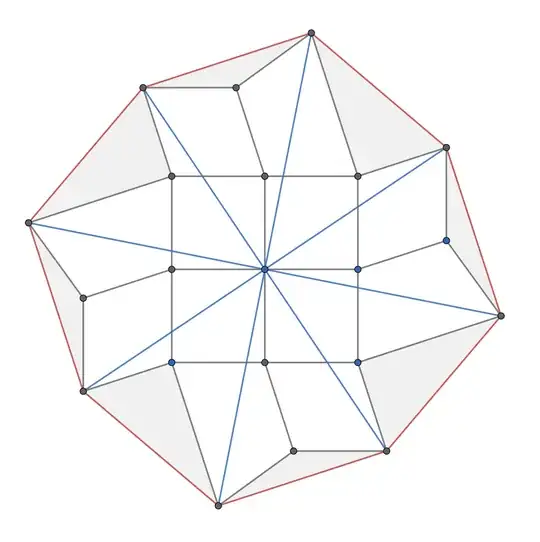
First, consider the following tiling pattern. The white region is made up only of tiles with angles $90^\circ$, $72^\circ$, and $108^\circ$, and it is surrounded by two types of gray triangles. Remarkably, in this setting all the outer (red) edges turn out to have the same length. In other words, the blue diagonals are evenly spaced every $45^\circ$.

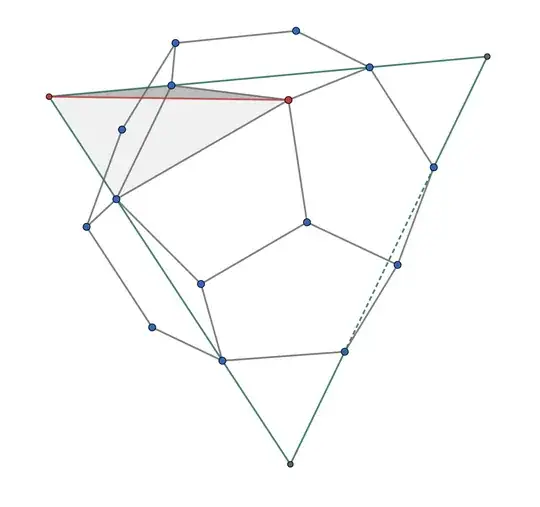
To see why this is the case, look at the equilateral triangle formed by joining certain diagonals of a regular dodecahedron as below. The two gray triangles on the front and top correspond exactly to the two types of gray triangles in the original figure, so we can conclude that their edge lengths are equal.

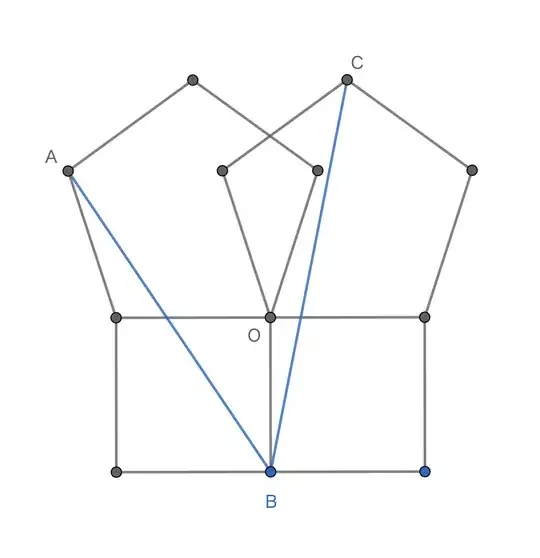
Now, if we extract the upper part of the original tiling pattern, we obtain the following configuration, where angle ABC measures $45^\circ$.

If we rotate the square and pentagon on the right by $72^\circ$ about point O, we get precisely the figure in question. Hence the desired angle is $$ 72^\circ − 45^\circ = 27^\circ. $$

Jun Koizumi
  • 2,281
7

Not an answer, but a musing upon a possible geometric solution: if we take the circumcircle of the triangle whose three vertices determine $\alpha$, then the corresponding central angle (red and dashed in the diagram below) will be $2\times27^\circ=54^\circ$; if we take circumcircles again, the new central angle (green) will be $2\times54^\circ=108^\circ$, which is the same as the angle at each vertex of the pentagon. Is there some way to argue geometrically that those angles must be equal?

diagram

Greg Martin
  • 94,676
  • 1
    Another possible route to geometrical proof: https://i.sstatic.net/YjPv1OMx.png . What remains to prove is that when you draw line from A through D to meet circumcircle at C, then the line B-C goes through pentagon vertex E. After that I think a proof that ∠BAC = 27° follows easily from known angles. – jpa Sep 14 '25 at 19:12
6

Here are some brute-force (Mathematica-assisted) calculations from coordinates.

enter image description here

For a pentagon with radius $r$ (and side-length $2\sin36^\circ$) turned so that the square ears lie in the first and fourth quadrants, and taking the taking the mystery angle to be $\theta:=\angle BAC$, we can write $$\begin{align} A &= \left(\;-r(1+\cos36^\circ), r\sin36^\circ\;\right) \\ B &= \left(\;2r \cos36^\circ \sin36^\circ, \phantom{-}2r \sin^236^\circ\;\right) \\ C &= \left(\;2r \cos36^\circ \sin36^\circ, -2r \sin^236^\circ\;\right) \end{align} \tag1$$ Note that $$\sin36^\circ = \frac12\sqrt{\frac12(5 - \sqrt{5})} = \frac12\sqrt{\frac{\sqrt{5}}{\phi}}=\frac{f}{2q} \qquad \cos36^\circ = \frac14 (1 + \sqrt{5}) = \frac12\phi = \frac12q^2 \tag2$$ where $\phi$ is the Golden Ratio (ie, the positive root of $\phi^2 = \phi+1$), and $f:=\sqrt{\sqrt{5}}$ and $q:=\sqrt{\phi}$ are for convenience. For more convenience, we take $r = 2q^2/f$ so that we have $$ A = (-fq^4, q) \quad B = (q^3, f) \quad C = (q^3,-f) \tag3 $$ and calculate $$ |BC| = 2f \qquad |AB|^2 = 4 f q^3 (f q + 1) \qquad |AC|^2 = 4 f q^4 (f + q) \tag4 $$ where here and hereafter I'm manipulating expressions involving $q$ with the help of the $q$-ified Golden Ratio identity, $q^4 = q^2+1$. Continuing, the Law of Cosines tells us $$\begin{align} \cos\theta &= \frac{-|BC|^2+|AB|^2+|AC|^2}{2|AB||AC|} \tag5\\[4pt] &= \frac{4f (2q^2 + 1) (f + q)}{2\sqrt{16 f^2 q^7 (fq + 1) (f + q)}} \tag6\\[4pt] &=\frac{2q^2 + 1}{2(q^2+1)} \sqrt{\frac{f + q}{f + 1/q}} \tag7 \end{align}$$ Showing that this is equivalent to $\cos 27^\circ$ is cumbersome. Instead, we can leverage our expectation that $\theta=27^\circ$, and work on showing that $$\cos2\theta = \cos 54^\circ = \sqrt{\frac18(5-\sqrt{5})} \tag8$$ That is, $$2\cos^2\theta - 1 - \frac{f}{2q} = 0 \tag{8'}$$ Substituting from $(5)$, clearing denominators, and doing some grouping, the left-hand side becomes $$\begin{align} (q^4 - q^2 - 1) (f + 6 q - f^2 q + 2 f q^2 + 4 q^3) \;+\; q (4 - 2 f^2 + 7 q^2 - 3 f^2 q^2) \tag9 \end{align}$$ The first factor of the first term vanishes by virtue of the Golden Ratio identity; the second factor of the second term vanishes upon substituting $f$ and $q$ with their definitions. This establishes $(8)$; and, since $\theta$ is clearly acute, we may conclude $\theta = 27^\circ$, as desired. $\square$


I notice that @intelligenti pauca's answer is a little more streamlined than mine, but still involves a bit of an algebraic slog; likewise, @Jean Marie's. I'm not sure there's a slog-less solution. Since the problem can be setup in terms of $36^\circ$, and the solution is $27^\circ$, I considered approaching this by expanding everything in terms of trigs of $9^\circ$, but it didn't seem to be getting any easier.

Blue
  • 85,834
  • 2
    I think a certain amount of slog is inevitable. Here's a little Sage thing I did (before looking at the existing answers) that draws the diagram and gives the angle using complex numbers. https://sagecell.sagemath.org/?q=fulaeo – PM 2Ring Sep 15 '25 at 02:32
6

Another start of a solution without trigonometry lies in the fact that a regular icosagon can be constructed from a pentagon by alternately tiling pentagons and squares of the same side length.Tiling alternatively pentagons and squares of same sides

The target angle (shown in red) must be tilted towards the right angle so that it intersects the 27° angle marks on the icosagon (a chord of three sides lengths)


Here is my earlier attempt (the proof is not yet complete):

Draw the circumcircle of the triangle formed by the vertices of the angle (like an earlier answer), and multiply this five times on the circle (blue circles).

Notice the symmetric arrangement of the four cross-marked points Q, R, S and T on the circle, forming 4 right angles.

Hence the resulting inscribed angle is 135°. Divide this back by 5.

The measure of the initial angle is therefore 27°.

Multiplying the angle 5 times gets an angle of 135°

Arjen Dijksman
  • 229
  • 1
  • 12
  • T and S are intersection points of the circle and the squares. Q and R are placed symmetrically. You can use the GeoGebra here. – Arjen Dijksman Sep 15 '25 at 20:31
  • Remaining hole in the proof is in the "notice". The points R and Q are the important ones, but proving their location does not seem straightforward. – jpa Sep 16 '25 at 06:00
  • @jpa Yes indeed. That's where I got stuck for the moment. How can this square QFTS emerge in the pentagon + 2 Mickey Mouse ears structure? There is somewhere a hidden symmetry still to be found. Probably in a larger tiling pattern pentagons and squares. – Arjen Dijksman Sep 16 '25 at 15:25
  • 1
  • Your paving is a sub-structure of this paving 2) One can imagine it is the trace left by a Rhombicosidodecahedron when it is rolled on a plane...
  • – Jean Marie Sep 19 '25 at 18:01
  • Nice tilings. But I didn't find any pentagon in wikipedia tiling images. In the rhombicosidodecahedron, yes. – Arjen Dijksman Sep 19 '25 at 21:57