During the last week-end i tried to see where the OP argument went wrong, but now i could find the time to draw and type.
This is a detailed answer, but the reader in hurry may take a look to the
inserted picture, then skip all computations (that double OP computations) and to straightforward to [The difference] section.
To have a clear situation, consider the following closed contour
$C=
C(0) \sqcup
C(1) \sqcup
C(2) \sqcup
C(3) \sqcup
C(4) \sqcup
C(3') \sqcup
C(2') \sqcup
C(1') \sqcup
$, it has many parts, and a prime suggest a reflection w.r.t. $Ox$-axis.
Consider the following variables.
- $\varepsilon>0$ ("tiny" i.e. later we take first the limit $\varepsilon\searrow 0$),
- $r>\varepsilon>0$ ("small" i.e. $r<1/2$, later we take the limit $r\searrow 0$),
- $R>0$ ("big", i.e. $R>2$, and we will go with $A\nearrow\infty$).
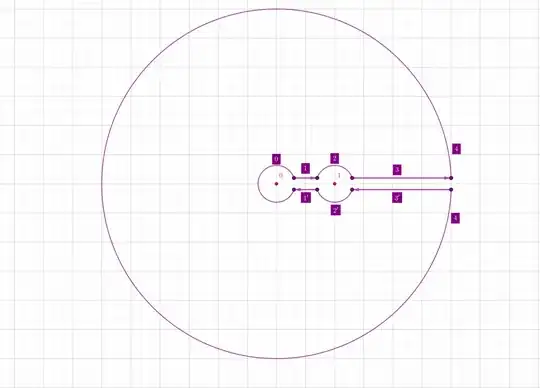
In the picture then the segments parallel to the $Ox$-axis have distance $\varepsilon$ to it. The paths used are denoted by $C(j)$, where $j$ is a label among $0,1,2,3,4,3',2',1'$. The arcs of circles centered in $0,1$ correspond to circles with radius $r$ for indices $j\in\{0,2,2'\}$, and $R$ for $j=4$.
Let $\ln$ be the usual branch of the logarithm function which is real on
the positive real ray $\Bbb R_{>0}$, and it is defined on $\Bbb C$ with a cut on the closed ray $\Bbb R_{\le 0}$.
Let $1,a,a^2$ be the roots of $Z^3-1$, $a=(-1\pm i\sqrt 3)/2$.
Let our function of interest be $f(z) = z\; \log^2 z\; /\; (z^3-1)$.
Here, $\log$ is the branch of the logarithm function which is defined inside the drawn closed contour $C$, and coincides with $\ln$ in their common part of the first quadrant, where they are both defined. Then on $C(j)$, $j=1,2,3$ we have $\log=\ln$, and on the reflected parts $C(j')$ we have $\log = \ln + 2\pi i$.
The integral of $f$ on $C(j)$ is denoted by $J(j)$.
The Cauchy PV-integral of $(z\ln z)/(z^3-1)$ on $(0,\infty)$ is denoted by $J$. This is the integral of interest.
We can already pass to the limit $\varepsilon\searrow 0$, also in the drawing, but take care which is $\log$ (either $\ln$, or $\ln + 2\pi i$) when integrating. Note that we can focus on the real part of the integrals.
Then we have the relations:
$$
\begin{aligned}
2\pi i\sum_{b=a,\,a^2 }\underset{z=b}{\operatorname{Res}}
\frac {z\;\log^2 z}{z^3-1}
&
=
\sum_j
\int_{C(j)}\frac {z\;\log^2 z}{z^3-1}\; dz
\\
&= J(0) + (J(1)+J(3)) + (J(1')+J(3')) + (J(2)+J(2')) + J(4)
\ .
\\[4mm]
&\qquad\text{Consider now each piece in part:}
\\[4mm]
\underset{z=b}{\operatorname{Res}}
\frac {z\;\log^2 z}{z^3-1}
&=
\lim_{z\to b}(z-b)\cdot \frac {z\;\log^2 z}{(z-1)(z-b)(z-b^2)}
=\frac {b\;\log^2 b}{(b-1)(b-b^2)}
\ ,
\\
\sum_{b=a,\,a^2 }\underset{z=b}{\operatorname{Res}} f(z)
&=
\frac {a\;\log^2 a}{(a-1)(a-a^2)} +
\frac {a^2\;\log^2 a^2}{(a^2-1)(a^2-a)}
\\
&=
\left(\frac{2\pi i}3\right)^2\cdot \frac 1{(a-1)(1-a)} +
\left(\frac{4\pi i}3\right)^2\cdot \frac 1{(a^2-1)(1-a^2)}
\\
&=
\left(\frac{2\pi}3\right)^2\cdot \frac 1{(1-a)^2}
\left(1 + \frac 4{(a+1)^2}\right)
=
\left(\frac{2\pi}3\right)^2\cdot
\left(\frac 13-a\right)
\ .
\\[2mm]
2\pi i\sum_{b=a,\,a^2 }\underset{z=b}{\operatorname{Res}} f(z)
&=
2\pi i \left(\frac{2\pi}3\right)^2\cdot
\left(\frac 13-a\right)
=2\pi \left(\frac{2\pi}3\right)^2\cdot
\left(\frac 56i+\frac {\sqrt3}2 \right)
\\
&=\frac {4\sqrt 3}{9}\pi^3 + i\frac {20}{27}\pi^3\ ,
\\
&\qquad\text{ in agreement with OP residue computations.}
\\[4mm]
\left|\int_{C(0)}f(z)\; dz\right|
&\le
\int_{C(0)}\frac {|z|\;|\log z|^2}{|1-z^3|}\; dz
\le
\operatorname{length}(C(0))\frac {r\;(\ln r + 2\pi)^2}{1-\frac 18}
\\
&\le
2\pi r\cdot r\;(\ln r + 2\pi)^2 \cdot \frac 87\to 0\ ,
\\[2mm]
\left|\int_{C(4)}f(z)\; dz\right|
&\le
\int_{C(4)}\frac {|z|\;|\log z|^2}{|z^3-1|}\; dz
\le
\operatorname{length}(C(4))\frac {R\;(\ln R + 2\pi)^2}{R^3-1}
\\
&\le
2\pi R\cdot \frac R{R^3-1}\;(\ln R + 2\pi)^2 \to 0\ ,
\\[2mm]
J(1)+J(3)+J(1')+J(3')
&\to
\left(\int_r^{1-r}+\int_{1+r}^R\right)
\frac {z\;\ln^2 z}{z^3-1}\; dz
-
\left(\int_r^{1-r}+\int_{1+r}^R\right)
\frac {z\;(\ln z + 2\pi i)^2}{z^3-1}\; dz
\\
&=
\left(\int_r^{1-r}+\int_{1+r}^R\right)
\frac {z\;(2\pi)^2}{z^3-1}\; dz
-
\left(\int_r^{1-r}+\int_{1+r}^R\right)
\frac {z\cdot 2\;\ln z(2\pi i)}{z^3-1}\; dz
\\
&\to
(2\pi)^2\cdot\operatorname{PV}\int_0^\infty
\frac z{z^3-1}\; dz
-
4\pi i
\underbrace{\operatorname{PV}\int_0^\infty
\frac {z\;\ln z}{z^3-1}\; dz}_{=J}
\\
&=
(2\pi)^2\cdot\lim_{r\nearrow 1}
\left(
\int_0^r\frac z{z^3-1}\; dz
+
\int_{1/r}^\infty\frac z{z^3-1}\; dz\right)
-4\pi i\; J
\\
&=
(2\pi)^2
\int_0^1\frac {z-1}{z^3-1}\; dz -4\pi i\; J
=
(2\pi)^2\cdot \frac {\pi\sqrt 3}9 -4\pi i\; J\ ,
\\
&\qquad\text{ in agreement with OP P.V. computations.}
\end{aligned}
$$
The difference:
So far everything went on the lines of the question.
Where is the error in the computation?
The problem is with the integral parts on the $C(2)$ and $C(2')$, the limiting process must be taken in detail, so that a Cauchy-P.V. part and the "remainder" are explicitly exposed.
Let $C(1, r)$ be the circle contour around one, radius $r$, it is (in the limit) $C(2)\sqcup C(2')$, but with opposite orientation. Then we have:
$$
\begin{aligned}
J(2)
&= \int_{C(2)}\frac {z\;\log^2z}{z^3-1}
= -\int_{\displaystyle\substack{z = 1+re^{it}\\t\in[0,\pi]}}
\frac {z\;\ln^2z}{z^3-1}\; dz
\\
J(2')
&= \int_{C(2')}\frac {z\;\log^2z}{z^3-1}
= -\int_{\displaystyle\substack{z = 1+re^{it}\\t\in[\pi,\,2\pi]}}
\frac {z\;(\ln z+2\pi i)^2}{z^3-1}\; dz
\\[2mm]
J(2)+J(2')
&=
-\int_{C(1,r)}
\underbrace{\frac {z\;\ln^2z}{z^3-1}}_{\text{zero residue}}\; dz
-\int_\pi^{2\pi}
\frac {(1+re^{it})\;(2\pi i)^2}{(1+re^{it})^3-1}\; ir\; e^{it}\; dt
\\
&=
(2\pi)^2\int_\pi^{2\pi}
\frac {1+re^{it}}{r^2e^{2it} + 3 re^{it} + 3}\; i\; dt
\\
&\to
(2\pi)^2\int_\pi^{2\pi}
\frac {1+0}{0 + 0 + 3}\; i\; dt
\qquad\text{ for $r\to 0$}
\\
&=i\frac 43\pi^3\ .
\end{aligned}
$$
We can now put all together.
In the limit we obtain from
$$
\begin{aligned}
2\pi i\sum_{b=a,\,a^2 }\underset{z=b}{\operatorname{Res}}
\frac {z\;\log^2 z}{z^3-1}
&
=
\sum_j
\int_{C(j)}\frac {z\;\log^2 z}{z^3-1}\; dz
\\
&= J(0) + \Big((J(1)+J(3)) + (J(1')+J(3'))\Big) + (J(2)+J(2')) + J(4)
\\[4mm]
&\text{ the following relation:}
\\[4mm]
\frac {4\sqrt 3}{9}\pi^3 + i\frac {20}{27}\pi^3
&=
0 + \left(\frac {4\sqrt 3}9\pi^3 -4\pi i\; J\right)
+
i\frac 43\pi^3
+
0\ .
\end{aligned}
$$
We have a perfect match of the real part.
And for the imaginary part we get:
$$
4\pi i\;\frac 5{27}\pi^2 =-4\pi i\; J
+4\pi i\;\frac 13\pi^2\ .
$$
This gives:
$$
J = \left(\frac 13 - \frac 5{27}\right)\pi^2
= \frac {9-5}{27}\pi^2
= \frac 4{27}\pi^2
\ ,
$$
as expected and wanted.
Note: The answer could have been written in a more spartan manner,
but in this case all giving details may be a good benefit for
the community.

