7

On a disk, two independent uniformly random points are chosen.

Two circles, $C_1$ and $C_2$, pass through these points and are tangent to the perimeter of the disk.

Two random circles on a disk

What is the probability that the intersection of $C_1$ and $C_2$ contains the centre of the disk?

I will post my answer, showing that the probability is $1/2$.

My answer uses integration; I am looking for a more intuitive explanation (here is an example of an intuitive explanation). If no such explanation is found, then I'll add this to my list.

I made a random circle generator.

Context

This question was inspired by a little geometry puzzle.

Dan
  • 41,295
  • 2
    Did you try a solution using inversive geometry? That seems like it might be suitable here. If no one tries it in the next couple of days, I'll give that a shot. There's a problem with the point distribution, of course, but there might be enough symmetries to finesse that. – Brian Tung Oct 06 '25 at 01:45
  • 1
    @BrianTung I haven't tried that. I'll think about it. Hope you do, too :) – Dan Oct 06 '25 at 01:48
  • 1
    Because the probability is $1/2$, I would expect their to be a bijection... oh well –  Oct 06 '25 at 01:57
  • 2
    @MaximeJaccon: If I take your meaning correctly (a bijection between point pairs, including and excluding?), you'd have to check to make sure that the point pairs have equal probability density. Otherwise, the probability doesn't necessarily come out to $1/2$. – Brian Tung Oct 06 '25 at 02:00
  • @BrianTung : you mean reflecting via outer circle? if so: that gives equivalent question and (see my answer) flips red circle when Rc passes Mr. – FirstName LastName Oct 06 '25 at 23:06
  • 1
    @FirstNameLastName: Yeah, that's what I decided too. Too bad; I was hoping there would be a nice elegant answer coming from that. (Or there may still be, but I'm insufficiently clever to see it.) – Brian Tung Oct 07 '25 at 00:07

2 Answers2

5

The probability is $1/2$

Assume that the radius of the disk is $1$.
Let the first random point be $P$, at a distance $x$ from the centre of the disk.
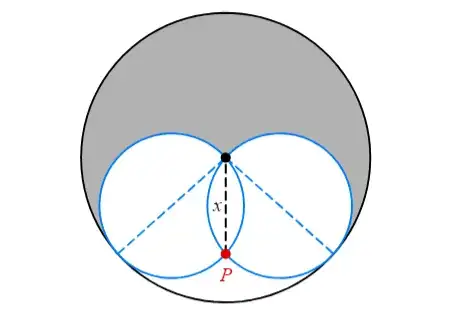
Solution diagram

Claim: The intersection of $C_1$ and $C_2$ contains the centre just if the second random point lies in the shaded region.

Proof of claim: If the second random point is on one of the six blue arcs, then one of the $C$ circles passes through the centre of the disk. From each blue arc, the second random point can move $(1)$ into the blue circle, or $(2)$ out of the blue circle. For each of the twelve movements (or six, applying symmetry), we check whether this results in both $C$ circles containing the centre. The claim follows.

The unshaded region is comprised of a circular sector (bounded by the dashed lines) and two semidisks of radius $\frac12$, so its area is $\arccos x+\frac{\pi}{4}$. We integrate this area from $x=0$ to $x=1$, noting that the probability density function of $x$ is $f(x)=2x$.

$P(\text{not contain})=\dfrac{1}{\pi}\displaystyle\int_0^12x\left(\arccos x+\dfrac{\pi}{4}\right)dx=\dfrac12\space$ (integration by parts)

$\therefore P(\text{contain})=1-\dfrac12=\boxed{\dfrac12}$

Simulations

I did a simulation: $10^7$ trials yielded a proportion of $0.50002$ containing the centre.

Incidentally, a simulation suggests that the expected area of the five regions formed by the two circles are all equal, i.e. $1/5$ the area of the disk.

More importantly

The diagram in this answer reminds me of a cartoon character that I cannot recall exactly. The shaded area is perhaps the character's hair, or a hat. Can anyone identify the character?

Dan
  • 41,295
0

enter image description here

An attempt to explain probability might perhaps differ from 1/2.

see https://www.geogebra.org/classic/x8mzfc2y

Let Bc be center of outer blue circle. Let Bg be center of inner green circle. Let Br be center of inner red circle.

Let cyan BG be where blue and green circles touch. Let magenta BR be where blue and red circles touch.

Since green and red circles intersect, at least one of them, say green one, have radius more than half the radius of the blue circle.

If Mg is middle of Bc:BG Gc is on Mg:Bc.

Rc is on BR:Bc.

In geogebra I take BG fixed and let BR move on blue circle and let Gc move and Rc move.

I see that Bc enters intersection when Rc passes Mr which is middle of Bc:BR.

That hints to 1/2 probability.

But if Rc:BR is small, there is no green red intersection and there are no A B so part of the segment Bc:BR seems to not apply...

Of course, we talk about uniform random points A B common to green and red circle.

Perhaps my choices do not translate to such uniform distribution.

I apologize for your valuable time.

  • 1
    Quote: "But if ... there is no green red intersection". According to OP, both of your green and red circles pass through two random points, so there must be green red intersections. – Dan Oct 06 '25 at 00:21
  • 1
    thanks for comment!, that is exactly my point, and my fear I may have mixed up uniform placement, because if the geogebra hint applies, something must be wrong, ... for all clarity: I modestly assume I am wrong, not you :) – FirstName LastName Oct 06 '25 at 00:24
  • 1
    thanks for adding simulation approximation! Have a nice day! – FirstName LastName Oct 06 '25 at 00:28
  • now I wonder if green red circle intersection points A B is a bijection ... sorry too keep on thinking aloud... – FirstName LastName Oct 06 '25 at 00:37