Here's a method for regular polygons with odd numbers of sides.
The figure below shows examples of regular $n$-gons for
$n = 3,$ $n = 5,$ and $n = 7.$
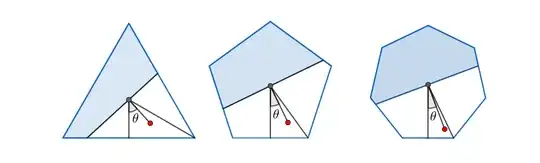
In each figure the red point represents one end of the diameter of the circle, selected as a random point within the lamina. We construct a line segment between the centroid of the lamina and the red point; perpendicular to this segment we construct a line through the centroid.
This line divides the lamina into two parts, one of which (the part containing the red point) is unshaded and the other of which is shaded.
The circle contains the centroid if and only if the other end of the diameter lies in the shaded portion of the lamina.
Therefore, given the location of one end of the diameter,
the conditional probability that the circle contains the centroid is equal to the ratio of the area of the shaded region to the area of the entire lamina.
We can construct a right triangle whose vertices are the centroid, the midpoint of an edge of the lamina, and a vertex on the same edge of the lamina. When the red point is within this triangle the conditional probability depends only on the angle $\theta$ between the segment connecting the red point to the centroid and the adjacent leg of the triangle. Moreover, by symmetry of the lamina the probability for the entire lamina is equal to the conditional probability given that the red point is in this triangle.
An intuition for why the overall probability is not $\frac12$ and a notion of how the probability differs from $\frac12$ depending on $n$ can be developed from the figure below showing a lamina in the shape of a regular pentagon.
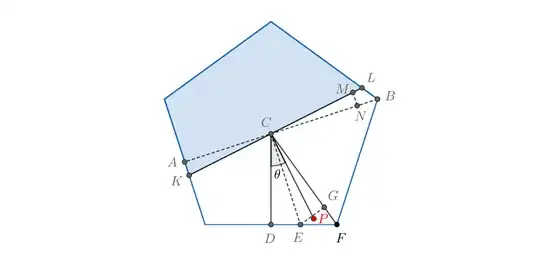
Let $C$ be the centroid of the pentagon, $D$ the midpoint of a side, $F$ a vertex on the same side, and $CE$ the bisector of the angle $\angle DCF.$
Let $P$ be the first random point selected. Without loss of generality we can assume $P$ is in the triangle $\triangle CDF.$
We shade the portion of the lamina such that if a point $Q$ is placed in that part of the lamina the circle on diameter $PQ$ contains the centroid $C.$
If $P$ is on the line $CE,$ the shaded part of the lamina is bounded by a line $AB$ through $C$ perpendicular to $CE,$ where $A$ is the midpoint of a side and $B$ is a vertex.
In that case the conditional probability that the circle contains the centroid is exactly $\frac12.$
Otherwise, if $P$ is in the triangle $\triangle CEF$
then a triangular region $\triangle ACK$ is added to the shaded region and a triangular region $\triangle BCL$ is removed.
For the pentagon, $\triangle BCL$ is larger than $\triangle ACK$;
in fact, $\triangle BCL$ can be subdivided into triangle $\triangle CMN$ (which is congruent to $\triangle ACK$) and the quadrilateral $BLMN.$
Therefore the conditional probability is less than $\frac12.$
But if $P$ is in triangle $\triangle CDE,$ the triangular region added to the shaded region is larger than the triangular region removed, producing a conditional probability greater than $\frac12.$
Let $\triangle CEG$ be the reflection of $\triangle CDE$ across $CE.$
By symmetry, the increases in probability for points $P$ in $\triangle CDE$ are exactly offset by the decreases in probability for points $P$ in $\triangle CEG.$
But $\triangle CDF$ can be partitioned into three triangles:
$\triangle CDE,$ $\triangle CEG,$ and $\triangle EFG.$
There is a positive probability that $P$ will be in $\triangle EFG,$
and when it is there then the conditional probability is less than $\frac12.$
Therefore the probability that the circle will contain the centroid $C$ is less than $\frac12.$
When we do the corresponding construction on a lamina in the shape of an equilateral triangle, however, when $P$ is in $\triangle EFG$ the region that is added to the shaded part of the lamina is greater than the part that is removed.
In general, we can tell whether the probability for a regular $n$-gon will be greater or less than $\frac12$ by looking at the line through the centroid $C$ perpendicular to $CE.$ If that line passes through the midpoint of a side on the same side of $CE$ as $\triangle EFG$ and through a vertex on the opposite side of $CE,$ the probability will be greater than $\frac12.$ This is the case for all $n$ of the form $n=4k - 1.$
If the vertex is on the same side of $CE$ as $\triangle EFG$ and the midpoint is on the opposite side, the probability will be less than $\frac12.$ This is the case for all $n$ of the form $n = 4k + 1.$
Moreover, intuitively we should expect the probability to be farthest from $\frac12$ when the quadrilateral $BLMN$ for each angle $\theta$ is largest. This occurs for the equilateral triangle. The equilateral triangle therefore maximizes the probability over all regular polygons.
The following is just a hunch, but it seems to me that the requirement of convexity reduces the upper bound on the probability. That is, convexity requires us to add material to the lamina that brings the probability closer to $\frac12.$
Consider the equilateral triangle, for example. Trisect each edge to construct the vertices of an equilateral hexagon. Divide the triangle into four pieces: that hexagon and three smaller equilateral triangles. The conditional probability that the circle contains the centroid given that both ends of the diagonal lie in the smaller triangles is some number $p > \frac12,$ but the probability given that both ends are in the hexagon is $\frac12$ and so is the probability given that one end is in a small triangle and one is in the hexagon. Since the probability for the entire triangle is a weighted average of $p$ and $\frac12,$ $p$ must be greater than the probability for the entire triangle. We could get as close to $p$ as we want while connecting the three triangles with thin strips, but we cannot get close to $p$ while taking the convex hull of the three triangles.
Taking this hunch to an extreme, we might hope to maximize the probability by removing the requirements of connectedness (which has trivial effect) and convexity (which appears to have a substantial effect). We might even maximize the probability by taking the lamina to be a set of small disks.
I cannot think of a better set of small disks than three disks placed at the vertices of an equilateral triangle. The probability that two random points chosen from these disks give the diameter of a circle containing the centroid is $\frac23.$ Taking the convex hull of these disks we get something like an equilateral triangle while lowering the probability somewhat. Extending the straight edges of that figure to make a true equilateral triangle just increases the probability again due to the chance that at least on end of the diameter is in the added pieces.
The disks could also be placed at vertices of a non-equilateral triangle and still achieve $\frac23$ probability, however, so the argument that the triangle should be equilateral doesn't seem as strong as the argument that the lamina should be a triangle.


What I am confused now is that it looks to me the same cancellations should also occur in the case of a equilateral triangle but your answer is already not $1/2$ in that case.
– dezdichado Oct 15 '25 at 13:43