What are some examples of a planar geometry problem with an elegant nonplanar solution?
I will post one example as an answer.

What are some examples of a planar geometry problem with an elegant nonplanar solution?
I will post one example as an answer.
The common chords of three circles intersect in a point:
Proof: Imagine we are actually looking at three spheres with the centers in the plane. The spheres intersect in circles, but we see those circles as these red chords. The three spheres have 2 common points (the intersection of 2 of them is a circle and it intersects the remaining sphere in two points) which we see as the intersection of the 3 chords.
Desargues' Theorem
That the three intersections are colinear follows from seeing this picture as a plane projection of a sliced triangular pyramid. The line is the intersection of the green and red slicing planes.
https://new.math.uiuc.edu/oldnew/netmath403/dup-publicSP11/affine/desargues.html
Given three coplanar disjoint circles, for each pair, draw the common external tangent lines. The intersections of each pair of tangent lines are collinear.
(Image from Mathworld)
Proof: Let each circle be the equator of a sphere. Let $P_1$ be the plane through the centres of the three spheres. Let $P_2$ be a plane that is externally tangent to the three spheres. Let $L$ be the intersection of $P_1$ and $P_2$. For each pair of spheres, draw the cone that encloses them. The tips of the cones are the intersections of each pair of tangent lines. Each cone's tip is in $P_1$ and also in $P_2$, so the tips all lie on $L$.
(This is Solution $1'$ from here.)
On square $ABCD$, points $E$ and $F$ lie on sides $BC$ and $CD$, respectively, such that $BE=CF$.
Line $BD$ intersects lines $AE$ and $AF$ at $G$ and $H$, respectively.
Using pure geometry, prove that a triangle with side lengths $BG$, $GH$ and $HD$ has at least one $60^\circ$ angle.
Solution:
This solution looks a bit complicated at first, but after you understand how it works, it is quite intuitive.
Rotate $ABCD$, along with lines $BD$ and $AF$, $90^\circ$ about $AB$ to form $ABB'A'$, as shown.
Rotate $ABCD$, along with lines $BD$ and $AE$, $90^\circ$ about $AD$ to form $AA'D'D$, as shown.
$\triangle AEF\cong\triangle AE'F'$ (SSS)
$\implies\angle GAH=\angle G'AH'$
$\implies\triangle GAH\cong\triangle G'AH'$ (SAS) (Side $G'H'$ goes through the interior of the cube.)
$\implies G'H'=GH$
We also have $A'G'=BG$ and $A'H'=HD$.
$\implies\triangle A'G'H'$ has side lengths $BG$, $GH$ and $HD$.
$\triangle A'BD$ is equilateral.
$\implies\angle G'A'H'=60^\circ$
$\therefore$ A triangle with side lengths $BG$, $GH$ and $HD$ has a $60^\circ$ angle.
This problem was posted on Puzzling.
Maybe this counts: a way to find the Delauney triangulation of a finite set of points in the plane is to
This is used in numerical computations because of efficient complex hull algorithms like QuickHull. It also generalizes to higher dimensions.
Imagine dots laid out in a hexagonal lattice. From a central dot how many (including the central dot itself) can be reached by marching $\le n$ units?
The array would look similar to the one drawn below for $n=2$. But we can bend this array along alternating radii to form a gnomon defining the difference between two cubes. Thus the answer to the above question is
$(n+1)^3-n^3=3n^2+3n+1.$
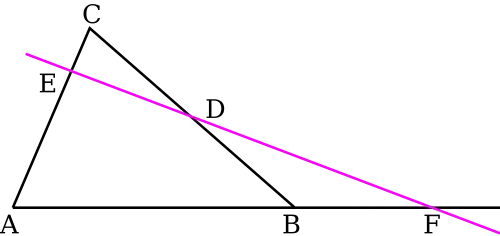
What about this one: The converse of Menelaus's theorem
Suppose $(AF/BF)*(BD/CD)*(CE/AE)=1$ with directed lengths. Then the six lengths here must all be nonzero. We can assume that $A,B,C,D,E,F$ (shown on the diagram) all lie on the $xy$ plane.
We can find nonzero reals $p,q,r$ with $AF/BF=p/q,BD/CD=q/r,CE/AE=r/p$ (directed lengths).
Let $A'$ have a z-coordinate of $p$, $B'$ have a z-coordinate of $q$ and $C'$ have a z-coordinate of $r$, and have $A', B', C'$ lie directly above/below $A,B,C$ respectively.
It is easy to see that the three sets $\{A',B',F\},\{B',C',D\},\{C',A',E\}$ each consist of colinear points, so the six points $A',B',C',D,E,F$ are coplanar. But $A,B,C,D,E,F$ all lie on the $xy$ plane, and as two planes intersect in a line we see that $D,E,F$ form a line.