7

Consider the set of of all $n$-tuples of non-negative numbers $x_i$ summing to $1$ and such that $x_i+x_j \geq x_k$ for any triple of distinct $i,j,k$. This is closed subset of the simplex, cut out by linear inequalities, so is a compact convex polytope.

  1. What are its vertices?
  2. More generally, what is known about it? E.g. what is its f-vector?
Max
  • 14,849

2 Answers2

6

Modest contribution :

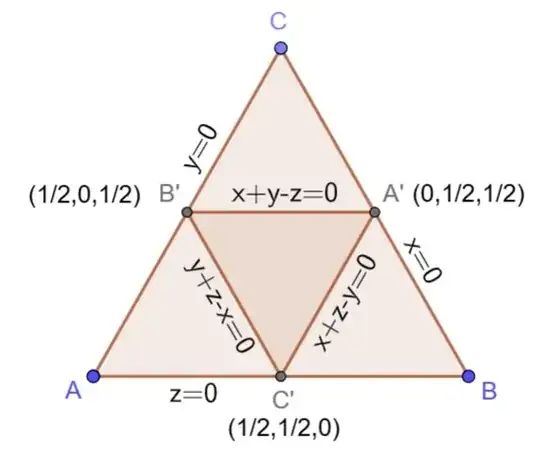
  1. Case $n=3$ where coordinates $x_1,x_2,x_3$, here denoted $x,y,z$ with $x+y+z=1$, can be interpreted as barycentric coordinates. With this interpretation, constraints $x+y=z, $ etc. can be represented as lines in barycentric coordinates, giving rise to vertices $A',B',C'$ with resp. coordinates : $$(0,\tfrac12,\tfrac12), \ (\tfrac12,0,\tfrac12), \ (\tfrac12,\tfrac12,0).$$

(see figure 1 below):
enter image description here

Fig. 1

  1. Case $n=4$: I have attempted to provide a similar representation (see fig. 2) with "generalized barycentric coordinates" where the triangle is replaced by a tetrahedron (see Fig. 2) with vertices in red. This figure takes the example of constraint $x+y=z$ (an example among 8 constraints $x+y=t, \ y+z=t, $ etc.) on barycentric coordinates, is represented by a plane, (vertices are to be found at the intersection of 4 planes).

Here are $8$ vertices divided into two groups:

$$\color{green}{(0,\tfrac13,\tfrac13,\tfrac13),(\tfrac13,0,\tfrac13,\tfrac13),(\tfrac13,\tfrac13,0,\tfrac13),(\tfrac13,\tfrac13,\tfrac13,0)}$$

(centers of mass of the different faces of the tetrahedron) and

$$\color{blue}{(\tfrac25,\tfrac15,\tfrac15,\tfrac15),(\tfrac15,\tfrac25,\tfrac15,\tfrac15),(\tfrac15,\tfrac15,\tfrac25,\tfrac15),(\tfrac15,\tfrac15,\tfrac15,\tfrac25)}$$

(colors' correspondence to be seen on Fig. 2)

But this has to be given a proof, moreover generalizable to any dimension...
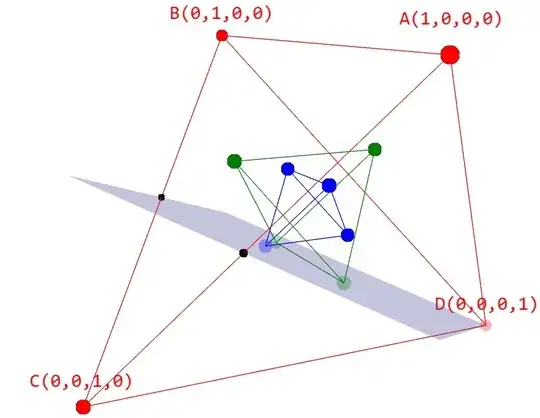
enter image description here

Fig. 2 : It has taken me some time before being able to visualize the (grey) plane defined by the following equation : $x+y=z$ (where $(x,y,z,t)$ are the 3D barycentric coordinates) ; it can be defined as the plane passing through vertex $D$ and the midpoints of edges $CA$ and $CB$. Besides, this plane contains 2 green points $(0,\tfrac13,\tfrac13,\tfrac13),(\tfrac13,0,\tfrac13,\tfrac13)$, and one blue point $(\tfrac15,\tfrac15,\tfrac25,\tfrac15).$

The equation of the grey plane in cartesian coordinates is $X-Y-3Z=1$ as a consequence of the following transformation :

$$\underbrace{\pmatrix{X\\Y\\Z\\1}}_{\text{hom. cart. coord.}}=\underbrace{\pmatrix{1&-1&1&-1\\1&-1&-1&1\\1&1&-1&-1\\1&1&1&1}}_{M}\underbrace{\pmatrix{x\\y\\z\\1-x-y-z}}_{\text{bar. coord.}}$$ $$\text{by taking} \ \pmatrix{x\\y\\z\\1-x-y-z}=\pmatrix{x\\y\\x+y\\1-2(x+y)}$$

$C=MB$ means converting barycentric coordinates $B$ into cartesian coordinates $C$ ; why that ? Because the colums of $M$ are the (homogeneous) cartesian coordinates of tetrahedron vertices $A,B,C,D$ resp.

Please note that the application of matrix $M$ is rendered in the program below by function $f$.

"SAGE" program for the generation of fig. 2 :

 var('x y z')
 a=1/3
 b=1/5
 #M=matrix(QQ,4,4,[[1,-1,1,-1],[1,-1,-1,1],[1,1,-1,-1],[1,1,1,1]])
 f(p,q,r,s)=(p-q+r-s,p-q-r+s,p+q-r-s) # matrix M applied to (p,q,r,s)  (baryc to cart)
 def F(L,c):
    A=L[0];B=L[1];C=L[2];D=L[3]
    M=line3d((A,B,C,D,A,C,B,D),color=c) # tetrahedron
    for k in range(4):
        M=M+point3d(L[k],color=c,size=20) # vertices
    return(M)
 L1=[f(1,0,0,0),f(0,1,0,0),f(0,0,1,0),f(0,0,0,1)]            
 L2=[f(0,a,a,a),f(a,0,a,a),f(a,a,0,a),f(a,a,a,0)]
 L3=[f(2*b,b,b,b),f(b,2*b,b,b),f(b,b,2*b,b),f(b,b,b,2*b)]
 G=F(L1,"red")+F(L2,"green")+F(L3,"blue")
 G+=implicit_plot3d(x-y-3*z-1,(x,-1,1),(y,-1,1),(z,-1,1),frame=false,opacity=0.3)
 e=0.15;
 G+=point3d(f(1/2,0,1/2,0),color="black",size=10)
 G+=point3d(f(0,1/2,1/2,0),color="black",size=10)
 G+=text3d("A(1,0,0,0)",(1,1,1+e),color="red")
 G+=text3d("B(0,1,0,0)",(-1,-1,1+e),color="red")
 G+=text3d("C(0,0,1,0)",(1,-1,-1+e),color="red")
 G+=text3d("D(0,0,0,1)",(-1,1,-1+e),color="red")
 show(G)
Jean Marie
  • 90,941
4

The equation and inequalities are symmetric with respect to the permutation group, hence so is the polytope $P$ in question. It follows that it is the union of subpolytopes obtained by permuting the variables from the polytope $Q$ defined by the same equation and inequalities plus the inequalities $x_1 \leq x_2 \ldots \leq x_n$, and every vertex of $P$ is a vertex of one of those. It is therefore enough to find all vertices of $Q$, and determine which of those are vertices of $P$ -- they and all of their images under coordinate permutations will be the vertices of $P$.

In general, for a convex set a point $p \in P$ is an extreme point if and only if there is no segment containing $p$ in the interior and contained in $P$. For convex polytopes these correspond to vertices.

Claim: For a convex polytope defined by a set of linear equations and inequalities, with corresponding hyperplanes $H_j$, and a point $p$ in it, take all the hyperplanes such that $p \in H_j$ (i.e. all the ones from the equations, and those of the inequalities for which $p$ makes them into equalities). Then $p$ is a vertex if and only if the normals to these planes span $\mathbb{R}^n$.

Proof: If $p$ is not a vertex, then it lies on some segment, i.e. there is a $v$ such that $p+t v \in P$ for all $t \in [-\varepsilon, \varepsilon]$. Then $v$ is in all the hyperplanes in question, and is orthogonal to all their normals. Hence the normals don't span. Conversely, if the normals don't span, there is a $v$ orthogonal to all of them, and the corresponding segment lies in $P$ for small enough $\varepsilon$. QED.

Returning to $Q$, the defining inequalities are $0 \leq x_1$, the $n-1$ inequalities $x_i \leq x_{i+1}$ for $i \in \{1,\ldots, n-1\}$, the triangle inequality $x_1+x_2\geq x_n$ and the equation $\sum x_i =1$ -- all other triangle inequalities follow from them. That is $n+2$ equations+inequalities. For $q \in Q$ to be a vertex, it must turn at least $n$ of them into equalities. Luckily, one of them is very strong:

Case 1: $x_1=0$. Then $x_2\geq x_n$ and $x_n\geq x_2$, so all $x_i$ are equal, $q=(0, 1/(n-1), \ldots, 1/(n-1))$. Then $q$ satisfies $x_1=0$, $x_1+x_i=x_j$, and $\sum x_i =1$. The normals span, so this is a vertex of $P$ (and of $Q$).

Case 2: $x_1>0$. Now there are $n+1$ equations/inequalities that can be satisfied.

Case 2a: $x_1+x_2 > x_n$. The remaining $n$ equations/inequalities must all be equalities, and they say that all $x_i$ are equal, so $q=(1/n, \ldots, 1/n)$. This is a vertex of $Q$, but not of $P$, as the segment $((1/n)+t, 1/n, \ldots, 1/n, (1/n)-t)$ attests.

Case 2b: $x_1+x_2=x_n$. Of the remaining $n-1$ inequalities $x_i\leq x_i$ at most one is strict, so $q$ is of the form $(a, \ldots, a, b, \ldots, b)$ with $a>0$, $b>a$. In particular there are at least two $a$s (otherwise $a+b=b$ is a contradiction), and $b=2a$. So $q=(a, \ldots, a, 2a, \ldots, 2a)$. The question is which of these are vertices of $P$. If there are exactly two $a$s, it is not a vertex -- we can take the segment $(a+t, a-t, 2a, \ldots, 2a)$. I claim that if there are 3 or more $a$s then it is a vertex.

Proof: Suppose $q$ has $x_1=x_2= \ldots=x_m=a$, $x_{m+1} = \ldots = x_n=2a$. We consider the span of the normals of all the defining hyperplanes of $P$ that $q$ lies one. hyperplanes The hyperplanes $x_i+x_j = x_n$ and $x_i+x_k=x_n$ show that all vectors $e_j-e_k$ with $j, k \leq m$ are in the span. The $x_1+x_2=x_l$ show that $e_l-e_r$ with $l, r > m$ are also in the span, as is $e_1 +e_2 - e_n$. Finally $\sum x_i=1$ says $\sum e_i$ is in teh span. This is enough -- anything orthogonal will have to be of the form $v=(t,\ldots t, 2t, \ldots, 2t)$ and with sum of all coordinates equal to $0$, i.e. has to be $0$.

In conclusion, the vertices of $P$ are of the form $(0, 1/(n-1), \ldots, 1/(n-1))$, and $(a,\ldots, a, 2a, \ldots 2a)$ with at least 3 coordinates equal to $a$ and at least one to $2a$ --- and all their images under permutations of coordinates.

Max
  • 14,849
  • [+1] Very thorough analysis, confirming what I had guessed for the $n=4$ case. – Jean Marie Nov 10 '25 at 07:06
  • An after-thought : could it be possible (in the spirit of the simplex algorithm) to "walk on the border of the polytope", making the different vertices "uprise" in the process of improving a certain "economical function" (I use here the traditional formulation) – Jean Marie Nov 11 '25 at 08:49