30

The diagram shows a rectangle, six circles, and a red line segment joining the centres of two circles. Wherever things look tangent, they are tangent. (The tangencies imply that there are three pairs of congruent circles.)

Rectangle, six circles and a line segment joining two circles' centres

Show that the length of the red line segment equals the height of the rectangle.

I will post my solution, which uses polynomials. I am looking for other solutions, in particular purely geometrical solutions.

Context: I sometimes create diagrams involving circles and discover that there are unexpected equal lengths, for example in a triangle with three circles.

Dan
  • 41,295
  • 2
    I'm not enough of a geometry whiz to solve the problem, but one thing that did surprise me is that the three radii are fixed up to scaling the rectangle; my intuition was that the middle radius could vary freely. If we let $x\approx0.30,y\approx0.26,z\approx0.20$ be the three radii, and take the height as $1$, we get $64x^6-64x^5-16x^4+64x^3+12x^2-12x+1=0$, $256y^6-256y^5-64y^4-32y^3+32y^2-8y+1=0$, and $64z^6-192z^5+368z^4-384z^3-20z^2+12z+1=0$. [Of course, we can then verify the tangencies and the equality in our CAS of choice, but this solution is far from satisfying.] – LegionMammal978 Dec 05 '25 at 03:53
  • I was able to use area computations, the Pythagorean theorem, and the observation that the centers of the $x$ and $y$ circles (as in Dan's answer below) form a rhombus to derive a single equation for $L$ in terms of $x,y,z$ only. The equation is quite nasty; I am not yet sure if it simplifies to just give 1. – Eli Seamans Dec 05 '25 at 15:01
  • @EliSeamans Taking $x,y,z$ as radii, it's pretty simple to draw a right triangle between an $x$ center, a $y$ center, and the midpoint to get $(L/2)^2+y^2=(x+y)^2$, which gives $L=2\sqrt{x(x+2y)}$. The big problem is connecting that to the height, which is $H=x+2\sqrt{xz}+z=(\sqrt x+\sqrt z)^2$; it works out algebraically if you plug in the values, but the question is how to do it geometrically. – LegionMammal978 Dec 05 '25 at 15:37
  • 2
    @LegionMammal978 The point of my comment was that you can use area calculations to potentially do it geometrically. – Eli Seamans Dec 05 '25 at 16:23
  • 1
    I may try to start a gemetric (or combined geometric and low level algebraic) approach, including (detailed) proofs, but for this i need please a clear description of what is given. So: Is it known, i.e. part of the given data that we have three pairs of equal circles, in each pair the circles being mirrored w.r.t. the center of the rectangle box? In parentheses the question mentions that there are three such pairs, but there is no simple reason for this. The tangencies of circles describe algebraic conditions of degree two, there are a lot of such conditions, and algebraically... – dan_fulea Dec 11 '25 at 14:11
  • ... we obtain a system of equations of a high degree. Then we eliminate, the degree remains. This is the reason for the need of polynomials in the last remained variable(s) of not so moderate degree. Some roots then lead to negative lengths, i.e. configurations where the circles are also "outside the box", but the tangencies between circles and between the circles and the sides of the box are present. This is a kind of a "positivity" that has to be "implemented" somehow in any solution (also in a geometric one, mayby tacitly, it is part of the complexity). – dan_fulea Dec 11 '25 at 14:15
  • @dan_fulea Yes, it is known that there are three pairs of equal circles, with each pair mirrored across the rectangle's centre. This can be deduced from the tangencies, as follows. Starting with two equal middle circles, we can adjust their size until the four side circles satisfy all the tangencies. So the tangencies can be achieved by three pairs of equal circles. Then from this arrangement, any change in the relative size of the two left circles will cause a cascade of changes that destroys the tangencies on the right side of the rectangle. So there must be three pairs of equal circles. – Dan Dec 11 '25 at 14:41
  • 1
    very nice question @Dan ............ +1 Your questions are always great with nice answers – TShiong Dec 17 '25 at 09:56

6 Answers6

7

Proof using polynomials

Define:

  • height of rectangle $=1$
  • $L=$ length of red line segment
  • $x=$ square root of radius of upper-left and lower-right circles
  • $y=$ square root of radius of two middle circles
  • $z=$ square root of radius of lower-left and upper-right circles

enter image description here

Summary of method: We will get two expressions for $y$ in terms of $x$, then show that $x$ is a root of a certain cubic equation. Then we will find an expression for $L^2-1$ in terms of $x$, a factor of which is the cubic expression found earlier, which will imply that $L=1$.


enter image description here

Use Pythagorus with the right triangle in the left half of the blue rectangle:

$$(1-x^2-z^2)^2+(x^2-z^2)^2=(x^2+z^2)^2$$

$$z^4-(2x^2+2)z^2+(x^2-1)^2=0$$

$$z=1-x$$

Use Pythagorus to equate the bottom and top side lengths of the blue rectangle:

$$\sqrt{(y^2+z^2)^2-(y^2-z^2)^2}=x^2-z^2+\sqrt{(x^2+y^2)^2-(1-x^2-y^2)^2}$$

Rearrange as a quadratic in $y$, solve for $y$, and use the previous result $z=1-x$:

$$y=\frac{\left(\sqrt{2}-2\right)x^2+\left(3-\sqrt{2}\right)x-1}{2x^2-4x+1}$$

Factorise the numerator and denominator and cancel common factors:

$$y=\frac{\left(\frac{1}{\sqrt2}-1\right)(x-1)}{x-1+\frac{1}{\sqrt2}}\tag{1}$$


enter image description here

Use Pythagorus to equate the bottom and top side lengths of the green rectangle:

$$\sqrt{(x^2+y^2)^2-(1-x^2-y^2)^2}+\sqrt{(2y^2)^2-(1-2y^2)^2}=\sqrt{(x^2+y^2)^2-(x^2-y^2)^2}$$

Rearrange as a quadratic in $y^2$ and solve for $y^2$:

$$y^2=\frac{x^2\left(2x^2-2\sqrt2x-1\right)}{4x^4-12x^2+1}$$

Factorise the numerator and denominator and cancel common factors:

$$y^2=\frac{x^2}{2\left(x+1+\frac{1}{\sqrt2}\right)\left(x-1+\frac{1}{\sqrt2}\right)}\tag{2}$$


Equate $y^2$ from equations $(1)$ and $(2)$:

$$\left(\frac{\left(\frac{1}{\sqrt2}-1\right)\left(x-1\right)}{x-1+\frac{1}{\sqrt2}}\right)^2=\frac{x^2}{2\left(x+1+\frac{1}{\sqrt2}\right)\left(x-1+\frac{1}{\sqrt2}\right)}$$

Cancel common factors and rearrange:

$$\color{red}{f(x)=\left(2-2\sqrt2\right)x^3+\left(3\sqrt2-4\right)x^2+\left(1-\sqrt2\right)x+1-\frac{1}{\sqrt2}=0}$$


enter image description here

Use Pythagorus with the right triangle above:

$$\left(\frac{L}{2}\right)^2+y^4=(x^2+y^2)^2$$

Use this and equation $(2)$ to express $L^2-1$:

$$L^2-1=\frac{g(x)}{x^2+\sqrt2x-\frac12}$$

where $g(x)=4x^6+4\sqrt2x^5+2x^4-x^2-\sqrt2x+\frac12$.

Using long division, we find that $g(x)$ is divisible by $\color{red}{f(x)}$.

$$L^2-1=\frac{f(x)\left(-\left(2+2\sqrt{2}\right)x^{3}-\left(4+3\sqrt{2}\right)x^{2}-\left(1+\sqrt{2}\right)x+1+\frac{1}{\sqrt{2}}\right)}{x^2+\sqrt2x-\frac12}$$

Since $f(x)=0$, therefore $L=1$.


Bonus result

The diagram below shows six circles in a rectangle of height $2$. Wherever things look tangent, they are tangent. The radii of the circles in the top row, from left to right, are $a,b,c$.

enter image description here

Using methods similar to my answer to the OP, we get the following elegant result:

$a+b=abc+1$

Dan
  • 41,295
6

For a geometric approach, let $EF$ intersect the large circles at $G$, $H$. Through $E$, $F$ draw $JEKL$ and $ONFM$ perpendicular to base $AB$ and join $KO$, $LN$.

circles in rectangle #2

If it can be shown that $KO$, $LN$ pass through $G$, $H$, then since $EK=EG$, and by symmetry $KO\parallel LN$, then$$KL=GH$$and therefore$$EF=EG+FH+GH=EJ+EK+KL=BC$$

Addendum: Through center $E$ of rectangle $ABCD$ draw $HJ\perp AB$ and complete quadrilateral $HFJG$. Thus $J$, $H$ are midpoints of $AB$, $CD$, respectively.

circles in rectangle #4

Since by symmetry $FH\parallel JG$ and $FJ\parallel HG$, then $HFJG$ is a parallelogram. If it is also a rectangle as it appears, then again$$FG=HJ=BC$$

Note: The posted construction seems to require a rectangle with a particular length/width ratio$$\frac{L}{W}\approx\frac{29}{19}$$Further, it appears rectangle $FJGH\sim ABCD$, and hence likewise admits three pairs of tangent circles, as seen below. Thus the construction can be made to spiral around point $E$, inward clockwise and outward counterclockwise, without limit.

circles in rectangle

  • 1
    Why do $KO,LN$ pass through $G,H$? – Dan Dec 06 '25 at 00:39
  • 2
    @Dan—I don’t know. – Edward Porcella Dec 06 '25 at 03:57
  • 1
    For reference, I do get algebraically that they truly do pass through those points, and it's not just an optical illusion. – LegionMammal978 Dec 06 '25 at 04:50
  • 1
    Notice that if you assume $O$, $G$, and $K$ are collinear, then it must be $JG\perp OK$. This is possible every time $BC = R + JO^2/4R$, where $R$ is the radius of the larger circle. So the result obtained by OP is common to many other configurations – dfnu Dec 06 '25 at 11:34
  • 1
    @EdwardPorcella . It seems to me that 29/19 is a better ratio approximation. – Jamil Sanjakdar Dec 11 '25 at 10:44
  • @Jamil Sanjakdar—Thank you $29/19=435/285$ works better than $431/282$. – Edward Porcella Dec 11 '25 at 16:48
  • @JamilSanjakdar the ratio $L/H$ can be expressed in radicals using the solution of the cubic equation $s^3+2s^2-2\sqrt 2 s -4-4\sqrt 2 = 0$, where $s = \sqrt R_1 + \sqrt R_3$, assuming the middle circle has radius $1$ (see the edit in my answer). – dfnu Dec 12 '25 at 11:04
  • 1
    @EdwardPorcella I can confirm, through the value of $\sqrt R_1+ \sqrt R_3$ that I found and some algebraic computation, that indeed the construction can be made spiraling around the center of simmetry, as you conjectured. – dfnu Dec 12 '25 at 19:39
6

I edited the original answer, to correct the mistake OP pointed out in the orignal version. The proof is not "purely geometrical", as probably OP hoped, but it hints and some interesting geometrical properties of the proposed configuration.

Furthremore, we show that once the thesis (i.e. the fact that the distance between the larger circles' centers equals the vertical side of the rectangle) is reached, one can use this result to obtain exact values of all the involved measures, by solving a cubic equation.

Let us consider a more general situation (depicted below), where the middle circles (assume they have radius $1$) are tangent to each other, and each of them is tangent either to the larger circle (with radius $R_1$) or to the smaller one (with radius $R_3$).

enter image description here

We are first going to prove that in all these configurations, the central axis of the middle circles $CD$ is parallel to the common tangent to larger and smaller circle $IP$.

Define $$s = \sqrt R_1 + \sqrt R_3$$ and $$d = \sqrt R_1 -\sqrt R_3.$$

Since $\overline{FN} = 2\sqrt R_1$, and $\overline{LM} = 2\sqrt R_3$, we have $$\overline{DE} = 2\cos \alpha = d(s + 2).\tag{1}\label{1}$$

From $\overline{GH} = 2\sqrt{R_1 R_3}$ we obtain $$\overline{CE} = 2\sin \alpha = s^2-2.\tag{2}\label{2}$$ The fundamental trigonometric identity, together with \eqref{1} and \eqref{2} yields $$d = s\cdot\sqrt\frac{2-s}{2+s}.\tag{3}\label{3}$$

Since $AGI\sim BHI$, we get $$\overline{HI} = \frac{2\sqrt{R_1R_3}}{R_3(R_1-R_3)},$$ whence \begin{eqnarray} \tan \frac{\beta}2 &=& \frac{2sd}{(s-d)(s+d)}\\ &\stackrel{\eqref{3}}{=}&\frac{\sqrt{(2-s)(2+s)}}{s}\tag{4}\label{4}, \end{eqnarray} and, therefore, \begin{eqnarray} \cos\beta &=& \frac{1-\tan^2\frac{\beta}2}{1+\tan^2\frac{\beta}2}\\ &=& \frac{s^2}2-1 \\ &=& \sin\alpha, \end{eqnarray} which proves our statement.

Now let us go back to the original problem and construct two replicas of the original rectangle as depicted below, where $A$ and $D$ are the center of the circles with radius $R_1$, $B$ and $C$ are the points where the rectangles intersect, $E$ is the center of the smaller circle on the bottom-left corner, and $F$ and $G$ are the orthogonal projections of $E$ and $D$ on $PQ$, the rectangle's side. $R$ is the top-left corner of the rectantle, and, finally $S$ and $T$ are the center of one of the radius-$1$ circles, and their tangency point, respectively.

enter image description here

  1. Because of the simmetry, $AB$ and $CD$ lie on the central axes of the large and small circles, therefore $A$, $B$ and $E$ are aligned, and $$AB\parallel CD.$$
  2. We also have $$\measuredangle BCD = 90^\circ+\frac{\beta}2$$ and $$\measuredangle BAD = \frac{\beta}2 + \alpha,$$ so that $$\measuredangle BCD + \measuredangle BAD = 90^\circ + \beta + \alpha = 180^\circ,$$implying that $ABCD$ is cyclic. Since it is a trapezoid, because of 1., it must be an isoceles trapezoid. Hence $$AD \cong BC.$$
  3. Now we have \begin{eqnarray} \overline{BC} &=& \overline{PQ}-\overline{PF} + \overline{BF}\\ & & - \overline{CG}-\overline{GQ}, \end{eqnarray} where \begin{eqnarray}\overline{PQ} &=& R_1 + R_3 + 2\sqrt R_1 + 2\sqrt R_3\\ \overline{PF} &=& R_3\\ \overline{BF} &=& R_3 \tan\frac{\beta}2\\ \overline{CG} &=& R_1 \tan\frac{\beta}2\\ \overline{GC} &=& R_1. \end{eqnarray} Hence we can write, using \eqref{3} and \eqref{4} \begin{eqnarray} \overline{BC} &=& 2\sqrt R_1 + 2\sqrt R_3 - (R_1-R_3)\tan\frac{\beta}2\ &=& 2s - sd \tan\frac{\beta}2\\ &=& 2s - s^2\cdot \sqrt{\frac{2-s}{2+s}} \cdot\frac{\sqrt{(2-s)(2+s)}}s\\ &=& s^2. \end{eqnarray}
  4. Since the vertical side of the rectangle is $$\overline{PR} = R_1 + R_3 + 2\sqrt{R_1 R_3} = s^2$$ we have our thesis, i.e. $$\boxed{AD \cong PR}.$$

The numerical values of $s$ and $p$ which correspond to OP's configuration can be determined by solving the simultaneous conditions $$ \begin{cases} d = s\cdot \sqrt{ \frac{2-s}{2+s}}\\ \frac{s^4}4 + 1 = \left[1+\left(\frac{s+d}2\right)^2\right]^2, \end{cases} $$ where we added to \eqref{3} Pythagorean Theorem applied to $ATS$. The resulting sextic equation is $$s^6+4s^5+4s^4−8s^3−24s^2−32s−16=0,$$ which we can factor (thanks to mezzoctane comment) as \begin{eqnarray} &&(s^3+2s^2-4)^2 -8(s+2)^2=0\\ &&(s^3+2s^2-2\sqrt 2 s -4-4\sqrt 2)\\ &&\cdot (s^3+2s^2+2\sqrt 2 s -4+4\sqrt 2)=0 \end{eqnarray} The only admissible solution comes from the first factor above. Using Cardano's formula yields \begin{eqnarray} s &=& -\frac23 + \sqrt[3]{\frac{46+36\sqrt 2+6\sqrt{72\sqrt 2 + 105}} {27}}\\ & & + \sqrt[3]{\frac{46+36\sqrt 2-6\sqrt{72\sqrt 2 + 105}} {27}}\\ &\approx& 1.9592641159631635. \end{eqnarray} which corresponds to $$d \approx 0.19873498225185185.$$ This results in $$R_1 = \frac{(s+d)^2}4 \approx 1.16424002697420486,$$ and $$R_3 = \frac{(s-d)^2}4 \approx 0.77486570766157536.$$ Note that the dimensions of the rectangle circumscribing the six circles are $$\overline{PR} = s^2,$$ as you already meantione, and, using \eqref{3}, \begin{eqnarray} \overline{PQ} &=& R_1 + R_3+ 2(\sqrt R_1 +\sqrt R_3)\\ &=& \frac{4s(1+s)}{2+s}, \end{eqnarray} so that \begin{eqnarray} \frac{\overline{PQ}}{\overline{PR}} &=& \frac{4(1+s)}{s(2+s)}\\ &\approx& 1.525977382531713. \end{eqnarray}

dfnu
  • 8,761
  • 1
    Note: the equation $s^6+4s^5+4s^4-8s^3-24s^2-32s-16=0$ factors $\left(s^3+2s^2-4+\sqrt{2}\cdot\left(2s+4\right)\right)\cdot\left(s^3+2s^2-4-\sqrt{2}\cdot\left(2s+4\right)\right)=0$ with real roots $s=\frac23\cdot\left(-1+\sqrt{6\sqrt{2}-4}\cdot\sinh\eta_1\right)\approx-0.901367877349345$, $\sinh\left(3\cdot\eta_1\right)=\frac{\left(37\sqrt{2}-120\right)\sqrt{3\sqrt{2}-2}}{196}$ and $s=\frac23\cdot\left(-1+\sqrt{6\sqrt{2}+4}\cdot\cosh\eta_2\right)\approx1.959264115963163$, $\cosh\left(3\cdot\eta_2\right)=\frac{\left(37\sqrt{2}+120\right)\sqrt{3\sqrt{2}+2}}{196}$. – mezzoctane Dec 12 '25 at 00:00
  • I don't understand why $BEF \cong BCD$. You wrote SAS; I guess you mean that $\angle BCD=\angle EFB$ (both right angles). But then how do we know that $BC=EF$ and $CD=FB$? – Dan Dec 12 '25 at 23:32
  • 1
    @Dan you're right! I originally intended ASA, but anyway it does not work, I got confused by the angles at common vertex $B$. I will try to amend the error or delete the answer. Thanks for pointing out! – dfnu Dec 13 '25 at 02:56
  • 1
    @Dan of course you can deduce the result by the value of $s$ obtained algebrically, which allows to find $R_1/R_2$, $R_3/R_3$, and ultimately all the lenghts involved, but that is not what you are looking for. – dfnu Dec 13 '25 at 08:41
  • @Dan I completely reviewed the geometrical part of the proof. Now it should work, but I hope you can have a careful read and then let me know if it works. – dfnu Dec 15 '25 at 16:57
  • 1
    @dfnu I checked your new solution, I think it works! But the steps between $(3)$ and $(4)$ are hard to follow. – Dan Dec 16 '25 at 06:05
2

This answer was started with the intention to show the claimed property by using a less involved calculus done by a human hand with a human eye. However, the complexity cannot be avoided. The only solution that is a fair complete solution is the computer path. It is simple, based on Groebner bases algorithms, and does the job immediately. It also shows why a naive approach cannot lead to simple quick solution. (Except for finding a trick, that i am maybe missing.) So i will also insert a human computational start, and a geometric point of view, also incomplete.


Computer view:

Psychologically it is a benefit to see first the computer solution, mainly because it makes clear, there is only one way to realize the picture. Here the human hand is imposing algebraic conditions, letting the computer solve a resulted system of algebraic equations. Its complexity equals the complexity of the stated problem.

How do we translate the picture into equations? We are placing the solution box with the center in the origin of axes, and let its width and height be $2w$ and $2h$.

Fig. $1$:
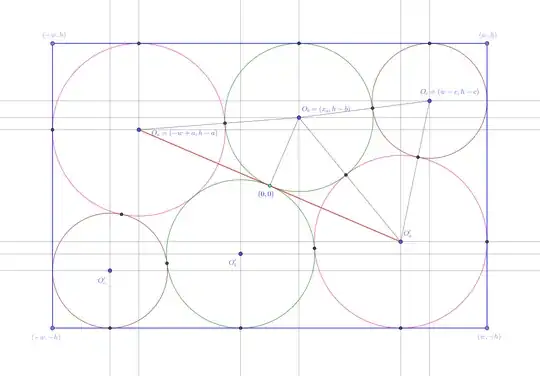
solution for the six circles in a box problem

The three circles have the radii $a,b,c$, and the upper $b$-radius circle has its $x$-coordinate $x_u$. The code below considers a polynomial ring $R$ in the six free variables $a,b,c;h,w;x_u$, immediately sets the half-height to one, $h=1$, and let $J$ be the ideal generated by the equations which reflect:

  • $h=1$,
  • upper $a$-circle is tangent to the upper $b$-circle,
  • upper $b$-circle is tangent to the upper $c$-circle,
  • upper $b$-circle is tangent to the lower $a$-circle,
  • upper $c$-circle is tangent to the lower $a$-circle,
  • upper $b$-circle passes through the origin
  • the line between the two centers of $a$-circles is tangent in the origin to the line between the two centers of $a$-circles.

There are seven equations, six variables, we check the dimension of the ideal, it is zero, and ask for its "variety" with coordinates in the real algebraic numbers, which is a set of points.

Sage Code: (Please skip if it feels annoying.)

R.<a,b,c,h,w,xu> = QQ[]

O = vector([0, 0,]) Oa = vector([-w + a, h - a]) Ob = vector([ xu, h - b]) Oc = vector([ w - c, h - c])

Oaa, Obb, Occ = -Oa, -Ob, -Oc

J = R.ideal([h - 1 , d2(Oa, Ob) - (a+b)^2 , d2(Ob, Oc) - (b+c)^2 , d2(Oc, Oaa) - (a+c)^2 , d2(Ob, Oaa) - (a+b)^2 , d2(Ob, O) - b^2, (Oa-Oaa)*Ob])

for sol in J.variety(AA): if sol[w] <= 0: continue if sol[a] <= 0: continue if sol[b] <= 0: continue if sol[c] <= 0: continue print(f'SOLUTION:') print(f' a = {sol[a]} with minimal polynomial {sol[a].minpoly()}') print(f' b = {sol[b]} with minimal polynomial {sol[b].minpoly()}') print(f' c = {sol[c]} with minimal polynomial {sol[c].minpoly()}') print(f' w = {sol[w]} with minimal polynomial {sol[w].minpoly()}') print(f' xu = {sol[xu]} with minimal polynomial {sol[xu].minpoly()}')

And here are the solutions:

SOLUTION:
    a  = 1 with minimal polynomial x - 1
    b  = 0.50000000000000000? with minimal polynomial x - 1/2
    c  = 5.828427124746190? with minimal polynomial x^2 - 6*x + 1
    w  = 2.414213562373095? with minimal polynomial x^2 - 2*x - 1
    xu = 0 with minimal polynomial x
SOLUTION:
    a  = 0.606577858091834? with minimal polynomial x^6 - 2*x^5 - x^4 + 8*x^3 + 3*x^2 - 6*x + 1
    b  = 0.5210075620474032? with minimal polynomial x^6 - 2*x^5 - x^4 - x^3 + 2*x^2 - x + 1/4
    c  = 0.4037108932628932? with minimal polynomial x^6 - 6*x^5 + 23*x^4 - 48*x^3 - 5*x^2 + 6*x + 1
    w  = 1.525935796142292? with minimal polynomial x^6 + 8*x^4 - 8*x^3 + 16*x^2 - 32*x - 16
    xu = 0.2049759110110414? with minimal polynomial x^6 - 2*x^5 + 3*x^4 - 8*x^3 + 7*x^2 - 6*x + 1

The first "solution" found is not a solution to our problem, but a solution of the problem of drawing six circles tangent to each other as specified and (somehow) to the axes of a box. Here is a plot of it, since it can be easily plotted with exactly specified coordinates.

Fig. $2$:
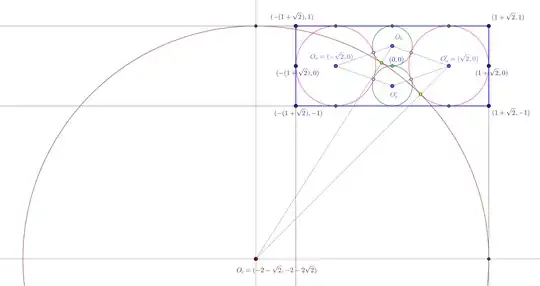
five circles tangent to a box and in some pairs

The missing circle is the reflection in the origin of the big brown $c$-circle.

The second solution was already plotted in the Figure $1$, and the values of $a,b,c;w,x_u$ are algebraic of degree $6$. This complexity cannot be eliminated.

The moral of the story is: We have exactly one configuration realizing the posted OP picture, and when normed to a height $H=2h=2$ it involves for the radii and the width complicated algebraic numbers (living in algebraic fields of degree six).

Note: Using similar eliminations, the computer shows that for $w\ne 0$ and $h=1$ from the given equations we have "only" $(e^2-1)(e^2-2)=0$. This relation is involved for the human eye, and also confirms the complexity of reaching the wanted $e=1$, after discarding $e=\sqrt 2$.


An algebraic path (incomplete solution): (Done humanly.) We are trying to solve the same system in a human manner: $$ \left\{ \begin{aligned} x_u^2 +(h-b)^2 &= b^2 & & \text{i.e.} &d(O_b,O) &= b\\ (x_u + w-a)^2 +(a-b)^2 &= (a+b)^2 & & \text{i.e.} &d(O_a,O_b) &= a+b\\ (-x_u + w-c)^2 +(b-c)^2 &= (b+c)^2 & & \text{i.e.} &d(O_b,O_c) &= b+c\\ (a-c)^2 +(2h-a-c)^2 &= (a+c)^2 & & \text{i.e.} &d(O_c,O'_a) &= a+c\\ x_u(w-a) & = (h-a)(h-b)& & \text{i.e.} & Oa_O&\perp O_bO\\ e^2 &= (a+b)^2 - b^2 \end{aligned} \right. $$ Below we are setting $h=1$, and trying to eliminate everything but $e$. The first variable we eliminate below is $x_u$. We have $x_u=(1-a)(1-b)/(w-a)$, and $x_u^2=2b-1$. So the above system implies: $$ \left\{ \begin{aligned} (1-a)^2(1-b)^2 &= (2b-1)(w-a)^2\\ (2b-1) + 2(1-a)(1-b) + (w-a)^2 &= 4ab\\ (2b-1) - 2(1-a)(1-b)\frac{w-c}{w-a} + (w-c)^2 &= 4bc\\ (2-a-c)^2 &= 4ac\\ e^2 &= (a+b)^2 - b^2 \end{aligned} \right. $$ We eliminate $w$ by using the expression for $(w-a)^2=(1-a)^2(1-b)^2/(2b-1)$ from the first equation in the second one. Also, we can subtract above the second and third equations from each other to cancel the term in $w^2$.

This gives $\displaystyle 2(1-a)(1-b)\left(2+\frac{a-c}{w-a}\right)-2w(a-c) +(a^2-c^2) =4b(a-c)$. We divide by $(a-c)$ and use the radical formula for $(w-a)$. $$ \left\{ \begin{aligned} 0 &= a^2b^2 - 2a^2b - 6ab^2 + a^2 + 2ab + b^2 \\ 4b &= 2(1-a)(1-b)\left(\frac2{a-c}+\frac{\sqrt{2b-1}}{(1-a)(1-b)}\right) -2\frac{(1-a)(1-b)}{\sqrt{2b-1}}-a-c\\ (2-a-c)^2 &= 4ac\\ e^2 &= (a+b)^2 - b^2 \end{aligned} \right. $$ The equation in $a,c$ only lets us write $c$ as $a+2\pm\sqrt{8a}$. Because of $c<2$ we have $c=a+2-\sqrt{8a}$. This leads to: $$ \left\{ \begin{aligned} 0 &= a^2b^2 - 2a^2b - 6ab^2 + a^2 + 2ab + b^2 \\ 0 &= (1-a)(1-b)\cdot\frac1{\sqrt{2a}-1} +\sqrt{2b-1} -\frac{(1-a)(1-b)}{\sqrt{2b-1}} +1 -\sqrt{2a} -2b\\ e^2 &= (a+b)^2 - b^2 \end{aligned} \right. $$ Now the first equation can be written as $0=a^2(1-b)^2-2ab(3b-1)+b^2$, and we consider it as an equation of second degree in $a$. This gives $$ a_\pm =\frac b{(1-b)^2}\Big[3b-1\pm2\sqrt{b(2b-1)}\Big]\ . $$ The right sign is minus, so we have a formula for $a$ in terms of $b$: $$ a =\frac b{(1-b)^2}\left(\sqrt b -\sqrt{2b-1}\right)^2\ . $$ In order of making computations without radicals, we are searching for a parametrization of $b$ so that $\sqrt b$ and $\sqrt{2b-1}$ are rational expressions. One such parametrization is $$ \small \begin{aligned} b &= \left(\frac{1+u^2}{1+2u-u^2}\right)^2 & a &=\frac 14\left(\frac{1+u^2}{1-u}\right)^2 \\ \sqrt b &= \frac{1+u^2}{1+2u-u^2} & \sqrt a &= \frac{1+u^2}{2(1-u)} & \sqrt{2b-1} &= \frac{1-2u-u^2}{1+2u-u^2} \\[2mm] 1-a &= \frac {(1-2u-u^2)(3-2u-u^2)}{4(1-u)^2} & 1-b &= \frac {4u(1-u)(1+u)}{{(1+2u-u^2)^2}}\ ,\\[2mm] e &=\frac 14\cdot\frac{(3-2u+u^2)(1+u^2)^2}{(1+2u-u^2)(1-u)^2}\ , \end{aligned} $$ where $u$ is a suitable real value. Using $u$ in the remained equation (involving radicals, now made to no longer involve them), we obtain: $$ \begin{aligned} 0 &= \frac{(1-a)(1-b)}{\sqrt{2a}-1} -\frac{(1-a)(1-b)}{\sqrt{2b-1}} -\sqrt{2a} +\sqrt{2b-1} -(2b-1)\\ &=\frac{(1-a)(1-b)}{\sqrt{2a}-1} - \frac {u(1+u)(3-2u-u^2)}{(1-u)(1+2u-u^2)} -\sqrt{2a} + \frac{4u(1-2u-u^2)}{(1+2u-u^2)^2} \end{aligned} $$ This can continue, but i have to stop here, the effort does not compensate for the result.


Geometric approach (incomplete): (But geometric properties are collected.)

We start with the following situation, which is a subconstellation in the given constellation of circles:
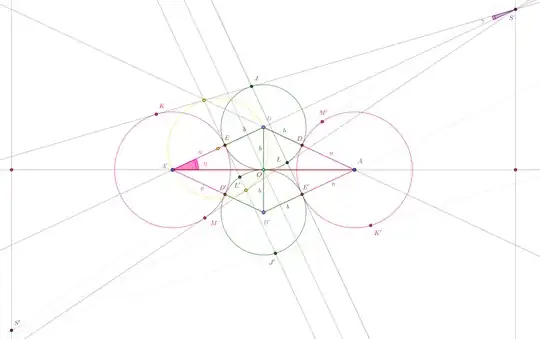
constellation of four circles with tangencies

Here, the "same" notation $a,b$ is used for the radii of the two pairs of equal (here in the sense of congruent) circles. The "red segment" $AA'$ matches the OP red segment. Explicitly, we introduce the involved points in the following order, so that everything is well defined. (We use cartesian axes only as orientation, no involved analytic geometry is needed.)

Let $O$ be a point, here taken as the origin of the axes. Denote by a prime the reflection w.r.t. $O$, so it is a map of points $X\to X'$.

Let $B$ be a point on the $Oy$-axis at distance $b$ from $O$. Let $A$ be a point on the $Ox$-axis at distance $a+b$ from $B$. In particular, its distance $e$ from $O$ satisfies $e^2=(a+b)^2-b^2=a^2$. (This $e$ has nothing to do with the later point $E$, nor with $\exp(1)$, i am just needing a new letter...)

(The picture was drawn with $OB=b=36$, $a=49$, $AB=a+b=85$, $e=77$. The triangle $\Delta AOB$ is a $36-77-85$ pythagorean triangle. So $a,b$ are perfect squares, just in case...)

Let $D\in AB$ be the tangency point of the circles $\mathcal A=\operatorname{Circle}(A,e)$ and $\mathcal B=\operatorname{Circle}(B,b)$.

Construct all reflected objects, the points $A',B',D'$, and the circles $$\mathcal A',$\mathcal B'$.

Reflect $D$ w.r.t. $OB$ to obtain $E$, and build $E'$.

So $D'\in A'B'$ is the tangency point of the circles $\mathcal A'=\operatorname{Circle}(A',\alpha)$ and $\mathcal B'=\operatorname{Circle}(B',b)$. And $E,E'$ are tangency points for the pairs of circles $(\mathcal A',\mathcal B)$ and $(\mathcal A,\mathcal B')$.

The exterior tangents of $(\mathcal A',\mathcal B)$ intersect in a point $S$, and these tangents are $SJK$, $SLM$, with $J,L\in \mathcal B$, and $K,M\in \mathcal A'$. Build also their reflections.

Arrange in notation of the two tangents that $SJK$ and its reflection $S'J'K'$ delimit a region of the plan (intersection of two half-planes) where all the picture lives in. (And the needed box will be the minimal rectangular box in this strip between the parallels $SJK\|S'J'K'$. We will build perpendiculars on them which are tangent to $\mathcal A,\mathcal A'$ on the far side w.r.t. $O$).

(This was a long exact description of what could be omitted, given the picture and a wink with the hands.)


We would want to get the sizes of the box.


As a warm up, let us compute the coordinates of some easy involved points. $$ \begin{aligned} B &=(0,b) %& B'&=-B=(0,-b) \\ A &= (e,0) %& A' &=-A=(-e,0)\ , \qquad e^2=(a+b)^2 - b^2 = a(a+2b)\\[2mm] D &= \frac b{a+b}(e,a) %& D' &= -D = -\frac b{a+b}(e,a) \\ E &= \frac b{a+b}(-e,a) %& E' &= -E = -\frac b{a+b}(-e,a)= \frac b{a+b}(e,-a) \\[2mm] S &= \left(\frac{be}{a-b}\ ,\ \frac{ae}{a-b}\right) %&S' &= -S =-\left(\frac{be}{a-b}\ ,\ \frac{ae}{a-b}\right) \end{aligned} $$ For $D=(x_D,y_D)$ we have used $y_D:b=y_D:OB=a/(a+b)$, and $x_D:b=x_D:DB=AO:AB=e:(a+b)$. For $S=(x_S,y_S)$ we have built similar to $\Delta A'BO$ a similar triangle $\Delta A'SP$, $P$ being the projection of $S$ on $AA'$. Then $y_S:(x_S+e)=SP:A'P=BO:A'O=b:e$, and a second relation can be obtained from the trapezium $A'BJK$. Project $B$ on $A'K$, we obtain a right triangle with sides $A'B=(a+b)$, and catheti $(a-b)=A'K-BJ$, and $2\sqrt {ab}$ (same as $JK$). This triangle is similar to $\Delta SJB$, so $SB:b=SB:JB=(a+b):(a-b)$, leading to a formula for $SB$, which can be used to obtain $x_B$ from the similarity $x_B:SB=e:(a+b)$.


Lemma A: The (light yellow) circle with diameter $A'B$ is tangent to $SJK$ in the mid point of $JK$, this mid point has same distance $\sqrt {ab}$ to $J,K,E$.

Note: This circle is thus after a reflection w.r.t. $SBA'$ also tangent to $SLM$ in the mid point of $LM$, this mid point has same distance $\sqrt {ab}$ to $L,M,E$.

The two mid points and $E$ are on the perpendicular in $E$ on $SBA'$.
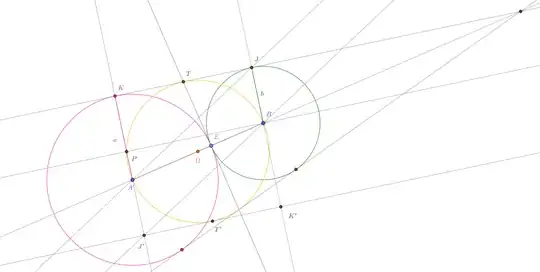
three circles with the same tangents

Proof: Consider the trapezium $A'BJK$, and the mid points Let $\Omega,T$ of $A'B$, $KJ$.

It may help to take a copy of this trapezium, and to paste it in reflection w.r.t. $\Omega$, this reflection is denoted by a star, so we have in the picture a rectangle $JKJ^*K^*$ centered in $\Omega$. We start the proof. Project $B$ on $A'K$ in $P$.

Consider the triangles $\Delta A'BP$ and $\Delta \Omega TE$ with $\hat \Omega =\hat{A'}$ and the proportionality of adjacent sides, $$ \frac{\Omega E}{\Omega T} = \frac{(a+b)/2}{(a-b)/2} = \frac{(a+b)}{(a-b)} = \frac{A'B}{A'P}\ . $$ They are similar, so $\hat E=\hat P=90^\circ$, and $TE=BP/2=KJ/2=\sqrt{ab}=TK=TJ$.

$\square$


Lemma B: The points $J,L,E'$ from Figure $1$ are collinear.

Proof: Let $R$ be the intersection of $JL$ with $SBEA'$. Let $O_1$ be the projection of $O$ on this line. By symmetry it is enough to show $O_1E=O_1R$. So we compute: $$ \begin{aligned} BR &=\frac{BJ^2}{BS}=\frac{b^2}{b(a+b)/(a-b)}=b\cdot\frac{a-b}{a+b} \\ O_1B &= \frac{BO^2}{BA'}=\frac{b^2}{a+b}=b\cdot\frac{b}{a+b} \\ O_1R &= O_1B+BR=b\cdot\frac{(a-b)+b}{a+b}=b\cdot\frac{a}{a+b} \\ O_1E &= BE-BO_1 =b-b\cdot\frac{b}{a+b} =b\cdot\frac{a}{a+b} \end{aligned} $$ so $O_1R=O_1E$.

$\square$


The height of the box:

Which is the distance $h$ from $O$ to the tangent $SJK$? Its double $H:=2h$ is the height of our box.

Recall that $O$ is one intersection point of the green circle $\odot(B)$ with the yellow circle $\odot(\Omega)$. We denote by $\gamma,\eta$ the angles $\gamma=\widehat{A'SK}=\widehat{PBA'}$, and $\eta=\widehat{OA'B}$. Then $\widehat{OBK^*}=\eta-\gamma$.

The distance $h$ from $O$ to the tangent $SJK$ is then $JB=b$ plus the projection of $OB=b$ on the side $BK^*$, which is $b\cos(\eta-\gamma)$.

If we really want, an algebraic formula for $h$ can be written, $$ \begin{aligned} h &=b+ b\cos(\eta-\gamma)=b+b\cos\eta\cos \gamma+b\sin\eta\sin\gamma \\ &= b +b\cdot \frac e{a+b}\cdot\frac{2\sqrt{ab}}{a+b} +b\cdot \frac b{a+b}\cdot\frac{a-b}{a+b} \ , \end{aligned} $$ which can be simplified, but a geometric view may want to work with $\eta,\gamma$.


The width of the box:

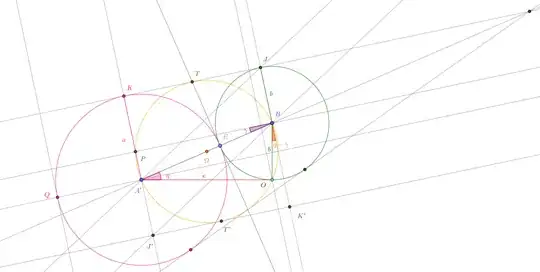
Which is the width $W=2w$ of the box? For this we draw a parallel to $SJK$ through $A'$. Let $Q$ be its far most intersection with the circle $\mathcal A'$, seen from $O$.
computing the width of the box with six tangent circles

Then the half-width $w$ is the projection of $OQ$ on the direction $SJK$, $$ \begin{aligned} w &= QA'+PB-OB\sin(\eta-\gamma) = a + 2\sqrt{ab} - b\sin(\eta-\gamma)\ ,\text{ so}\\ w-a &= 2\sqrt{ab}\cdot\frac{e^2}{(a+b)^2} + e\cdot\frac{b(a-b)}{(a+b)^2}\ . \end{aligned} $$ and again, an algebraic formula in $a,b$ can be given.


The corner tangencies:

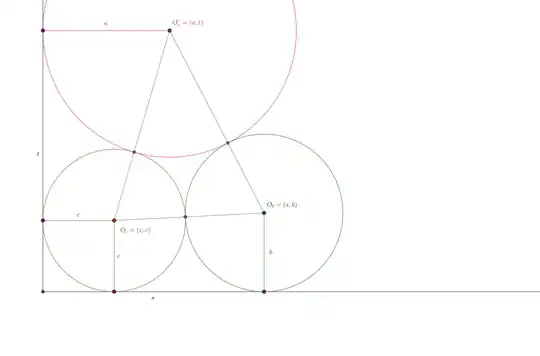
We come closer to the fully filled box, the question is when a further circle of radius $c$ in OP notation may fit in the corner of the box, so that it is tangent to the two box sides at the corner, and to both a green circle and a red circle.

We are in the following situation:
corner picture tangency of three circles

The equations extracted from the picture are: $$ \left\{ \begin{aligned} (a-c)^2 +(t-c)^2 &= (a+c)^2\\ (b-c)^2 +(s-c)^2 &= (b+c)^2\\ (a-s)^2 + (b-t)^2 &= (a+b)^2 \end{aligned} \right. $$ and in our case the lengths of $s,t$ are: $$ \left\{ \begin{aligned} s &=w-b\sin(\eta-\gamma)\\ t &=h-a\ . \end{aligned} \right. $$ One can simplify to some extent, but again, algebraic computations of a higher degree are involved.

dan_fulea
  • 38,874
  • Quote: "The only solution that is a fair complete solution is the computer path." My solution does not require a computer. – Dan Dec 14 '25 at 05:49
  • Hi Dan, i was pointing to the three sections of my answer, which are the computer supported solution, the algebraic one, the geometric one. Only the computer approach was indeed a solution. I posted, since i promised in some comment i would do so. Your approach writes $x^2, y^2,z^2$ for the radii, and this indeed leads to a quick factorization of the equation, this is nice! But i could not double the solution, had to try something else, but things got messy. My hope was to finish on the geometric path, but reached a dead end. So i also posted some interesting properties. Hoping it helps... – dan_fulea Dec 15 '25 at 11:54
  • Oh, I now see what you meant. Thanks for posting. – Dan Dec 15 '25 at 12:08
  • Your answers are always a very rich diet, and this one is also full of hints to further work. In the meantime I think I amended my answer. If it works, it shows that an efficient approach (to solving entirely the configuration), is to first prove OP's thesis (I used a mix of trigonometry and synthetic geometry), and then use this result to write a cubic equation in $\sqrt R_1 + \sqrt R_3$. – dfnu Dec 15 '25 at 17:08
1

I keep the same notations as in OP solution and I will propose another one which doesn't require polynomial factorization .
First , we can calculate the width of the rectangle in two ways by orthogonal projection of the red line , and we therefore obtain : enter image description here

enter image description here

Jamil Sanjakdar
  • 2,042
  • 1
  • 3
  • 18
  • 8
    Please don't use images for text and equations. It can't be searched, and it may not be accessible to visually-impaired visitors requiring assistive technologies such as screen-readers. – Blue Dec 10 '25 at 23:30
  • Please use the text that was leading to the image, retype and reformat the writing by using mathjax, see also https://math.meta.stackexchange.com/questions/5020/mathjax-basic-tutorial-and-quick-reference. This makes the answer live longer, and questions may use pieces of it. Images have the habit to disappear after some time, imagine what happens and remains from the answer in this case. Also upvoting such an answer is a problem, since it does not match the guidelines of the community. So retyping (and understanding mathjax for future answers - similar to latex also very useful) has its merit. – dan_fulea Dec 11 '25 at 14:04
1

I don't have a geometrical solution.

I think your solution is nice, and using your idea, I'll show another (maybe simpler) way to get $f(x)=0$.

Also, I'll show some results which are similar to the bonus result you wrote.


As you wrote, we have $z=1-x$ and

$$\sqrt{(y^2+z^2)^2-(y^2-z^2)^2}=x^2-z^2+\sqrt{(x^2+y^2)^2-(1-x^2-y^2)^2}$$ i.e. $$\sqrt{2x^2+2y^2-1}=2y-2xy+1-2x\tag3$$

from which you correctly got $$y=\frac{\left(\frac{1}{\sqrt2}-1\right)(x-1)}{x-1+\frac{1}{\sqrt2}}\tag{1}$$

Next, as you wrote, we have

$$\sqrt{(x^2+y^2)^2-(1-x^2-y^2)^2}+\sqrt{(2y^2)^2-(1-2y^2)^2}=\sqrt{(x^2+y^2)^2-(x^2-y^2)^2}$$

i.e.

$$\sqrt{2x^2+2y^2-1}=2xy-\sqrt{4y^2-1}\tag4$$

Now, we can use $(3)(4)$ to have $$2y-2xy+1-2x=2xy-\sqrt{4y^2-1}$$ i.e. $$\sqrt{(2y+1)(2y-1)}=2x(2y+1)-(2y+1)$$ Dividing the both sides by $\sqrt{2y+1}$ gives $$\sqrt{2y-1}=(2x-1)\sqrt{2y+1}$$ Squaring the both sides, we get $$y=\frac{2x^2-2x+1}{4x(1-x)}\tag5$$

From $(1)(5)$, we obtain $f(x)=0$.


You wrote an elegant result when the height of the rectangle is $2$.

Letting $h$ be square root of height of the rectangle, we have $$\begin{cases}z=h-x \\\\y=\dfrac{(\frac{1}{\sqrt 2}-1)(x-h)h}{x-(1-\frac{1}{\sqrt 2})h} \\\\(2-2\sqrt 2) x^3+ (3 \sqrt 2 - 4) h x^2+ (1 - \sqrt 2 )h^2 x+(1 - \frac{1}{\sqrt 2}) h^3 =0\end{cases}$$ from which I got $$\color{red}{x^2+y^2=\frac{4}{h^4}x^2y^2z^2+\frac{h^2}{2}}$$ and $$\color{red}{z^2x^2+\frac{ h^2}{2}z^2+\frac{h^4}{4}=\frac{ h^2}{2}x^2+h^2y^2}$$

Let $a=x^2,b=y^2$ and $c=z^2$ as you did.

  • For $h=\sqrt 2$, we get your result $$a+b=abc+1$$ and $$ca+c+1=a+2b$$

  • For $h=2$, we get $$4a+4b=abc+8$$ and $$ca+2c+4=2a+4b$$

mathlove
  • 155,494