There is a homotopy equivalence $\Sigma_2 \simeq \mathbb R^3\setminus (L_1\cup L_2\cup Y)$, where $L_i$ are the lines and $\Sigma_2$ is a genus 2 surface.
Define paths $A,B,C,D,P,Q$ and base-point $x$ on $\Sigma_2$ as in the diagram below
(notation compatible with Hatcher, cf. How to construct a genus 2 surface from 8-gon?)
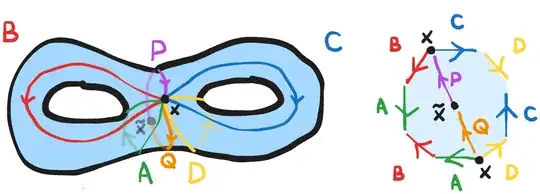
Denote by $\tilde{x}$ the point directly below $x$ in the diagram (on the opposite side of the surface), and analogously denote by $\tilde{B}, \tilde{C}$ the paths based at $\tilde x$ below $B$ and $C$ (mirror images across the horizontal plane of symmetry).
The problem is to show that $BC$ and $\tilde{B}\tilde{C}$ are not freely homotopic, or that homotopy classes of $BC$ and $P^{-1}\tilde{B}\tilde{C}P$ are not conjugate in $\pi_1(\Sigma_2, x)$.
Observe that $\tilde{B} \sim PBQ$ and $\tilde{C} \sim PCQ$, so that $P^{-1}\tilde{B}\tilde{C}P \sim BQPCQP \sim B[A,B]C[A,B]$.
We use the presentation of $G = \pi_1(\Sigma_2, x)$ where $a,b,c,d$ are the homotopy classes of $A,B,C,D$:
$$G = \langle a,b,c,d\ |\ [a,b][c,d] = 1\rangle$$
The problem is reduced to showing that $bc$ is not conjugate to $b[a,b]c[a,b]$ in $G$. We'll do that below.
Computations in $G$ itself are difficult, but it suffices to prove non-conjugacy in a quotient group. The lower central series quotient $G/G_3$, the maximal 2-nilpotent quotient, will be sufficient.
The universal central extension of the abelianization $G_{ab} = \mathbb{Z}^4$ is an extension by $\bigwedge^2(\mathbb{Z}^4) = \mathbb{Z}^6$ and maps onto $G/G_3$ with kernel given by the relation $[a,b][c,d] = 1$ (reducing rank by $1$). It follows there is a central extension
$$1 \to \mathbb{Z^5} \to G/G_3 \to G_{ab} \to 1$$
The problem is now to show that there is no solution for $g \in G/G_3$ to $$[g, bc] =[a,b]^2$$
For $2$-nilpotent groups (where commutators are central) $[-,z]$ is a homomorphism. (Proof: rewrite $[xy,z] = x[y,z]x^{-1}[x,z]$ then commute)
Any element $g \in G/G_3$ can be represented as an ordered monomial $g = a^ib^jc^kd^\ell z$, where $z$ is central. Use the homomorphism property of commutators to compute:
$$
\begin{aligned}\
[a^ib^jc^kd^\ell, bc] &= [a,b]^i[a,c]^i[b,c]^{j-k}[b,d]^{-\ell}[c,d]^{-\ell}\\
&= [a,b]^{i+\ell}[a,c]^i[b,c]^{j-k}[b,d]^{-\ell}
\end{aligned}
$$
There is no choice of $i,j,k,\ell$ such that this equals $[a,b]^2$. QED
Addendum
Regarding the variation where figure-eights are replaced with once-twisted unknots - a similar approach as above seems to work.
In this case the complement is instead homotopy-equivalent to $\Sigma_1 \vee S^1$, or $\Sigma_2$ with a $2$-cell attached along $AD^{-1}$. Identifying $a = d$, the fundamental group is thus $H = \langle a,b,c\ |\ [a,b][c,a] = 1 \rangle$. Paths corresponding to the two non-isotopic embeddings of $X$ (on either side of $Y$) are $bac^{-1}$ and $b(b^{-1}ab)c^{-1} = abc^{-1}$. The quotient $H/H_3$ extends $H_{ab}$ by $\mathbb{Z}^2$ with basis $\{[a,b],[b,c]\}$, and the conjugacy equation in $H/H_3$ becomes $[g,bac^{-1}] = [a,b]$. Taking $g = a^ib^jc^kz$ with $[a^ib^jc^k, bac^{-1}] = [a,b]^{2i-j+k}[b,c]^{-j-k}$, observe that if $j=-k$ then the coefficient on $[a,b]$ is even, so the conjugacy equation is not satisfiable.


There ought to be a more conceptual answer to this question that covers both cases, and more generally when $X$ and $Y$ are any single-component links besides the untwisted unknot.
– Ben Dec 29 '25 at 01:52