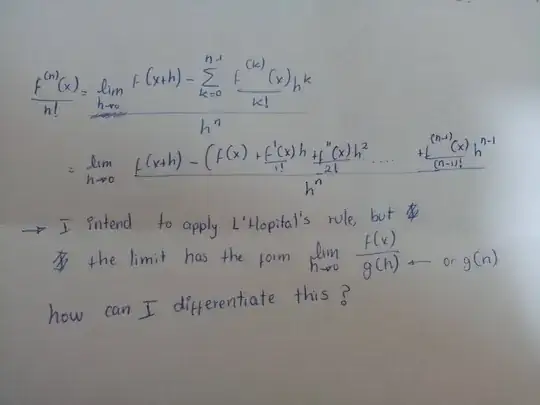
First let me clarify few things. We have the following theorem:
If $f^{(n)}(a)$ exists then $$ \frac{f^{(n)}(a)}{n!} = \lim_{h \to 0}\dfrac{{\displaystyle f(a + h) - \sum_{k = 0}^{n - 1}\dfrac{f^{(k)}(a)}{k!}h^{k}}}{h^{n}}$$
Note that this is not the definition of $f^{(n)}(a)$, but rather it is result which holds when $f^{(n)}(a)$ exists. It may happen that the limit on the right exists but $f^{(n)}(a)$ does not exist.
This result can be proved by repeatedly applying L'Hospital's rule. Similar is the case with the formula $$f''(a) = \lim_{h \to 0}\frac{f(a + h) - 2f(a) + f(a - h)}{h^{2}}$$ or the formula which OP has written (although he made a mistake of forgetting a divide by 2, which I have corrected)
All these formulas hold only when the necessary derivatives exist. These formulas are not definitions of higher derivatives (although for $n = 1$ it does turn out to be the definition of $f'(a)$).
Again the other issue is "how to differentiate when these are constant". For applying L'Hospital here one has to differentiate with respect to $h$ and not with respect to $x$ (as in given question) or $a$ (my notation).