
Is there an intuitive explanation for why all the known non-trivial solutions of $$\frac{1}{1^z} - \frac{1}{2^z} + \frac{1}{3^z} - \frac{1}{4^z} + \cdots=0$$ have a real part of $\frac{1}{2}$?
Asked
Active
Viewed 568 times
4
-
3Your premise is incorrect or you forgot a hypothesis. If you look on the Wikipedia page about this function, http://en.wikipedia.org/wiki/Dirichlet_eta_function, you'll see that it's $(1 - 2^{1-s})\zeta(s)$, so it has plenty of explicit zeros with real part not equal to 1/2: any trivial zero of $\zeta(s)$ and also all $s = 1 + 2\pi{i}k/\log 2$ for nonzero integers $k$. – KCd Nov 01 '13 at 11:43
-
I've added 'non-trivial' to it. I'm mainly interested in $0 < Re(s) < 1$ – user85798 Nov 01 '13 at 11:50
-
3But in that case your question is equivalent to asking why the Riemann hypothesis is true, since the elementary formula relating that alternating series to the Riemann zeta-function shows the only zeros it has other than zeros of $\zeta(s)$ are zeros of $1 - 2^{1-s}$ besides 1, and the zeros of $1 - 2^{1-s}$ all lie on the line ${\rm Re}(s) = 1$. Where have you seen a list of any zeros of this alternating series that doesn't mention the Riemann hypothesis? – KCd Nov 01 '13 at 11:52
-
...have you heard of the Riemann hypothesis? – anon Nov 01 '13 at 11:55
-
I'm not really after a proof though, I just want some intuition to what is so special about 1/2 in relation to that alternating series. – user85798 Nov 01 '13 at 11:56
-
There is nothing more special about $1/2$ in relation to the alternating series than in relation to the original Riemann zeta function, so you might as well ask about the Riemann zeta function in particular or $L$-functions in general (making the series alternating is a red herring). And to answer that: a conjectural physical reason to expect $\rm Re=1/2$ is Hilbert-Pólya. (There is a lot of current theoretical work investigating the spectral properties of $L$-functions.) – anon Nov 01 '13 at 11:57
-
I know, but what difference does it make if I'm only concerned with this particular series? - Ok, thanks, I'll read about that – user85798 Nov 01 '13 at 12:09
-
2Chapter 3 in this document lists some pieces of "evidence" in favor of the Riemann Hypothesis being true. – Daniel R Nov 01 '13 at 12:11
1 Answers
4
As pointed out in the comments above, your expression is equal to:
$$\frac{1}{1^s} - \frac{1}{2^s} + \frac{1}{3^s} - \frac{1}{4^s} + \cdots = \zeta(s)(1 - 2^{1-s})$$
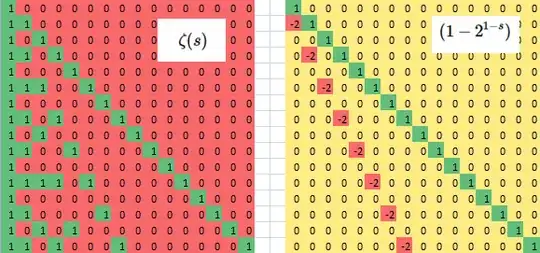
To illustrate this further we can look at the matrix multiplication that becomes your series above by creating the following two tables:
First table (red and green) called $\zeta(s)$:
$k \mid n : 1$ else $0$.
Second table (red, green and yellow) called $(1 - 2^{1-s})$:
$n=k: 1$ else if $n=2 \cdot k: -2$ else $0$
Taking the matrix product of the two tables above we get:
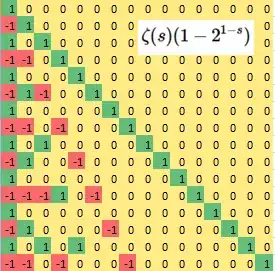
The first column then has the numerators of your series.
Some Mathematica code to try:
Clear[n, s];
s = 2;
Sum[1/(2*n + 1)^s - 1/(2*n + 2)^s, {n, 0, Infinity}]
Zeta[s]*(1 - 2^(1 - s))
which when evaluated gives identical answers.
So because the alternating series has $\zeta(s)$ as a factor, the alternating series must also have all the non-trivial zeros of the $\zeta(s)$ function as zeros.
Edit 22.4.2015: But note that $(1 - 2^{1-s})$ has zeros with real part not equal to $\frac{1}{2}$
Mats Granvik
- 7,644