4

Does a function's limit when x goes to infinity must be zero for its integral to converge?

I had proved in my homework that if the function is non-negative, it's not necessarily true. Now I read a solution that uses this as a fact - For an improper integral to converge, function's limit must be zero.

I hadn't found it in my books and notebook, and I can't find a reliable place says it is.

any help would be appreciate, thanks
Splash
  • 634
  • 1
  • 5
  • 14
  • 1
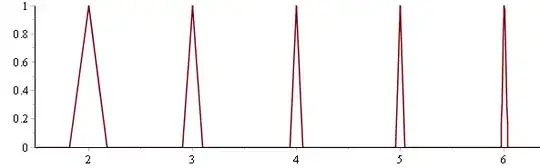
    No. Think of "spikes" of height $1$, centered at the positive integers, the length of whose bases go to $0$ sufficiently fast to force the integral to converge. – David Mitra Jan 19 '14 at 17:29
  • Even easier examples abound for non-continuous functions. – David Mitra Jan 19 '14 at 17:31
  • 1
    No but if the improper integral converges and if $\lim_{x\rightarrow\infty}f(x)$ exists then $\lim_{x\rightarrow\infty}f(x)=0$ –  Jan 19 '14 at 17:31
  • Related: https://math.stackexchange.com/questions/102678/is-there-a-continuous-positive-function-whose-integral-over-0-infty-converg – Hans Lundmark Dec 19 '19 at 12:57

2 Answers2

10

For an improper integral to converge, function's limit must be zero.

That is correct only if we know that $\lim_{x\to\infty} f(x)$ exists. A nonzero value of this limit (say, $L$) would make the antiderivative $F$ grow at linear rate ($\sim Lx$) which is not compatible with $F$ having a limit at infinity.

But it may well be that $\lim_{x\to\infty} f(x)$ fails to exist but the integral $\int_a^\infty f(x)\,dx$ converges. A popular example, described by David Mitra in a comment, looks like this:

spikes

user127096
  • 10,071
4

Perhaps this is a counterexample: \begin{equation} \int_0^{\infty} \sin(x^2/2)\,dx=\sqrt{\pi}/2. \end{equation}

Jog

Jog
  • 804