8

I know that $\mathbb{C}$ is an unordered field and that (strictly non-real) complex numbers cannot be 'compared' in the sense that one is less than/greater than another.

However, we can compare real numbers; geometrically, this is because they lie on a straight line through the origin, $0+0i$, and one real is greater than another if it's 'further' along the real line than the other.

I'm wondering whether, given that two (or more) strictly complex (i.e. ones with nonzero real and imaginary parts) numbers can be compared given that they lie on a straight line through the origin. e.g. to me, it makes sense to say that $1+i<2+2i$, for instance, and that $i<10i,$ as one is a real multiple of the other.

Essentially, what I'm asking, is: can we compare complex numbers in any way other than comparing their moduli?

Thanks

beep-boop
  • 11,865
  • 1
    The partial ordering you described is exactly the same as the partial ordering given by the modulus. – oxeimon May 08 '14 at 20:02
  • Yes, this can be done. The definition you're looking for is:$z \leq w$ iff there exists $r \in [1,\infty)$ such that $rz=w$. This is a genuine partial order, and it is compatible with the multiplicative structure of $\mathbb{C}$ but not the additive structure. Contrary to oxeimon's comment, this is not the partial order induced on $\mathbb{C}$ by the modulus function, since that is a mere preorder; more precisely, its not antisymmetric. – goblin GONE May 31 '15 at 09:37
  • There is another interesting partial ordering of $\mathbb{C}$ given as follows: $z \leq w$ iff there exists $r \in [0,\infty)$ such that $z+r=w$. This is compatible with the additive structure of $\mathbb{C}$, and slightly compatible with the multiplicative. I leave it to you to work out the details. – goblin GONE May 31 '15 at 09:42

3 Answers3

4

Yes, you can put a lexicographical ordering on the complex numbers, which makes it a totally ordered set. However, we cannot introduce a totally ordered relation on the complex numbers (as a field such that the field operations are compatible with the defined order) since, every ordered field is a formally real field.

Math137
  • 1,869
  • What if we're comparing $a+bi$ and $c+di$, but $a<c$ and $b>d$? In this case, which is the bigger of the two? – beep-boop May 08 '14 at 19:30
  • in this case the second one is "bigger" – Math137 May 08 '14 at 19:31
  • Oh, so it's like comparing 'Alan Smith' and 'Joe Bloggs' in their position in the phone book? – beep-boop May 08 '14 at 19:33
  • 1
    Yes, it is exactly looks like ordering words in a dictionary. – Math137 May 08 '14 at 19:39
  • Exactly, this is why it is called "lexicographical", it is the same order as in a the dictionnary. By the whay, it is actually a total order on $\mathbb{C}$ – yago May 08 '14 at 19:40
  • @YannHamdaoui , No it is not a a total order, and we cannot define any totally order relation on $\mathbb{C}$ – Math137 May 08 '14 at 19:41
  • 1
    Yes it is. What you cannot define is a total order relation that is operation-compatible, which is not the case of the lexicographical order. Look at the wikipedia link you gave, they state explicitely that if the order used in the construction is total (corresponds to the usual order on $\mathbb{R}$ here, which is total), so is the lexicographical order. Actually, with axiom of choice, you can build a strict total order on a arbitrary set. But once again, in $\mathbb{C}$, it won't be operation compatible. If you're not convinced, please give me two non comparable elements ? – yago May 08 '14 at 19:47
  • @YannHamdaoui I think I miss understood your point, sorry. Now I think you mean complex numbers as a set can be totally ordered not as a field, and I have made that clear in my answer (I edited it). Thank you :). – Math137 May 08 '14 at 19:50
  • Well, ordering "as a field" is just ordering the set with an order that is compatible with operations. If you talk about ordered field, then it makes no sense to say that lexicographical order is partial, because $\mathbb{C}$ with this order is NOT even an ordered field. So we obviously talk about ordering the set of complex numbers, and you even wrote "which makes it a partial ordered set". Once again, this is false, because lexicographical order is total on the set of complex numbers. And it doesn't contradict the second link precisely because it is not seen as an ordered field, but set – yago May 08 '14 at 19:55
  • @YannHamdaoui I agree with you, I should have said totally ordered set, but saying that makes the set partially ordered is not wrong. – Math137 May 08 '14 at 20:00
  • Yes you're right, but it was misleading ^^ it's just that accepted answer can be red by other people than the OP and should be precise. Thanks for edit – yago May 08 '14 at 20:04
  • @YannHamdaoui Thank you, your comments made the answer better :) – Math137 May 08 '14 at 20:05
  • @YannHamdaoui: a detail: with the Axiom of Choice, you obtain a well-order on any set. For example, it is easy to construct a total order $\mathbb C$ (cf math137's answer) but, as far as I know, the AC is necessary to a well-order. – Taladris May 12 '14 at 15:27
  • @Taladris indeed, actually I just wanted to highlight the difference between being ordered as a field (that can be only $\mathbb{R}$ itself if it contains it) and as a set, by saying that with AC you can even totally order an arbitrary set, so the "well-ordering" part was not even relevant here, but since it's given for free by the well-ordering theorem... – yago May 12 '14 at 15:50
  • -1 this answer is irrelevant to the question, which is obviously a question about useful partial orderings of the complex. This should have been a comment, or at best a remark in a larger and more relevant answer. Edit. Also, your answer is full of typos. For instance, in the first sentence you explain how to totally-order $\mathbb{C}$, whereas in the second sentence, you claim that totally-ordering $\mathbb{C}$ is impossible. – goblin GONE May 31 '15 at 09:29
  • @goblin OP asks "Essentially, what I'm asking, is: can we compare complex numbers in any way other than comparing their moduli?" – Math137 May 31 '15 at 09:35
  • @Math137, but read between the lines. What they really want to know is: can we usefully compare complex numbers in any other way than comparing their moduli? Of course, every set can be well-ordered, so without the usefulness condition, the question is completely vacuous. – goblin GONE May 31 '15 at 09:40
2

Yes, it totally makes sense.

In order to use $\gt$, $\lt$ and $=$ the same way they are used on real numbers, a many-to-one relation that maps complex numbers into real numbers will suffice.

More generally, an order is nothing but a relation. A total order is a relation $R$ that is transitive, asymmetrical and connected.

Transitive: if $xRy$ and $yRz$ then $xRz$, e.g. if 3>2 and 2>1 then 3>1;

Asymmetrical: if $xRy$ then $yRx$ must be false, e.g. if 3 > 1 then 1 > 3 must be false;

Connected: Given any two terms $x$ and $y$, either $xRy$ or $yRx$.

Source: Russell, Bertrand. Introduction to Mathematical Philosophy, "Chapter IV The Definition of Order"

Example1: Who gets off the Ferris Wheel first

Given any two complex numbers $a=r_1e^{i\phi}$ and $b=r_2e^{i\psi}$,

we define $a>b$ as

$(\phi > \psi) $ or $(\phi=\psi$ and $r_1>r_2 )$

This means that the person who has travelled a greater degree from the starting point or, if the travelled degrees are the same, the person who is on the further end of the spoke gets off first.

Thus, $3e^{i\pi}> 2e^{i\pi}> 3e^{i\dfrac{\pi}{2}}$

Example2: Sailing in crosswinds enter image description here
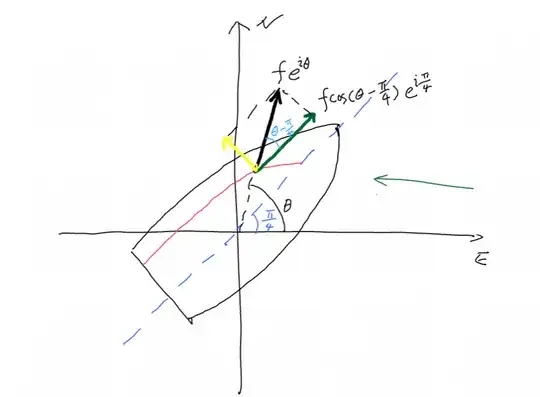
Suppose you are sailing towards Northeast$(\dfrac{π}{4})$. You can produce various lifts by adjusting your sail, but some lifts are better than others because they produce more forward thrusts. Given a lift $fe^{i\theta}$, the forward thrust it produces is $fcos(θ−\dfrac{π}{4})$. This is the value you use to compare various lifts.

Edit: Depending on the field of terms, this comparison does not necessarily give rise to a total order. Different lifts can produce the same forward thrusts, thus the asymmetrical requirement is violated. Nevertheless, you can still compare lifts.

If you know Ruby programming language, you can customize the spaceship operator to sort complex numbers.

George Chen
  • 1,581
  • 1
  • 13
  • 19
  • But, according to this approach, which term dominates out of the distance travelled, $r$, and the angle from the starting point, $\theta$? Say $r_1>r_2$ but $\theta_1<\theta_2$. In this case, which is bigger? Is there a way to get a weighted average of $\theta$ and $r$, in general? – beep-boop May 09 '14 at 00:07
  • The angle dominates. In your example, $r_2\angle\theta_2$ is greater. – George Chen May 09 '14 at 00:11
  • 1
    This is a very practical question, by the way. Imagine a ship detects a salvo of anti-ship missiles from all directions, the computerized phalanx would have to quickly decide which missile to shoot first. – George Chen May 09 '14 at 00:15
  • Do you have a formula to calculate the weighted average of $r$ and $\theta$? Or is it always the case that the angle dominates, even if $\theta_1$ is only slightly bigger than $\theta_2$, but $r_1<<r_2$? – beep-boop May 09 '14 at 00:28
  • In this particular example yes, $\theta$ always dominates. Just imagine the order people get off a Ferris Wheel. – George Chen May 09 '14 at 00:31
  • The point is, in order to create a series(with comparable properties),all you need is to construct a relation that is transitive, asymmetrical and connected. – George Chen May 09 '14 at 00:33
  • Oh, so you've defined $re^{i\theta}<se^{i \phi}$ iff $\theta>\phi$? – beep-boop May 09 '14 at 00:34
  • Is that just as arbitrary as choosing $r$ to dominate or is there a reason for this? – beep-boop May 09 '14 at 00:35
  • In the anti-missile example, the "precedes" relation would be like this $a$ precedes $b$ if $r_1 < r_2$ or $r_1=r_2 and \theta_1 < \theta_2$. – George Chen May 09 '14 at 00:35
  • Yes, it's an arbitrary example that satisfies the three relational requirements. – George Chen May 09 '14 at 00:37
  • Going back to your missile analogy, surely it would be unwise to first shoot down a missile 10 miles away that requires a rotation of 10 degrees, than a missile 0.2 miles away but requires a rotation of 180 degrees? – beep-boop May 09 '14 at 00:38
  • The weighted algorithm is a good question. I believe there is one, but I can't come up with it this moment. – George Chen May 09 '14 at 00:38
  • You understand me perfectly. – George Chen May 09 '14 at 00:38
  • What do you mean? – beep-boop May 09 '14 at 00:39
  • Again, the key point is the three relational requirements. – George Chen May 09 '14 at 00:39
  • No, I mean what do you mean by 'you understand me perfectly'? – beep-boop May 09 '14 at 00:40
  • You totally understand my missile analogy. – George Chen May 09 '14 at 00:40
  • Ahh- I thought it was some romantic phrase that suggests we are destined for each other. – beep-boop May 09 '14 at 00:41
  • 1
    The core idea is, in order to create a series, all you need is to construct a relation that is transitive, connected, asymetrical – George Chen May 09 '14 at 00:41
  • I added another example. – George Chen May 09 '14 at 17:11
  • In fact, three symbols are not enough to express the relationship between two complex numbers. We need nine symbols. Nine symbols cover all possible relative-positional relationships between two random points on a plane, and hence, between any two given complex numbers. – Mohan Pathak Oct 29 '25 at 16:48
0

Recently I have explored one way to look at this question. Noticing that when we compare real numbers, we are essentially comparing their position on the number line, and they can have only three relative positions (left, same or right), which correspond to 'less than', 'equal' or 'greater than' relations, I found that if we extend this idea to the complex plane, there can be only nine relative positions between two complex numbers. Extending to higher dimensions, we can say there can be only $3^n$ relative positions between n-dimensional vectors.

I have explained the things in detail in my question here.