18

Let $a,b,c>0$ such that $$\dfrac{1}{a^2+2}+\dfrac{1}{b^2+2}+\dfrac{1}{c^2+2}=\dfrac{1}{3}.$$ Show that $$\dfrac{1}{a}+\dfrac{1}{b}+\dfrac{1}{c}\le\dfrac{3}{\sqrt{7}}.$$

My try: since $$\dfrac{1}{2+a^2}=\dfrac{1}{2}\left(1-\dfrac{a^2}{a^2+2}\right)$$ so $$\dfrac{a^2}{a^2+2}+\dfrac{b^2}{b^2+2}+\dfrac{c^2}{c^2+2}=\dfrac{7}{3}$$ we only prove

$\dfrac{1}{a}+\dfrac{1}{b}+\dfrac{1}{c}\le\dfrac{3}{\sqrt{7}}$

and I want use Cauchy-Schwarz inequality to prove it,But I can't works,such $$\left(\dfrac{a^2}{a^2+2}+\dfrac{b^2}{b^2+2}+\dfrac{c^2}{c^2+2}\right)(a^2+2+b^2+2+c^2+2)\ge (a+b+c)^2$$ $$(a^2+b^2+c^2+6)\ge \dfrac{3}{7}(a^2+b^2+c^2+2ab+2bc+2ac)$$ $$\Longrightarrow 4(a^2+b^2+c^2)+42\ge 6(ab+bc+ac)$$ and let $$p=a+b+c,q=ab+bc+ac,r=abc$$ so $$2p^2+21\ge 7q$$ and we only prove $$\dfrac{1}{a}+\dfrac{1}{b}+\dfrac{1}{c}=\dfrac{ab+bc+ac}{abc}=\dfrac{q}{r}\le\dfrac{3}{\sqrt{7}}$$ maybe this is not true.

But this not usefull to solve this problem .

Thank you
River Li
  • 51,793
math110
  • 95,328
  • 17
  • 156
  • 531

5 Answers5

4

Let $\frac{1}{a}+\frac{1}{b}+\frac{1}{c}>\frac{3}{\sqrt7}$, $\frac{1}{a}=\frac{kx}{\sqrt7}$, $\frac{1}{b}=\frac{ky}{\sqrt7}$ and $\frac{1}{c}=\frac{kz}{\sqrt7}$, where $k>0$ and $x+y+z=3$.

Hence, $k>1$ and $\frac{1}{3}=\sum\limits_{cyc}\frac{1}{a^2+2}=\sum\limits_{cyc}\frac{1}{\frac{7}{k^2x^2}+2}>\sum\limits_{cyc}\frac{1}{\frac{7}{x^2}+2}=\sum\limits_{cyc}\frac{x^2}{7+2x^2}$,

which is a contradiction because we'll prove now that $\sum\limits_{cyc}\frac{x^2}{7+2x^2}\geq\frac{1}{3}$.

Indeed, let $x+y+z=3u$, $xy+xz+yz=3v^2$ and $xyz=w^3$.

Hence, we need to prove that $$4x^2y^2x^2+\sum\limits_{cyc}(8x^2y^2+7x^2)-49\geq0$$ or $$4w^6+8(9v^4-6uw^3)u^2+7(9u^2-6v^2)u^4-49u^6\geq0$$ or $f(w^3)\geq0$, where $f(w^3)=2w^6-24u^3w^3+7u^6-21u^4v^2+36u^2v^4$.

We see that $f'(w^3)=4w^3-24u^3<0$, which says that it's enough to prove that

$f(w^3)\geq0$ for a maximal value of $w^3$, which happens for equality case of two variables.

Let $y=x$ and $z=3-2x$.

Hence, $\sum\limits_{cyc}\frac{x^2}{7+2x^2}\geq\frac{1}{3}\Leftrightarrow(x-1)^2(2x-1)^2\geq0$.

Done!

Also we can use the Vasc's LCF Theorem.

3

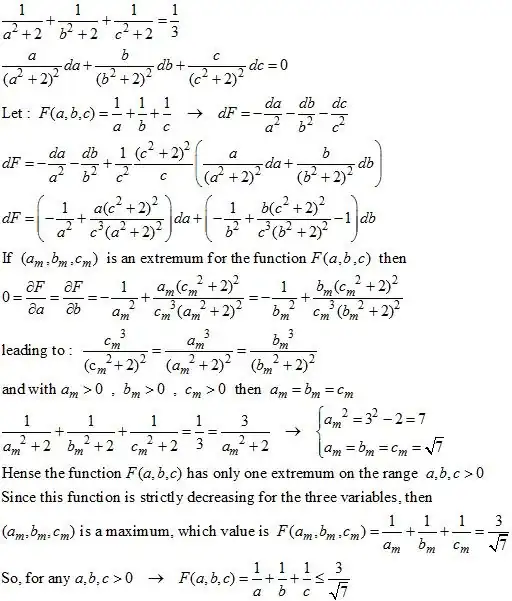
An analytical proof is proposed below :

enter image description here

JJacquelin
  • 69,089
  • first,Thank you for your answer,I think this inequality have without analysis methods,I like deal inequality use Cauchy-Schwarz inequality,AM-GM,Holder,and other. – math110 May 23 '14 at 08:43
  • @ china math : You should have stated that you don't want any method but a particular one. Also, I like the Cauchy-Schwartz inequality. Nevertheless I use another method in the cases where the calculus is easier. – JJacquelin May 23 '14 at 08:54
  • 1
    @JJacquelin Your solution is wrong, because the equality occurs not for $a=b=c$ only. See my solution. – Michael Rozenberg Dec 16 '16 at 18:11
2

By AM-GM, $1=\dfrac{3}{a^2+2}+\dfrac{3}{b^2+2}+\dfrac{3}{c^2+2} \geq \dfrac{9}{\sqrt[3]{(a^2+2)(b^2+2)(c^2+2)}}$

By AM-GM, $7 = \dfrac{3a^2}{a^2+2}+\dfrac{3b^2}{b^2+2}+\dfrac{3c^2}{c^2+2} \geq \dfrac{9\sqrt[3]{a^2b^2c^2}}{\sqrt[3]{(a^2+2)(b^2+2)(c^2+2)}}$

As everything is positive, we can safely divide the inequalities with each other.

$\dfrac{7}{1} \geq \dfrac{\dfrac{9\sqrt[3]{a^2b^2c^2}}{\sqrt[3]{(a^2+2)(b^2+2)(c^2+2)}}}{\dfrac{9}{\sqrt[3]{(a^2+2)(b^2+2)(c^2+2)}}}$

$\Rightarrow 7 \geq (abc)^{\dfrac{2}{3}}$

$\Rightarrow \dfrac{1}{\sqrt[3]{abc}} \geq \dfrac{1}{\sqrt{7}}$

By AM-GM, $\dfrac{1}{a}+\dfrac{1}{b}+\dfrac{1}{c} \geq \dfrac{3}{\sqrt[3]{abc}}\geq \dfrac{3}{\sqrt{7}}$

$\therefore \dfrac{1}{a}+\dfrac{1}{b}+\dfrac{1}{c} \geq \dfrac{3}{\sqrt{7}}$

MafPrivate
  • 4,241
  • 15
  • 41
  • 4
    $1 \ge 0.5$ and $0.5 \ge 0.1$ does not imply $1/0.5 \ge 0.5/0.1$ – vnd Jan 04 '16 at 05:39
  • I was thinking about that... Do you know of a way to prevent that case from arising? – Jack Tiger Lam Jan 04 '16 at 05:41
  • if $cd \gt 0$ then $ad -bc \ge 0$ would imply $\frac{a}{c} \ge \frac{b}{d}$ – vnd Jan 04 '16 at 05:48
  • This answer is wrong. $7 \geq (abc)^{2/3}$ is wrong. For example, $a = 3, b = 3/2, c = \frac12\sqrt{553}$, then $\frac{1}{a^2+2}+\frac{1}{b^2+2}+\frac{1}{c^2+2}=\frac{1}{3}$, however $(abc)^{2/3} > 14 > 7$. – River Li Jul 29 '22 at 12:20
  • The problem is to prove $\frac{1}{a}+\frac{1}{b}+\frac{1}{c}\le\frac{3}{\sqrt{7}}$. However, this answer is to prove $\frac{1}{a}+\frac{1}{b}+\frac{1}{c} \geq \frac{3}{\sqrt{7}}$. – River Li Jul 29 '22 at 12:23
0

Alternative proof, without using uvw:

Let $x = \frac{\sqrt 7}{a}, y = \frac{\sqrt 7}{b}, z = \frac{\sqrt 7}{c}$. We have $x, y, z > 0$ and $$\frac{1}{2x^2 + 7} + \frac{1}{2y^2 + 7} + \frac{1}{2z^2 + 7} = \frac13. \tag{1}$$ We need to prove that $$x + y + z \le 3. $$

WLOG, assume that $x \le y \le z$. Let $w = \frac{x + y}{2}$.

Fact 1: $x + y \le 2$.
(The proof is given at the end.)

Fact 2: It holds that $$\frac{1}{2x^2 + 7} + \frac{1}{2y^2 + 7} \le 2 \cdot \frac{1}{2w^2 + 7}.$$ (The proof is given at the end.)

By Fact 2 and (1), we have $$2 \cdot \frac{1}{2w^2 + 7} + \frac{1}{2z^2 + 7} \ge \frac13$$ or $$\frac{2(2w^2z^2 + 4w^2 + z^2 - 7)}{3(2w^2+7)(2z^2+7)} \le 0.$$ Thus, we have $$2w^2z^2 + 4w^2 + z^2 - 7 \le 0$$ or $$2(wz - 1)^2 + (2w + z)^2 \le 9$$ which results in $$2w + z \le 3$$ that is $$x + y + z \le 3.$$

We are done.


Proof of Fact 1:

From (1) and $x \le y \le z$, we have $$\frac{1}{2x^2 + 7} + \frac{1}{2y^2 + 7} \ge \frac29$$ or $$\frac{8x^2y^2 + 10x^2 + 10y^2 - 28}{9(2x^2+7)(2y^2+7)} \le 0$$ or $$8x^2y^2 + 10x^2 + 10y^2 - 28 \le 0.$$ Using $x^2y^2 + 1 \ge 2xy$, we have $$8(2xy - 1) + 10x^2 + 10y^2 - 28 \le 0$$ or $$16xy + 10x^2 + 10y^2 - 36 \le 0$$ or $$8(x + y)^2 + 2x^2 + 2y^2 - 36 \le 0$$ Using $2x^2 + 2y^2 \ge (x + y)^2$, we have $$9(x + y)^2 \le 36$$ or $$x + y \le 2.$$

We are done.

Proof of Fact 2:

It suffices to prove that $$\frac{1}{2x^2+7} - \frac{1}{2w^2 + 7} \le \frac{1}{2w^2+7} - \frac{1}{2y^2 + 7}$$ or $$\frac{2(w-x)(w + x)}{(2x^2+7)(2w^2+7)} \le \frac{2(y - w)(y + w)}{(2w^2+7)(2y^2+7)}$$ or (using $w - x = y - w = (y-x)/2 \ge 0$) $$\frac{w + x}{2x^2+7} \le \frac{y + w}{2y^2+7}$$ or $$\frac{(y - x)(2wx + 2wy + 2xy - 7)}{(2y^2+7)(2x^2+7)} \le 0$$ or $$2wx + 2wy + 2xy - 7 \le 0$$ or $$(x + y)^2 + 2xy - 7\le 0$$ which is true using $x + y \le 2$ (Fact 1).

We are done.

River Li
  • 51,793
-2

This might not be the "proper" way, but it can be seen that both the expressions are symmetrical in all terms. And we need the maximum of the second eqn. This can happen only when all the terms contribute equally to the sum, if it were not so then, let 1/a<1/b<1/c, then we can make b and c to a, and get higher sum. So, putting it back in the first eqn. we get $ \frac{3}{a^2+2} = 1/3$, solving which we get $ a = \sqrt{7}$ or $-\sqrt{7} $. Choosing the positive root, as we need maximum values, we get $ \frac{1}{a} + \frac{1}{b}+\frac{1}{c} = \frac{3}{\sqrt{7}}$

Missed JJacquelin's answer, by a few minutes. It is more analytical, than mine.

tpb261
  • 802