14

This was asked at an oral examination.

Does the series $\displaystyle \sum _{k\geq1}\frac{\sin\left(\sqrt{k}\right)}{k}$ converge ?

After playing with Mathematica, it's very likely it converges, but slowly (sort of oscillating).

To actually prove convergence, summation by part is useless since $\displaystyle \sum _{k\geq1}\sin\left(\sqrt{k}\right)$ diverges.

Any suggestion is appreciated.
Gabriel Romon
  • 37,182

5 Answers5

21

The convergence of $\int_1^\infty\frac{\sin\sqrt t}tdt$ can be deduced by a substitution $s=\sqrt t$ and the convergence of $\int_1^\infty\frac{\sin s}sds$. Define $$a_k:=\int_k^{k+1}\frac{\sin\sqrt t}{t}\mathrm dt-\frac{\sin\sqrt k}k$$ and $g(x):=\frac{\sin(\sqrt x)}x$. Since $$g'(x)=\frac{\cos(\sqrt x)}{x^{3/2}}-\frac{\sin(\sqrt x)}{x^2}$$ and by the mean value theorem, $a_k=g'(x_k)$ for some $x_k\in [k,k+1)$, we obtain $$|a_k|\leqslant \frac 2{k^{3/2}},$$ hence $\sum_{k\geqslant 1}|a_k|$ is convergent.

Davide Giraudo
  • 183,428
3

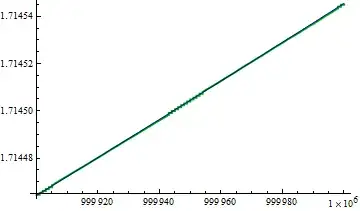
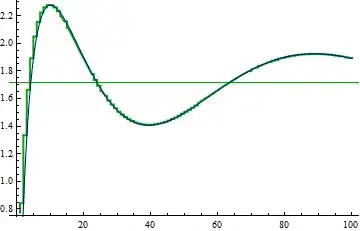
$\sum_{k=1}^{n}\dfrac{\sin(\sqrt{k})}{k}$ plotted against $C-\dfrac{2\cos(\sqrt{k-\sqrt{\pi}})}{\sqrt{k+\sqrt{\pi}}}$, where $C$ is calculated in Mathematica numerically with fact that $\sum_{k=1}^{\infty}\dfrac{\sin(\sqrt{k})}{k}=\sum_{k=1}^{\infty}\dfrac{e^{i\sqrt{k}}}{k}$:

enter image description here

c = Quiet[N[Im[Sum[E^(I Sqrt[k])/k, {k, 1, Infinity}]]]];
Show[Plot[Sum[Sin[Sqrt[k]]/k, {k, 1, n}], {n, 0, 100}, 
GridLines -> {{}, {c}}, GridLinesStyle -> Darker[Green], 
PlotStyle -> {Darker[Green], Thick}], 
Plot[c - 2 Cos[Sqrt[k - Sqrt[Pi]]]/Sqrt[k + Sqrt[Pi]], {k, 0, 100}, 
PlotStyle -> {Darker[Blue], Thin}, PlotRange -> All]]

and for larger $k$:

enter image description here

Quiet[N[Im[Sum[E^(I Sqrt[k])/k, {k, 1, Infinity}]]]]

then gives $C\approx1.7156717726570607\dots$.

martin
  • 9,206
1

@Davide Giraudo's method is essentially Euler-Maclaurin formula (first order): Suppose $m<n$ are integers and $f'$ is continuous on $[m,n]$, then $$\sum_{k=m}^{n}f(k)=\frac{f(m)+f(n)}{2}+\int_{m}^{n}f(x)\mathrm dx +\int_{m}^{n}\left(x-[x]-\frac12\right)f'(x)\mathrm dx.$$

Using Euler-Maclaurin formula, we can get $$\sum_{k=1}^n\sin\sqrt{k}=O(\sqrt{n}),\quad n\to\infty.\tag{*}$$ This can also be got by a result of @Angelo (take $a_n=\sqrt{n}$), which says that(MSE3788621):

If $\;\left\{a_n\right\}_{n\in\mathbb{N}}\;$ is a sequence of real numbers such that $\;\left\{a_n-a_{n-1}\right\}_{n\in\mathbb{N}\setminus\{1\}}\;$ is monotonic and there exists $\;k\in\mathbb{Z}\;$ for which $\;2\pi k<a_n-a_{n-1}<2\pi+2\pi k\;\;\;\;\forall n\in\mathbb{N}\setminus\{1\}\;,\;\;\;$ then $$2\left|\sum_{i=1}^n \sin a_i\right|\leq\; \left|\cot\left(\frac{a_n-a_{n-1}}{2}\right)-\cot\left(\frac{a_2-a_1}{2}\right)\right|+\left|\cot\left(\frac{a_n-a_{n-1}}{2}\right)\right|\\+|\cos a_1|\left|\cot\left(\frac{a_2-a_1}{2}\right)\right|+|\sin a_1|+1$$ for all $\;n\in\mathbb{N}\setminus\{1\}.$

By the result $(*)$ and Abel's summation formula: $$\sum_{k=1}^n\frac{\sin\sqrt{k}}{k} =\frac{S_n}{n}+\sum_{k=1}^{n-1}\frac{S_k}{k(k+1)} \to0+\sum_{n=1}^\infty\frac{S_n}{n(n+1)},$$ where $S_k=\sin1+\sin\sqrt2+\cdots+\sin\sqrt{k}$ and $$\frac{S_n}{n(n+1)}=O\left(\frac{1}{n^{\frac32}}\right).$$ Hence, $$\sum _{n=1}^\infty\frac{\sin\left(\sqrt{n}\right)}n$$ is convergent. Actually, this seres is conditionally convergent which is due to: $$\frac{|\sin\left(\sqrt{n}\right)|}n\geq\frac{\sin^2\sqrt{n}}{n} =\frac{1-\cos(2\sqrt{n})}{2n}=\frac{1}{2n}-\frac{\cos(2\sqrt{n})}{2n},$$ and $$\sum _{n=1}^\infty\frac{1}{2n}=\infty,$$ $$\sum _{n=1}^\infty\frac{\cos(2\sqrt{n})}{2n}$$ is convergent.

Riemann
  • 12,425
1

Since we know that $$\int \frac{\sin \left(\sqrt{k}\right)}{k}\,dk=2 \text{Si}\left(\sqrt{k}\right)\qquad \text{and} \qquad \int_1^\infty \frac{\sin \left(\sqrt{k}\right)}{k}\,dk=\pi -2 \text{Si}(1)$$ using the simplest form of Euler-Maclaurin summation gives $$\sum_{k=1}^\infty \frac{\sin \left(\sqrt{k}\right)}{k}\sim \pi -2 \text{Si}(1)+\frac{89266330 \sin (1)-5555913 \cos (1)}{154828800}$$ which is almost the constant $C$ given by @Martin.

0

More digits can be obtained with the series. $$\pi -\sum _{j=1}^{35} \frac{(-1)^j x^{j/2} \zeta \left(1-\frac{j}{2}\right) \sin \left(\frac{\pi j}{2}\right)}{j!}$$ corresponding to the series $$\sum _{k=1}^{\infty } \frac{\sin \left(\sqrt{k x}\right)}{k}$$ When $x=1$, you get $1.715671794709121011996182359693374247813$ better than the poor resut of Quiet[N[Re[Sum[Sin[Sqrt[k]]/k, {k, 1, Infinity}]]]]

  • As it’s currently written, your answer is unclear. Please [edit] to add additional details that will help others understand how this addresses the question asked. You can find more information on how to write good answers in the help center. – Community Sep 05 '25 at 12:13
  • I apologize, but I think the answer is quite clear—the function does indeed converge. If anyone requires it, I can provide the numerical result of the series computed to 25 digits of precision as requested by some. – Capeamate Sep 05 '25 at 12:24
  • Your anwer would be clearer if you explained the "corrispindence", especially the upper limit $35$ in that sum. Why not $42$, and leave the justification to Douglas Adams? – wasn't me Sep 05 '25 at 18:34
  • define $$\left(f(n)-f(n-1)=\frac{(-1)^n x^{n/2} \zeta \left(1-\frac{n}{2}\right) \sin \left(\frac{\pi n}{2}\right)}{n!}\right) \left(f(\text{n$_$})\text{:=}\pi -\sum _{j=1}^n \frac{(-1)^j x^{j/2} \zeta \left(1-\frac{j}{2}\right) \sin \left(\frac{\pi j}{2}\right)}{j!}\right)$$ an then $$\frac{(-1)^n x^{n/2} \zeta \left(1-\frac{n}{2}\right) \sin \left(\frac{\pi n}{2}\right)}{n!}\text{/.}, n\to 35\text{/.}, x\to 1=\text{1.2612122220107098$\grave{ }$*${}^{\wedge}$-40}$$ – Capeamate Sep 05 '25 at 19:33